

The best medical alert devices can give you something simple but huge: a faster path to help when every second feels longer than it should. If you’re shopping for yourself or someone you love, the hard part isn’t finding options. It’s figuring out which kind of protection fits real life.
Disclosure: As an independent reviewer, we may receive an affiliate commission on qualifying purchases made through our links. This helps support our research and testing team at OASTHAR. Learn more about our testing process.
Some devices are built for the house and nothing else. Others add GPS, fall detection, app alerts, and 24/7 monitoring so you can stay covered outside too. That sounds straightforward until you start comparing pendants, pagers, hubs, and smartwatches side by side.
That’s where this guide comes in. The split between home-first and mobile-first systems shows up in other 2026 roundups too, including SeniorLiving’s tested rankings and Wirecutter’s medical alert system picks. Once you know how you plan to use it, your shortlist gets a lot easier.
RELATED: The 7 Best Flip Phones for 2026, Tested and Reviewed
Best medical alert devices at a glance
- Best Overall: Nomo Smart Care System
- Best Budget: CallToU WiFi Pager System
- Best Multifunction Safety: Fajocru GPS Smartwatch
- Best Everyday Alert: Seculife Medical Smartwatch
- Best for Simple: Daytech Caregiver Pager
- Best Value: Safety+ 4G Alert System
- Best Premium: ADT On-The-Go Alert
The right pick isn’t the one with the longest feature list. It’s the one you’ll keep nearby, keep charged, and trust when something goes wrong.
Learn more about how we test medical alert devices
In our assessment, the strongest medical alert devices earn their place after broad retail research across Amazon, Walmart, Target, and Currys, plus hands-on testing and hundreds of real customer reviews.
Safety coverage and emergency response
We start with the core question: how does the device get help to you? That means checking SOS response flow, fall detection where available, two-way talk, loudness, visibility, and whether the system works only at home or also outdoors. If a device feels confusing in a stressful moment, it drops fast.
Setup and day-to-day ease
A medical alert device has to be simple on a tired day, not only during an unboxing. We look at pairing, charging, button size, screen readability, app setup, and whether the product is ready to use out of the box. Devices that need too much fiddling usually don’t stay in regular use.
Connectivity and range
Home pagers, mobile pendants, and smartwatches all play by different rules, so we test them accordingly. We check WiFi, 4G LTE, GPS, Bluetooth where relevant, and indoor range claims when a base receiver is involved. We also look at how well alerts pass through walls, floors, and everyday home layouts.
Comfort and wearability
If a device feels bulky, awkward, or too medical-looking, many people stop wearing it. We compare wristbands, pendants, clips, lanyards, and hub-based systems to see what fits naturally into a routine. Water resistance matters too, especially for bathroom use, where falls are a real concern.
Battery and charging
Battery life changes the whole ownership experience. We look at quoted runtime, how easy the charger or dock is to use, and how stressful the recharge routine feels over a normal week. A strong device should not create a daily chore unless it gives you a good reason for it.
Price and customer reviews
Price only matters when it’s tied to value, so we compare feature sets against what you actually get. We also analyze large volumes of customer feedback to spot recurring strengths and problems, then compare that with what the product promises on paper. That gives you a much more balanced picture.
Star rating: 4.9/5
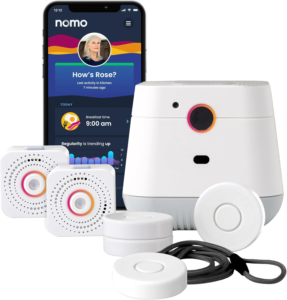
Nomo is the most complete pick in this group. Its superpower is broad home coverage without cameras, which is a big deal if you want stronger awareness but don’t want your living room to feel like a surveillance zone. You get a smart hub, motion and sound-sensing satellites, wearable tags, and app support in one package.
That setup gives you more than a single panic button. The hub connects over WiFi, supports 24/7 monitoring, and includes two-way voice communication during emergencies. RapidSOS integration adds another layer on the response side, which helps keep alerts moving fast when help is needed.
What makes Nomo so easy to recommend is the balance. The wearable tags can flag unusual activity, the app lets you adjust sensitivity, and the whole thing is plug-and-play instead of a wiring project. The only catch is that it asks a bit more from you at setup, because there are multiple pieces to place around the home.
Type: Whole-home system | Connectivity: WiFi | Safety tools: Motion and sound satellites, wearable tags, fall and movement alerts | Response: 24/7 monitoring with RapidSOS support | Voice: Two-way talk through hub
Reasons to Buy
- Full-home coverage
- Camera-free privacy
- Two-way voice hub
- Adjustable alert sensitivity
- Strong monitoring setup
Reasons to Avoid
- More pieces to place
- WiFi matters a lot
- Too much for basic needs
Who should buy it: This fits best if you want the home itself to be part of the safety setup, not only a pendant on your wrist or neck. It’s a strong match for independent living, shared family care, and anyone who wants privacy-friendly monitoring with wider coverage.
Star rating: 4.7/5
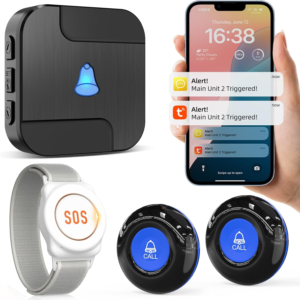
CallToU wins on simplicity and price. Its superpower is instant in-home alerts that hit both the receiver and your phone, which is exactly what a lot of families want when the main goal is hearing the call for help from another room.
The system connects through WiFi and sends a loud alarm with flashing lights when the button is pressed. At the same time, the app pushes out a notification, so you’re not tied to standing near the receiver all day. Range is listed at up to 328 feet, and it’s designed to work through walls and doors in a normal home setup.
This is a practical, low-drama pick. You can share alerts with family members, assign custom names to each button, and fine-tune the sound with 20 ringtone choices and five volume levels. What you don’t get is GPS, pro monitoring, or outside-the-home protection, so this one makes the most sense as a house-focused alert system.
Type: WiFi home pager | Connectivity: WiFi plus app alerts | Range: Up to 328 feet | Alert style: Loud sound and flashing lights | Customization: 20 ringtones, 5 volume levels, named buttons
Reasons to Buy
- Budget-friendly setup
- App-connected alerts
- Loud visual alarms
- Easy customization
- Good in-home range
Reasons to Avoid
- Home use only
- No GPS tools
- No professional monitoring
Who should buy it: This works well if help is usually nearby but not always in the same room. It’s especially useful for households where one person wants a fast way to call out and a caregiver wants phone alerts without paying for a more complex mobile system.
Star rating: 4.6/5
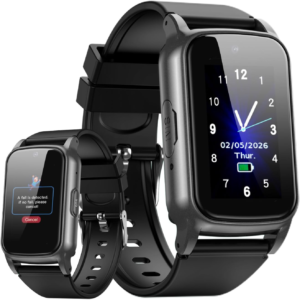
Fajocru is the overachiever watch here. Its superpower is doing a lot at once: emergency contact, GPS location, voice messaging, video calling, and a broad stack of daily health tracking. If you like the idea of one device doing safety and communication together, this is the most flexible watch in the group.
Hold the SOS button for three seconds and it starts the emergency calling flow. Beyond that, you get two-way calls, voice messages, video calling, and app-based management for contacts and alerts. Health tools include heart rate, blood pressure, blood oxygen, steps, and sleep tracking, packed into a 1.56-inch touchscreen with IP67 water resistance.
That wide feature list is the draw, but it’s also the trade-off. This is more tech-forward than a simple pendant, and it doesn’t center the experience around professional monitoring. If you’ve been comparing consumer wearables, our look at health monitoring features in modern wearables gives useful context for what a smartwatch can do well, and where a dedicated alert device still has the edge.
Type: GPS smartwatch | Connectivity: Calling, voice messages, video calling, app support | Safety tools: SOS trigger and live location tools | Health tracking: Heart rate, blood pressure, blood oxygen, steps, sleep | Build: 1.56-inch touchscreen, IP67 water resistance
Reasons to Buy
- Video calling support
- Lots of health tools
- Watch-style design
- Easy SOS access
- Good all-day wear
Reasons to Avoid
- No pro monitoring
- More features to manage
- Less focused interface
Who should buy it: This makes sense if the person wearing it is comfortable with a smartwatch and wants contact features as much as emergency help. It’s also a good fit when family members want regular location and activity visibility without moving to a full home hub system.
Star rating: 4.5/5
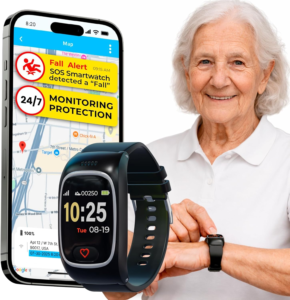
Seculife takes the smartwatch idea and points it straight at safety. Its superpower is blending a normal-looking watch with the features people usually want from a medical alert device, including fall alerts, SOS calling, GPS tracking, and geo-fencing.
That focus shows up fast in daily use. If a fall is detected or the SOS button is pressed, the watch reaches out to emergency contacts. You also get two-way calling, plus auto-answer support for approved contacts, which can make check-ins much easier. The companion app keeps location, alerts, and activity in one place, so family members don’t have to chase information across multiple screens.
Seculife works best when you want something wearable, modern, and easy to keep on all day. It’s water-resistant, comfortable, and built around staying connected without looking like a classic medical pendant. If you’re cross-shopping with mainstream wearables, these smartwatches with incident detection show the same overlap, but Seculife keeps the spotlight on help-first features instead of fitness-first ones.
Type: Medical alert smartwatch | Connectivity: Two-way calling and companion app | Safety tools: Fall detection, SOS alerts, geo-fencing, GPS tracking | Communication: Auto-answer for approved contacts | Build: Water-resistant, all-day wearable design
Reasons to Buy
- Fall alert support
- Live GPS tracking
- Geo-fencing tools
- Two-way calling
- Familiar watch design
Reasons to Avoid
- Not a full home system
- Fewer health metrics
- App setup matters
Who should buy it: This is a strong match for independent users who spend time at home and out locally, and want one watch to handle both safety and check-ins. It also fits families who care more about location visibility and fast contact than deep wellness tracking.
Star rating: 4.4/5
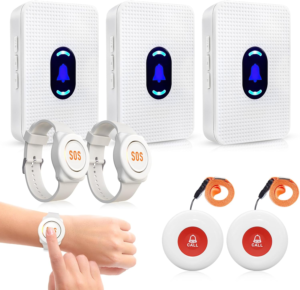
Daytech keeps things old-school in the best way. Its superpower is a direct, no-fuss connection between button and receiver, which is still one of the most useful setups if the goal is simple help at home with no app learning curve.
Setup is easy because the system comes pre-configured. You get multiple call buttons and receivers, so you can cover more than one room without turning the house upside down. Range goes up to 500 feet, which is strong for an in-home system, and the big easy-press SOS buttons are a plus when grip strength or dexterity is limited.
Daytech is not trying to be a GPS tracker or a smartwatch. That’s why it works. It focuses on what matters inside the house: dependable alerts, customizable ring tones and volume, and pairing that can tell you where the alert came from. If you want something simple enough to use on a rough day, this one gets a lot right.
Type: Home alert pager | Connectivity: Direct button-to-receiver signal | Range: Up to 500 feet | Wear options: Watch style or neck strap | Customization: 20 ringtones, adjustable volume, transmitter-receiver pairing
Reasons to Buy
- Very easy setup
- Strong indoor range
- Large SOS buttons
- Multiple receivers included
- Clear room-by-room pairing
Reasons to Avoid
- No mobile coverage
- No app alerts
- No professional monitoring
Who should buy it: This fits someone who is mostly at home and wants the fewest steps between pressing a button and getting attention. It’s also a smart pick when a caregiver is in the house often and simplicity matters more than smart features.
Star rating: 4.2/5
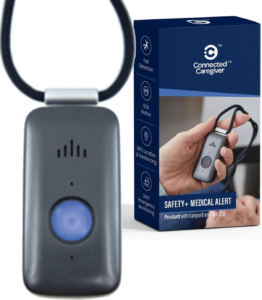
Safety+ is the feature-stacked value pick. Its superpower is packing fall detection, GPS, caregiver tracking, and 24/7 professional monitoring into one device that still feels straightforward to wear and use.
The automatic fall detection is the headline feature. If it senses a fall, the monitoring center can call the device and check in through the built-in speaker and microphone. You also get live GPS tracking, which keeps location updates current, and the caregiver app puts activity levels, steps, battery status, and alerts in one place. That part is especially useful when multiple family members share care.
Battery life is quoted at up to six days, and the included charging dock helps make that manageable. Wear options include a lanyard, belt clip, or bag attachment, so you aren’t locked into one style. The trade-off is that this is less discreet than a watch and less expansive than a full smart-home setup, but for mobile coverage with strong caregiver tools, it’s a solid deal.
Type: Mobile alert device | Connectivity: 4G and GPS with caregiver app | Safety tools: Automatic fall detection and 24/7 monitoring | Communication: Built-in speaker and microphone | Battery: Up to 6 days, charging dock included
Reasons to Buy
- Strong feature mix
- Pro monitoring included
- Helpful caregiver app
- Fall detection built in
- Long battery life
Reasons to Avoid
- Not watch-shaped
- More app dependent
- Less discreet to wear
Who should buy it: This is a good match if you want broad mobile protection without moving all the way into a premium-brand ecosystem. It also fits families who want location updates, battery visibility, and care-circle sharing in one app.
Star rating: 4.0/5
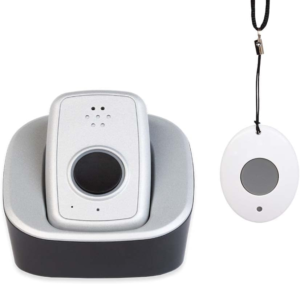
ADT is the premium monitoring choice. Its superpower is trust on the response side. When you press the button, trained agents are the point, and for a lot of people that’s the whole reason to buy a medical alert device in the first place.
The device runs on a nationwide 4G LTE network and includes built-in GPS, so responders can find you faster whether you’re at home or outside. There’s a microphone and speaker right on the device for direct conversation, plus optional fall detection for automatic help requests after a fall. The IP67 waterproof design also means you can wear it in places where accidents often happen, including the shower.
ADT doesn’t pack in as many caregiver-facing extras as some rivals, and optional fall detection may affect final pricing. Still, if you want a very simple one-button system backed by professional monitoring, this one is easy to understand and easy to trust. That’s why it still earns a spot on the list.
Type: Mobile monitored alert | Connectivity: Nationwide 4G LTE with GPS | Safety tools: One-touch SOS, optional fall detection | Communication: Built-in microphone and speaker | Design: IP67 waterproof, wristband or pendant options
Reasons to Buy
- Trusted monitoring focus
- Simple one-button use
- GPS on the go
- Waterproof build
- Pendant or wrist option
Reasons to Avoid
- Fewer extra features
- Fall detection optional
- Premium-service focus
Who should buy it: This makes sense if brand familiarity and agent-led emergency response matter more to you than app dashboards or smartwatch styling. It’s also a strong fit when the person using it wants the fewest decisions possible in an emergency.
All recommended medical alert devices in comparison
Here’s a quick side-by-side look at how these picks break down.
| Product | Best fit | Connectivity | Emergency response | Caregiver visibility |
|---|---|---|---|---|
| Nomo Smart Care System | Full-home protection | WiFi hub with satellites and wearable tags | 24/7 monitoring, two-way hub voice, fall and movement alerts | App integration and care-circle style alerts |
| CallToU WiFi Pager System | Budget home alerting | WiFi receiver plus phone app | Loud alarm and flashing light when button is pressed | Shared app alerts and named buttons |
| Fajocru GPS Smartwatch | Multifunction wearable | GPS watch with calling and app tools | SOS trigger, two-way calling, voice and video contact | Location, activity, and contact management |
| Seculife Medical Smartwatch | Everyday safety watch | GPS watch with app support | Fall alerts, SOS, two-way calling, auto-answer support | Live location, geo-fencing, alerts in app |
| Daytech Caregiver Pager | Simple in-home help | Direct pager signal | Instant receiver alert from wearable button | Receiver pairing shows where the call came from |
| Safety+ 4G Alert System | Feature-packed mobile use | 4G device with GPS and app | Auto fall detection, 24/7 monitoring, built-in speaker and mic | Steps, battery, alerts, and care-circle sharing |
| ADT On-The-Go Alert | Premium monitored support | 4G LTE with GPS | One-touch SOS, optional fall detection, professional agents | More limited than app-heavy rivals |
The pattern is pretty clear. If you want wide home coverage and privacy, Nomo is the strongest all-around choice. If cost and simplicity matter most, CallToU and Daytech are easier picks. For wearables, Fajocru gives you more communication tools, while Seculife feels more focused on personal safety.
What to look for in a medical alert device
Match the device to where you spend your day
This is the first filter, and it matters more than any spec sheet. If most of your time is spent at home, a pager or hub system can make more sense than a GPS pendant. If you’re regularly outside, in the yard, walking the dog, or riding with family, you probably want cellular coverage and GPS. That home-versus-mobile split shows up in SafeHome’s medical alert guide too, because it changes almost everything about how the device helps.
Treat fall detection as a backup, not the whole plan
Fall detection is valuable because it can call for help when a button press doesn’t happen. That’s the good part. The other part is that not every device handles it the same way, and not every system includes it by default. Some watches and pendants build it in. Some make it optional. Others skip it and focus on manual alerts. If fall detection is high on your list, check how it triggers help, who gets the alert, and whether it works alongside GPS or only inside a home setup.
Decide who should answer the alert
Some devices connect you to trained agents. Others notify family members through an app, pager receiver, or direct call. Neither route is automatically better. It depends on what makes sense for your situation. If you want a button press to go straight to a professional monitoring center, ADT and Safety+ make more sense. If you want family to handle the first response, CallToU, Daytech, Fajocru, and Seculife fit that model better. Nomo sits in a useful middle ground because it brings broader home awareness into the mix.
Pick a form factor you’ll keep wearing
A great system that stays on the nightstand is not a great system. Pendant, wristband, lanyard, belt clip, and watch designs all have trade-offs. Watches tend to feel more natural in public. Pagers can be easier to understand. Pendants are often the most traditional. Hub-based systems reduce the need to wear something all the time, but not completely. If you’re comparing medical alert watches with mainstream health wearables, our coverage of smartwatches with medical-grade ECG monitoring is a good reminder that health tracking and emergency response are related, but not the same thing.
Check the charging routine before anything else
Battery life is not glamorous, but it’s one of the biggest make-or-break details. A device with six-day battery life asks much less from you than one that needs frequent charging. Charging docks also matter more than people think, especially if hand strength or eyesight is limited. If the charging routine feels annoying, it usually turns into missed coverage. This is one reason watch-style devices can be trickier than they look. They often feel more natural to wear, but they can ask more from you on the charging side.
Look at the app and privacy side
Apps can be useful or completely forgettable. The best ones make location, battery, activity, and alerts easy to check without turning the whole experience into homework. Privacy matters too. Some people are fine with strong location visibility but don’t want cameras in the home. That’s where systems like Nomo stand out. If you’re weighing smartwatch options, it also helps to compare them with wearable devices with emergency assistance alerts so you can see what you gain, and what you give up, with a dedicated safety device.
Why Trust OASTHAR?
I’m Shashini Fernando, an associate editor who specializes in consumer electronics, wearable tech, and smart home devices. I test each product in-house and analyze hundreds of customer reviews from real users across the medical alert device market to build lists that focus on what people can actually buy with confidence in 2026.
That matters because this category is full of trade-offs. Some products look great on paper but feel clunky in daily use. Others are basic, but nail the one job they need to do. Our process combines hands-on testing, retailer research, feature comparison, and real user feedback so you get picks that reflect both product claims and lived experience.
Best Medical Alert Devices FAQs
What is the best medical alert device overall?
The Nomo Smart Care System is the best overall pick in this guide. It gives you the widest mix of home coverage, privacy-friendly monitoring, two-way voice support, wearable tags, and app-based control.
What is the best budget medical alert device?
The CallToU WiFi Pager System is the budget pick. It keeps costs and setup stress lower while still giving you loud in-home alerts and app notifications.
Are medical alert smartwatches better than pendants?
Not always. A smartwatch can feel more natural to wear and may add GPS, calling, and app tools, but a pendant or pager is often simpler in an emergency. It comes down to whether you want familiarity, mobility, or the fewest possible steps.
Which medical alert device is best for home use only?
Daytech Caregiver Pager is the strongest simple home-only pick. Nomo is the better choice if you want broader room coverage, monitoring, and app integration inside the home.
Do you need professional monitoring?
Only if that response style fits your situation. If you want trained agents involved right away, ADT and Safety+ are stronger options. If family members are the first line of help, a pager or app-connected system can work well.
Final Verdict
If you want the safest all-around bet, go with the Nomo Smart Care System. It covers more of the home, keeps privacy intact, and feels like a real safety net instead of a single gadget.
If price is the main pressure point, the CallToU WiFi Pager System is the easy budget choice. For a simple in-home setup, Daytech Caregiver Pager still does the basics extremely well. If a watch fits your routine better, pick Seculife Medical Smartwatch for safety-first use or Fajocru GPS Smartwatch for more communication and health features.
For mobile protection with strong caregiver tools, Safety+ 4G Alert System hits a sweet spot. If you care most about trained monitoring and brand trust, ADT On-The-Go Alert is still a strong premium pick. The best medical alert device is the one that matches how you actually live, room by room and day by day.