

Should you buy the Sonos Play, or is it another pricey portable that only makes sense on a spec sheet? If you’re looking at this speaker, that’s the question that matters, because the Play sits in a slightly unusual spot in Sonos’ lineup.
This is Sonos’ new 2026 portable speaker, not the old Play:1 or Play:5 with revived branding. At GBP299 or $299, it’s pitched between the Roam 2 and Move 2, which means you get more presence than the small one, without lugging around the big one.
You also get a speaker that’s best understood as a home model you can carry outside when needed. That’s the frame to keep in mind as you read the rest of this review.
RELATED: JBL Quantum 950X Review (2026): Best What You Get for $399?
Quick Summary
The short version is pretty simple. The Sonos Play is a portable Sonos speaker first, and a general Bluetooth speaker second.
You get a 24-hour battery claim, IP67 protection, a charging dock in the box, clear vocals, and bass that feels bigger than the cabinet. It also supports Wi-Fi, Bluetooth, AirPlay 2, Spotify Connect, voice control, stereo pairing, and Sonos’ multi-room features. Early coverage from The Guardian’s review lands in much the same place, flexible and easy to live with.
Buy it for the ecosystem, not for Bluetooth alone.
That’s the value test. If you’ll use Wi-Fi streaming, room grouping, app controls, and possibly a stereo pair, the price makes sense. If you mostly want a speaker for casual Bluetooth playback away from home, the Play is harder to justify.
Specifications
Here are the specs that matter most in daily use.
| Spec | Sonos Play |
|---|---|
| Price | GBP299 / $299 |
| Battery | Up to 24 hours |
| Tested loud playback | 14 hours 25 minutes at 80dB |
| Water and dust resistance | IP67 |
| Drivers | 2 angled tweeters, 1 mid-woofer |
| Amplification | 3 Class-H digital amplifiers |
| Connectivity | Wi-Fi 6, Bluetooth 5.3, AirPlay 2, Spotify Connect, USB-C |
| Bluetooth codecs | SBC, AAC |
| Voice assistants | Alexa, Sonos Voice Control |
| Charging | Included wireless charging dock, USB-C backup charging |
| Weight | 1.3kg |
| Dimensions | 192mm tall |
| Battery | User-replaceable |
| Colors | Matte black, matte white |
Design, Portability & Build Quality
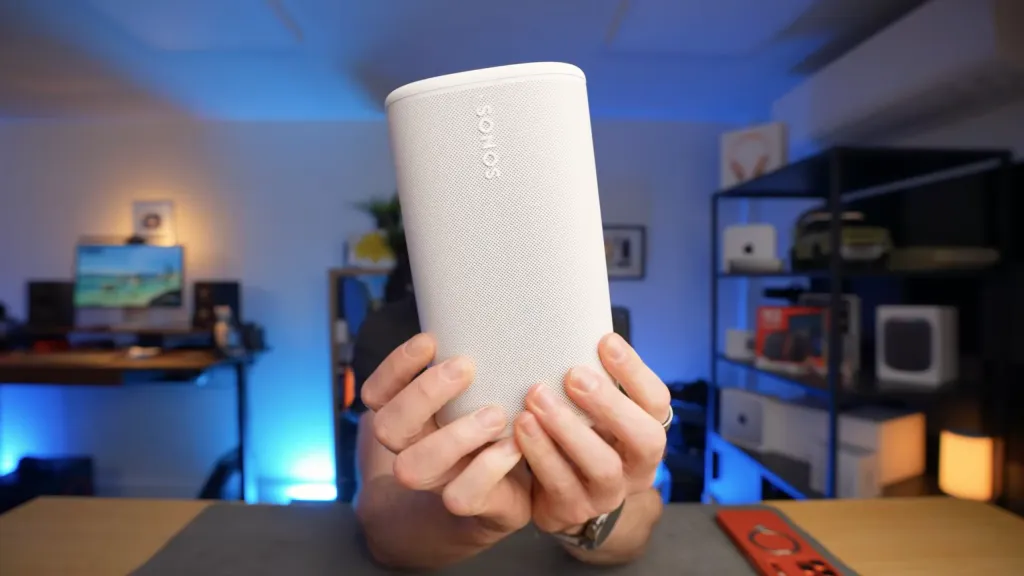
Pick up the Play and the first thing you notice is the density. It feels like a proper Sonos product, not a hollow plastic tube with a badge on it.
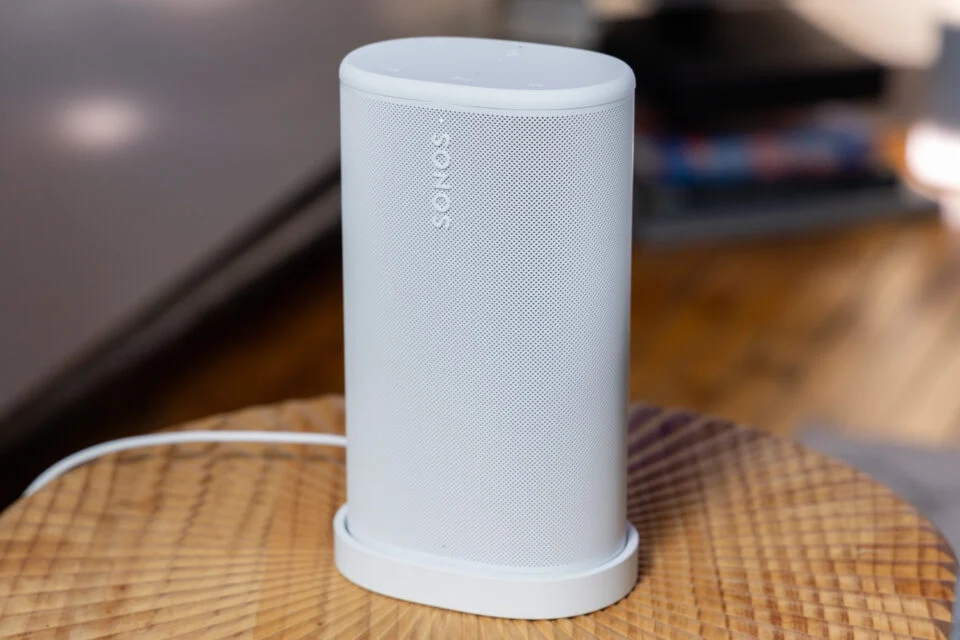
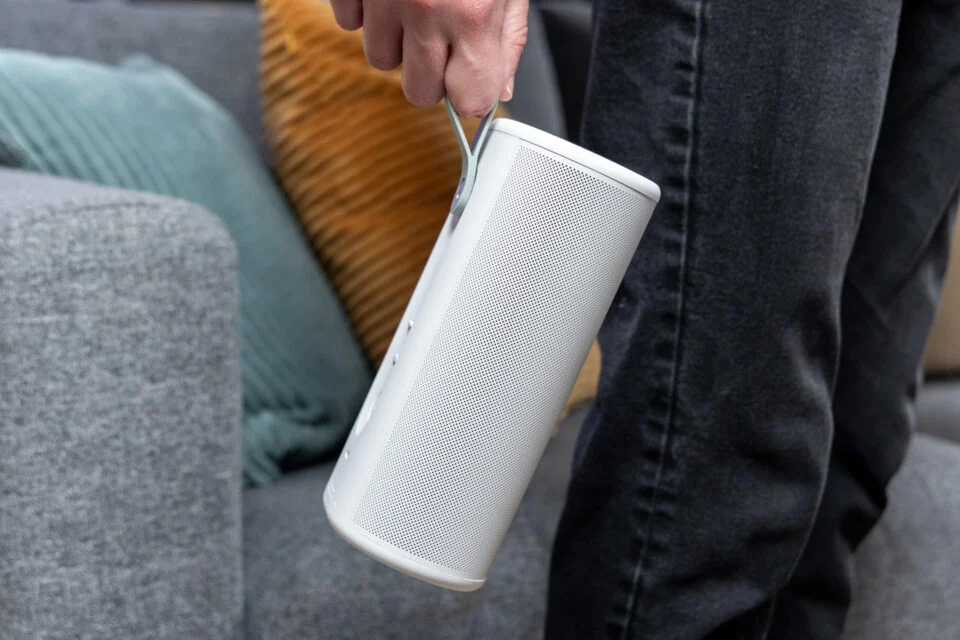
That works in its favor at home. It looks clean on a kitchen counter, shelf, desk, or patio table, and the included dock helps it behave like an in-room speaker when you’re not moving it. At about 1.3kg, though, this isn’t the sort of thing you’ll want to toss in a bag every day. It’s portable, yes, but in the “grab it and walk to the garden” sense.
What stands out about the design
The upright shape gives it a small footprint, which matters more than you might think. It takes up less room than many horizontal portables, and it blends in better with the rest of Sonos’ home gear.
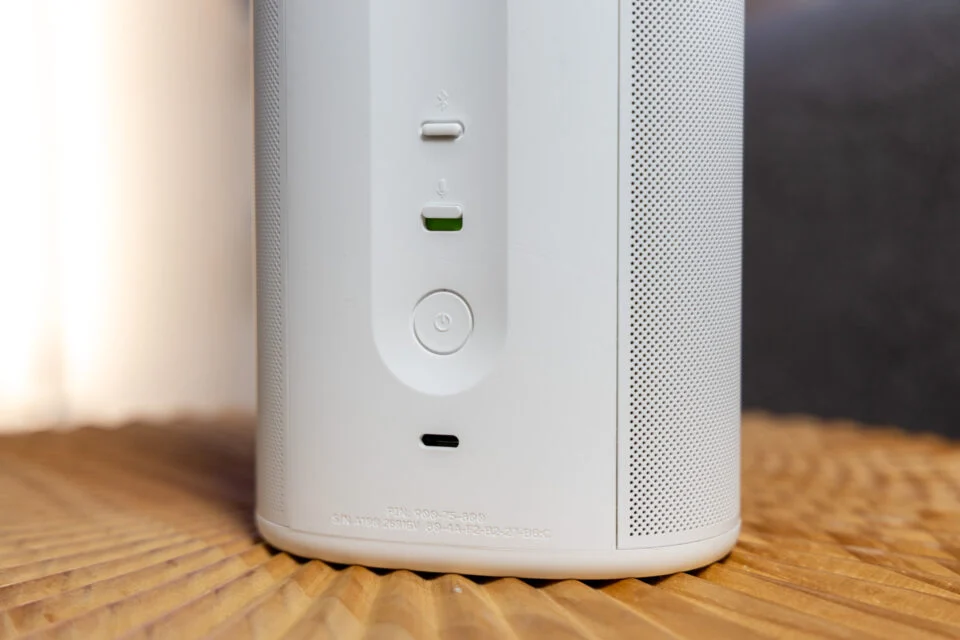
You get a metal grille, matte black or white finishes, silicone on the top and base, and a rear loop for carrying or hanging. Up top are the playback and voice controls. Around the back, you get power, Bluetooth, and the hardware mic switch. WIRED’s review also called out how sensible that control layout is, and that feels right.
How durable and practical is it really?
IP67 means dust-tight, and protected in water up to 1 meter for 30 minutes. In plain English, rain, splashes, bathroom steam, and a quick accidental dunk shouldn’t ruin your day.
The bigger long-term win is the replaceable battery. That’s still too rare in portable audio, and it matters. If you keep the speaker for years, you don’t have to treat it like a sealed disposable gadget.
Sounds
This is where the Play earns its price. Inside, Sonos uses two angled tweeters and one mid-woofer, backed by passive radiators and three Class-H amps. On paper, that’s a compact setup. In practice, it sounds larger than it looks.
The character is easy to like. You get an open presentation for a single-box speaker, a wider sweet spot than most small portables, and vocals that come through with real clarity. It’s not a flat studio-style tuning. Sonos has clearly voiced it to sound full and lively straight away.
Bass is generous for the size, sometimes impressively so. But it can also get a bit loose on bass-heavy tracks, and there are moments where the low end starts masking small details. Treble helps the Play sound crisp and spacious, though if you push volume hard, the top end can edge toward sharp.
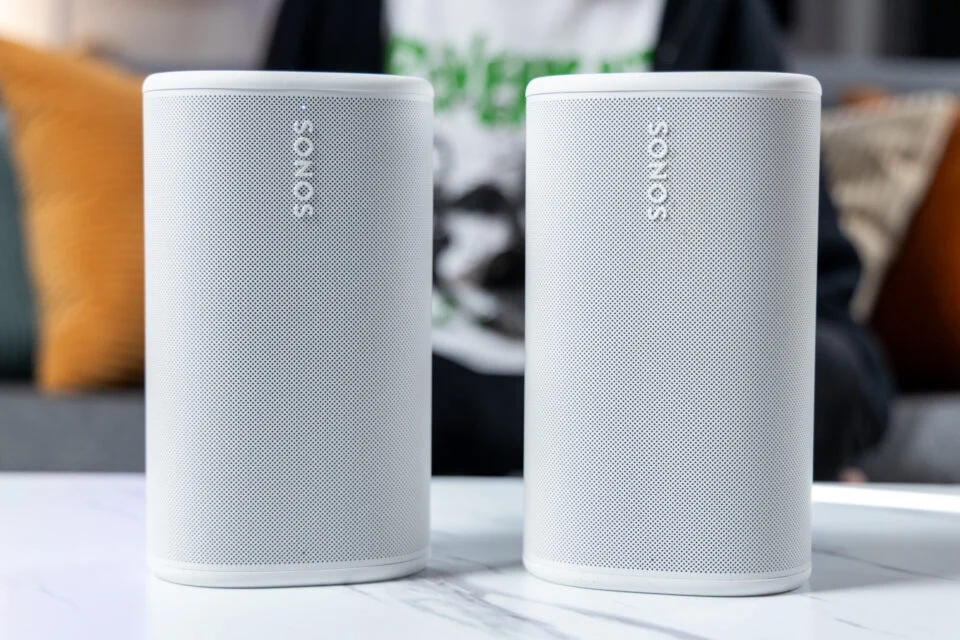
That said, it stays composed better than many compact rivals. PCMag’s review and other early tests point to the same thing, strong musicality without ugly distortion. If you run two Plays as a stereo pair over Wi-Fi, the jump in width and scale is easy to hear.
Bass and volume performance
The Play punches above its size. It won’t match the Move 2 for deep bass or sheer output, but it gets closer than you’d expect.
At high volume, it stays cleaner than many portable speakers. It doesn’t turn brittle or wheezy when pushed, and that’s a big part of why it feels premium.
Midrange, vocals, and stereo spread
Vocals are the highlight. Voices sound clear, natural, and easy to follow, even in busy mixes.
The angled tweeters also help more than the spec sheet suggests. You don’t get true left-right separation from one cabinet, but you do get a broader soundstage and a less boxy presentation than most compact portables.
ANC
The Sonos Play doesn’t have ANC or transparency mode. That’s normal, because this is a speaker, not a pair of earbuds or headphones.
Its microphones are there for voice assistants and Automatic Trueplay. They’re not doing noise canceling.
Mic & Call Quality
The mics support Alexa, Sonos Voice Control, and Automatic Trueplay room tuning. They also let the speaker adapt when you move it around the house, as long as microphones are enabled.
What they do not do is phone calls. There is no speakerphone mode here, so if a call comes in, you still take it on your phone. Privacy-minded buyers will like the physical mic switch on the back, because it cuts the microphones entirely.
Features
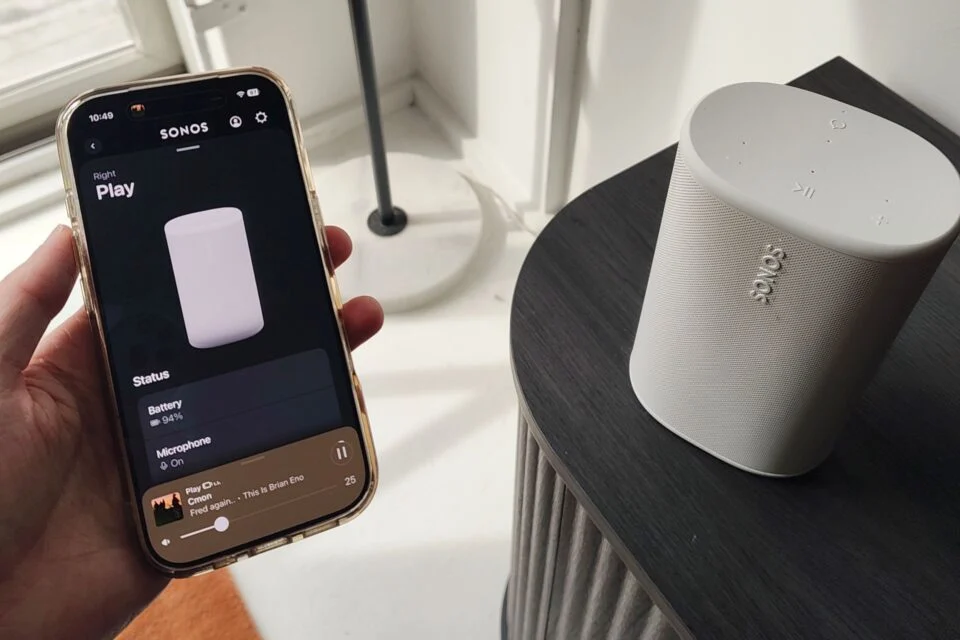
Most of the Play’s value shows up once you use it over Wi-Fi. Through the Sonos app, you can group it with other speakers, stream directly from supported services, tweak bass and treble, use AirPlay 2, and stereo pair two units for proper left-right playback.
Automatic Trueplay is one of the more useful extras. Move the speaker from a shelf to a bathroom counter or patio table, and it can re-tune itself for that space. You also get optional line-in through Sonos’ USB-C adapter, which is handy if you want to bring something like a turntable into your system. The Verge’s review backs up that overall picture, especially the Wi-Fi-first nature of the speaker.
The best features if you already use Sonos
If you’ve already got Sonos at home, the Play makes immediate sense. You can drop it into a kitchen, move it to the patio, group it with the rest of the house, and keep your music following you.
Stereo pairing over Wi-Fi is also a big step up. A pair sounds more spacious, more stable in the center, and more convincing at filling a room.
The limits you should know before buying
There are catches. EQ is limited to bass and treble, so you can’t fine-tune the midrange. There is no Google Assistant in the provided feature set, only Alexa and Sonos Voice Control.
Bluetooth use also has a weird edge to it. You can play over Bluetooth, but the app still wants Wi-Fi for full access to things like EQ and system controls. Setup may take some patience too, as some reviewers ran into connection hiccups during initial install.
Connectivity & Controls
The Play covers the basics well. You get Wi-Fi 6, Bluetooth 5.3, AirPlay 2, Spotify Connect, and USB-C. Over Bluetooth, the supported codecs are SBC and AAC.
The hardware is refreshingly straightforward. Top controls handle playback, volume, and voice. On the back, you get dedicated power and Bluetooth buttons, plus the mic switch.
USB-C can do more than charge the speaker. It can top up a phone in a pinch, and with Sonos’ optional line-in adapter, it can accept an external source. If you mainly want a straightforward travel speaker, though, you’ll probably find better value in these best Bluetooth speaker picks.
Battery Life & Charging
Sonos rates the Play at up to 24 hours, and that’s a strong number for this size. In louder real-world testing at 80dB, one run landed at 14 hours and 25 minutes from 1 meter away.
That’s still a good result. It covers a full day of listening, and if you’re listening more casually at lower volume, you should get longer runtimes. The included charging dock makes daily use easy too, because you can drop it back in place instead of hunting for a cable.
There is USB-C backup charging, but no wall adapter in the box, so you’ll need your own 18W or higher PD charger. Idle drain looks modest at about 1 percent per day in battery-saver use, and the user-replaceable battery helps the long-term value story.
Room Performance & Placement
The Play works best in the places you actually live. Kitchens, bedrooms, offices, bathrooms, patios, and medium-size garden spaces all make sense.
Automatic Trueplay helps here. As long as the microphones are on, the speaker can adapt when you move it. That’s part of why the Play feels more like a home speaker that happens to be portable, not a travel-first speaker for camping trips or all-day bag carry.
Price & Value
At this price, use case is everything. If you want one speaker that lives on a dock indoors, joins your Sonos system, and comes outside when needed, the Play feels fairly priced.
If you only want casual Bluetooth playback, it’s a tougher sell. You can spend less and get similar portability, sometimes with longer battery life. That’s also where the lineup trade-offs become clear. The Roam 2 is smaller and cheaper. The Move 2 is bigger and bassier. The Era 100 is the smarter buy if you don’t need battery power. The Play sits in the middle, and for the right person, that’s the whole point.
Who is it for?
Buy it if:
- You already use Sonos and want a speaker that fits neatly into that system.
- You want one speaker for inside the house and outside on the patio or in the garden.
- You care about long battery life, dock charging, and better sound than the Roam 2.
Skip it if:
- You mainly want a Bluetooth-only speaker for travel or casual use.
- You want the deepest bass and highest party volume, because the Move 2 still does that better.
- You’re on a tighter budget and don’t need Wi-Fi features or multi-room audio.
FAQs
Is the Sonos Play really the best portable Sonos for home?
For most people, yes. You get the sweet spot between Roam 2 and Move 2, with stronger sound than Roam and far easier portability than Move 2.
How good is Sonos Play sound quality for everyday listening?
It’s warm, open, and more spacious than you’d expect from one box. Vocals come through especially well, though the bass can sound a bit boosted at higher volumes.
Does the Sonos Play work well without Wi-Fi at home?
It does over Bluetooth, but that’s not where it makes the most sense. You lose some app-dependent features away from Wi-Fi, so it’s better as a Wi-Fi speaker first.
How does Sonos Play compare with Roam 2 and Move 2?
Think of it as the middle option done properly. It beats Roam 2 for fullness and battery life, while staying much easier to carry than the heavier Move 2.
Is the Sonos Play worth $299 if you’re new to Sonos?
If you want one speaker for kitchen, patio, bathroom, and multi-room use, yes. If you only need basic Bluetooth audio, cheaper rivals make more financial sense.
What battery life can you actually expect from Sonos Play?
Sonos rates it for 24 hours, but real-world testing at louder levels landed closer to 14 hours 25 minutes. At normal home volumes, you’ll likely get longer.
Can you use two Sonos Play speakers as a stereo pair?
You can, but only over Wi-Fi. A stereo pair gives you a wider presentation, better center focus for vocals, and a more convincing room-filling sound overall.
What are the biggest Sonos Play drawbacks you should know?
The price isn’t casual, setup can be fiddly, and EQ control is limited. Also, if you mainly use Bluetooth away from Wi-Fi, its value drops pretty quickly.
Final Verdict
The Sonos Play gets the important stuff right. You get strong sound, a premium build, useful battery life, smart home-friendly features, and portability that fits real life better than many rugged travel speakers.
The catch is easy to understand. Its best features depend on Wi-Fi, the Sonos app, and the wider ecosystem. Used mostly over Bluetooth, it looks expensive.
So your decision comes down to one question. Do you want a portable speaker, or do you want a Sonos speaker that happens to be portable? If it’s the second one, the Play is a very good buy.