

If you’ve ever wished your phone could turn into a real tablet without feeling like a compromise, the Galaxy Z TriFold is Samsung’s strongest answer so far. It folds twice across three panels, so you get a normal-feeling phone on the outside and a 10-inch screen when fully opened.
That matters because most book-style foldables still land in an awkward middle, bigger than a phone but not quite tablet-comfy for movies, reading, or serious multitasking. The TriFold is closer to the “phone plus tablet” vibe people have been waiting for.
As of February 2026, it’s officially launched in the US (January 30, 2026) starting at $2,899 (512GB), and early stock moved fast in a few regions, which tracks with the curiosity around this form factor. Here’s what you’ll want to know about design, displays, speed, battery, cameras, audio, connectivity, software, value, and who it fits best.
Related: RedMagic 11 Air Review (2026): Best 144Hz Gaming Phone?
Galaxy Z TriFold specs at a glance
| Spec | Galaxy Z TriFold |
|---|---|
| Cover display | 6.5-inch AMOLED, 2520 x 1080, 1 to 120Hz |
| Main display | 10-inch AMOLED, 2160 x 1584, 1 to 120Hz |
| Thickness | Closed 12.9mm, open about 3.9mm to 4.2mm (by panel) |
| Weight | 309g |
| Chip | Snapdragon 8 Elite for Galaxy |
| RAM | 16GB |
| Storage | 512GB, 1TB (timing may vary) |
| Battery | 5600 mAh |
| Charging | 45W wired, Qi wireless |
| Rear cameras | 200MP wide, 12MP ultrawide, 10MP telephoto |
| Selfie cameras | 10MP cover, 10MP internal |
| Video | Up to 8K |
| OS | Android 16 with One UI 8 |
| Connectivity | Wi‑Fi 7, Bluetooth 5.4, NFC, USB‑C |
| Durability | IP48 |
| Biometrics | Fingerprint sensor |
- In daily use, this spec mix is about comfort under load, meaning you can keep three apps open and still switch quickly without the device feeling stressed.
- The biggest “spec” is the shape, because the 10-inch canvas changes how you watch, read, type, and manage split-screen work (for a full spec reference, see GSMArena’s TriFold spec sheet).
Design and build
The TriFold’s hardware is simple to explain and harder to copy well. You’ve got two hinges and three screen panels, and when you open it fully you’re holding something that feels closer to a compact tablet than an oversized phone.
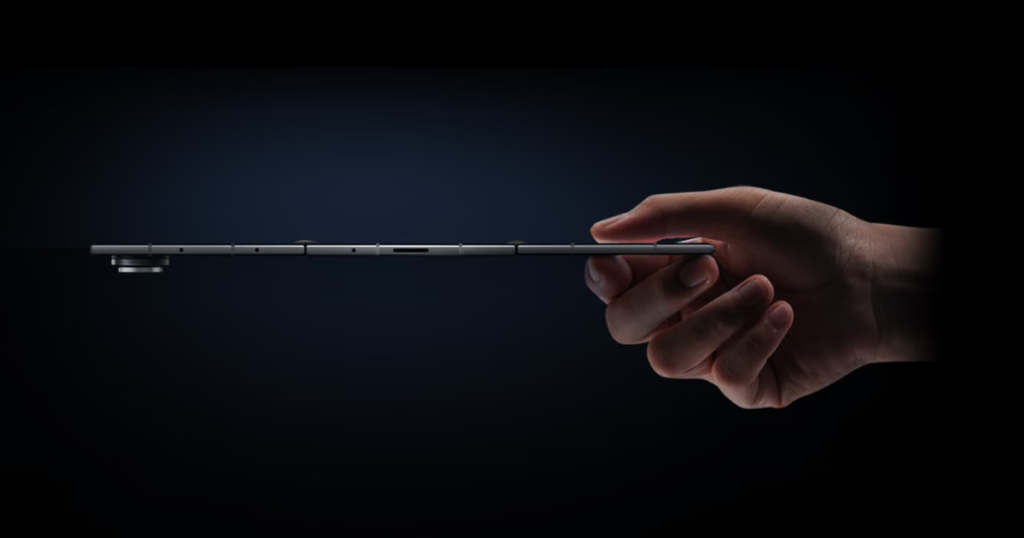
Closed, it’s 12.9mm thick, which you’ll notice in a pocket. At 309g, it’s also heavier than most phones. The surprising part is that the weight doesn’t always feel as “heavy” as the number suggests, because the device spreads mass across a wider footprint. Still, if you’re used to a thin slab phone, the first week can feel like switching from a paperback to a hardcover.
Open, the story flips. It’s impressively thin (roughly 3.9mm to 4.2mm, depending on the panel), and it feels more “normal” in two hands than you’d expect. The matte, carbon-fiber-like back on the retail model also helps with grip, even if it doesn’t scream jewelry-grade luxury.
There’s also a real learning curve: you need to close the left panel first. Do it the wrong way and the phone gives haptic feedback and an on-screen warning. It’s helpful, and it also tells you Samsung expects people to mess this up early on.
The main tradeoff is flexibility. Unlike some foldables that encourage half-open “tent” or “laptop” poses, the TriFold experience is mostly fully closed or fully open.
Hinges, creases, and day to day durability
Two hinges also means two creases. The good news is they’re fairly subdued in normal viewing, especially once your eyes focus on content instead of reflections. You’ll still catch them in harsh light, and you’ll feel them more than you’ll see them.
Samsung’s message here is durability. The company says the hinge system is tested to around 200,000 folds (see the official product positioning on Samsung’s Galaxy Z TriFold page). In plain terms, that’s designed to survive years of typical open-close habits, not weeks.
A few care habits make a bigger difference on a tri-fold than on a normal phone:
- Keep grit away from the hinge gaps, especially sand and fine dust.
- Use the included case if your market bundle has it.
- Don’t force the wrong fold direction, even if you’re in a hurry.
Displays and multitasking
If you buy this device for one reason, it’s the screens. The 6.5-inch cover display is big enough that it doesn’t feel like a “preview” screen. You can text, clear notifications, reply to email, scan a boarding pass, and do the quick stuff you do 50 times a day, without opening the whole device.
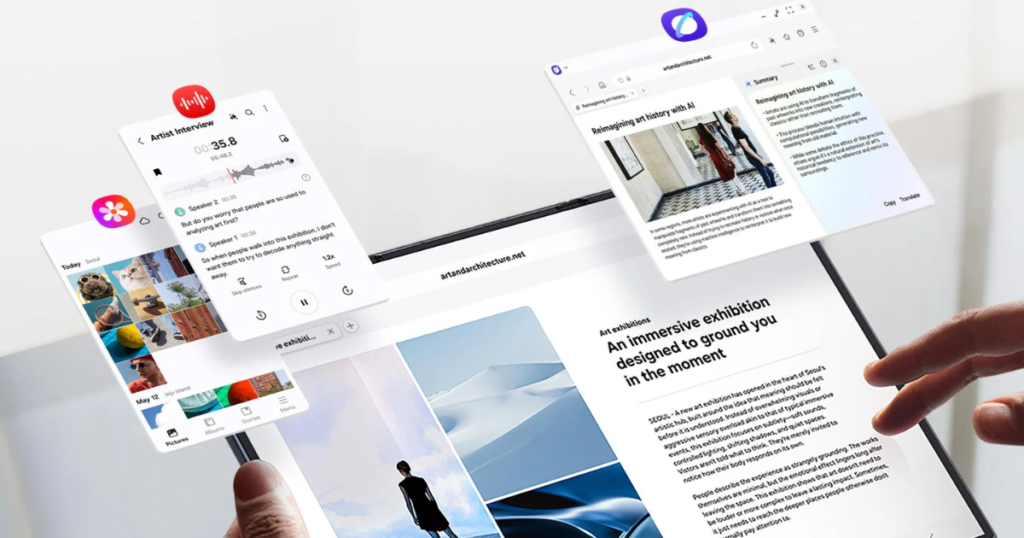
Then you unfold it and the 10-inch main display changes your habits. Watching video feels less like “phone video but larger” and more like a small tablet that happens to fold into your pocket. Games also benefit, not just from size but from layout, since touch controls and UI elements have more breathing room.
Both displays run up to 120Hz, so scrolling and animations stay smooth. Multitasking is where it clicks. Yes, you can run up to three apps on many foldables, but on the TriFold it doesn’t feel like you’re squeezing three rooms into a studio apartment. You can read and tap more accurately, and your keyboard doesn’t crowd everything.
A limitation to keep in mind: the main screen’s pixel density is lower than the cover screen, so tiny text can look a bit softer if you’re picky and you stare closely. Outdoor brightness can also feel inconsistent across panels depending on what’s on-screen.
DeX is the other piece. With more screen space, the “phone as a mini computer” idea becomes more practical, and current reporting suggests this model supports a newer DeX experience that can run without an external monitor, which fits the TriFold’s whole point.
How it compares to the Galaxy Z Fold 7?
A Fold-style device is still the cleaner everyday carry. It’s slimmer, simpler, and easier to handle one-handed. If you open your phone 20 times for quick tasks and only unfold a few times a day, the book-style shape can feel more natural.
The TriFold wins when you care about a tablet-like view. Movies and sports look bigger with fewer compromises, and three-app split-screen layouts are easier to read and touch. Both can do multi-window, but the TriFold makes it feel less like a party trick and more like a workspace.
The cost is obvious: you pay more, carry more weight, and accept a more complex folding routine.
Performance, software, and Galaxy AI
On paper, the TriFold isn’t trying to be exotic. It runs the Snapdragon 8 Elite for Galaxy, paired with 16GB RAM, on Android 16 with One UI 8. In practice, that’s a lot of headroom for the kind of usage this device encourages: multiple apps open, floating windows, and rapid switching.
The best use cases are the ones where a slab phone feels cramped:
You can edit a doc while keeping notes open, drag content between apps, research on one side while writing on the other, and do quick photo or short video edits without constant zooming. Heat and sustained performance are still the big unknown long-term. Public benchmark coverage and extended thermal testing are limited early in the US release cycle, so you should treat “laptop replacement” as occasional, not guaranteed.
Galaxy AI is part of the pitch, and it’s most useful when it saves you time. Think photo cleanups (object removal), quick reframes, and sketch-to-image style features. For a productivity angle from early hands-on reporting, PCMag’s perspective is worth scanning: PCMag’s TriFold CES impressions.
Battery life and charging
A 5600 mAh battery is reassuring because big screens tempt you into big-screen behavior. This is the largest battery Samsung has put in a foldable, and early reporting pegs video playback around 17 hours in ideal conditions. Real life is messier.
If you spend your day on the cover screen and open the main display for focused sessions, you can reasonably expect a full day. If you treat it like a tablet all day, streaming and multitasking with brightness up, you’ll drain it faster than you’d think just by looking at the battery number.
Charging is solid: 45W wired plus Qi wireless. One nice detail is packaging. Some launch regions include a charging brick in the box, and bundle contents can vary by retailer and country, so it’s worth confirming before you buy.
Cameras and video
Samsung didn’t use the TriFold as an excuse to cut camera ambition. You get a 200MP main camera, 12MP ultrawide, and 10MP telephoto, plus two 10MP selfie cameras (one on the cover side, one inside). Video goes up to 8K.
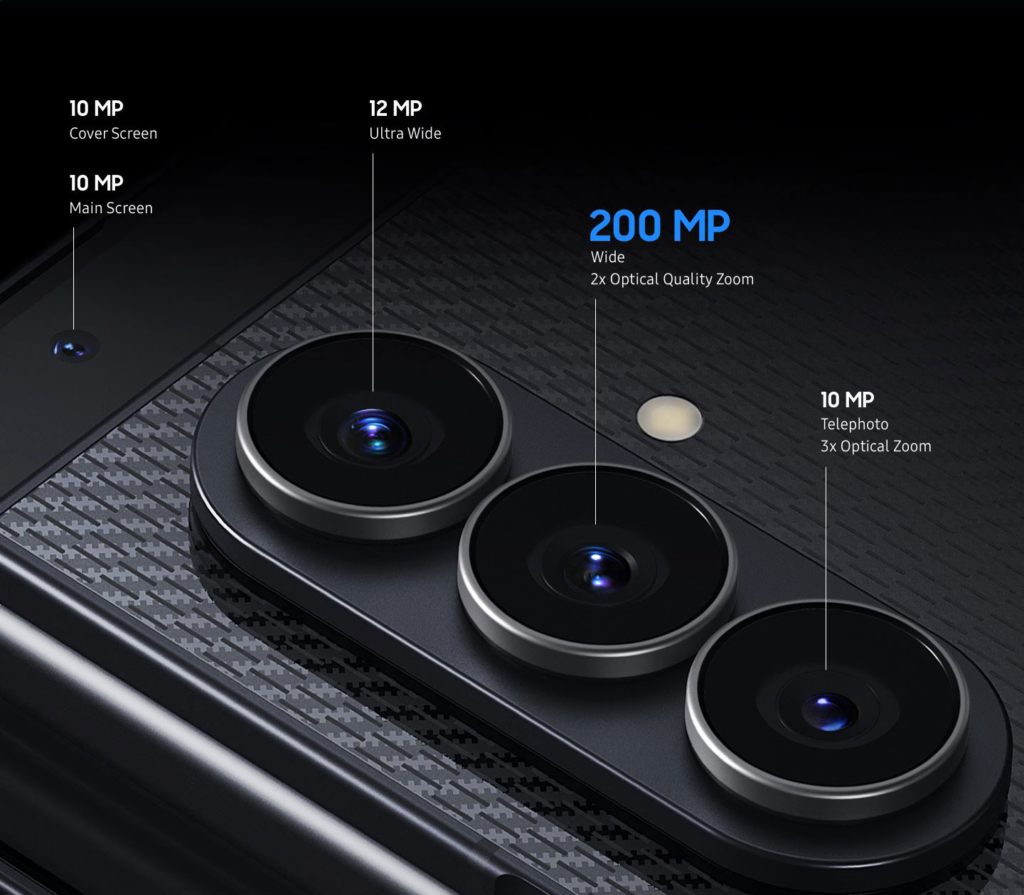
What that means day to day is simple: the main camera can produce sharp, detailed shots, the telephoto gives you more flexibility than the “no-zoom foldable” experience, and the big inner screen makes framing, culling, and quick edits easier. It’s a small workflow upgrade that matters if you shoot a lot, because you can actually see what you captured without pinching and zooming every other photo.
A practical trick: you can take high-quality selfies using the rear cameras while previewing on the cover display. It’s one of those foldable perks that feels normal after a week.
Limits still apply. There’s no expandable storage, so high-res photos and 8K clips can fill 512GB faster than you expect. Also, the camera bump can make the phone wobble on a table unless you use a case.
Audio and connectivity
This is the unglamorous part of a review, and it’s where expensive phones sometimes disappoint. The TriFold’s stereo speaker setup can sound strong for a device that folds thin, and it’s loud enough for casual video in a hotel room. If speaker quality is a big deal for you, test for two things: maximum loudness without harshness, and bass that doesn’t collapse when you raise volume.
Connectivity is current-gen: Wi‑Fi 7, Bluetooth 5.4, NFC, and USB‑C. Wi‑Fi 7 is the most “future” feature here, and it matters if you already have a Wi‑Fi 7 router (or plan to upgrade) and you move large files across your home network. Bluetooth 5.4 helps with stable earbuds and controllers, and NFC keeps tap-to-pay easy.
Durability is better than early foldables but not rugged. IP48 gives you meaningful protection against water and larger dust particles, but it’s not a beach-day invitation. There’s also no headphone jack, so plan on USB‑C or wireless audio.
Price and value
In the US, the starting price is $2,899 for 512GB, and that number sets the tone. You’re paying for the unique screen size and versatility, not for thinness bragging rights. If you think of it as “a phone plus a small tablet that shares one brain and one data plan,” the price starts to make emotional sense, even if it still stings.
Availability is also part of the decision. Early demand has been strong in some markets, with stock selling quickly in bursts. Color choice is limited at launch (in the US, it’s been positioned in a single signature finish), so if you like expressive colors, you may feel boxed in.
Ownership costs can climb too. Cases and screen protection matter more on a foldable, and early accessory options can be uneven. Trade-in and insurance details can also vary by carrier and region early on, so read the fine print before you assume your usual upgrade math applies.
A simple value test: if you won’t use the 10-inch screen most days for work, reading, or long media sessions, you’ll likely be happier with a cheaper foldable, or a standard phone plus a compact tablet.
Galaxy Z TriFold vs Huawei style tri fold phones
Tri-fold phones don’t all fold the same way. Some competitors use a design where one panel stays on the outside when folded. That can look elegant, and it can avoid the need for an extra outside display panel.
The downside is durability in real pockets. An exposed flexible screen is the one that meets keys, lint, grit, and mystery crumbs. Over time, that risk adds up, even if you’re careful.
Samsung’s approach keeps the flexible screens folded inward, so the outside surfaces are more protected. You pay for that protection with a thicker closed feel and the need to fold in the correct order. Ecosystem also matters. For many buyers in the US, Samsung tends to be the easier path for app support and Google services, and US availability is straightforward compared with many competitor models. For extra background on Samsung’s positioning and early impressions, CNET’s hands-on coverage adds context: CNET’s Galaxy Z TriFold hands-on.
Should you buy it?
You shouldn’t buy the Galaxy Z TriFold just because it’s rare. You should buy it because you’ll use the extra space with intent.
Buy it if:
- You want a true pocket tablet for split-screen work, long reading, flights, and hotel TV replacement.
- You plan to use DeX-style workflows with a keyboard and mouse.
- You’re fine carrying a thicker, heavier device to get a 10-inch screen.
Skip it if:
- You care most about one-hand comfort and a light pocket feel.
- You mainly scroll social apps and answer messages.
- You want the best value per dollar, not the most interesting form factor.
Before you commit, do a quick reality check in-store if you can: hold it closed, practice the fold order, type a few paragraphs on the cover screen, and open a three-app layout you’d actually use. Also decide whether 512GB is enough for how you shoot, especially if you record lots of high-res video.
Galaxy Z TriFold FAQ
Is the Galaxy Z TriFold really a 10-inch tablet?
Yes. You unfold two hinges to reach a 10-inch AMOLED internal display, which feels closer to a small tablet than a typical book-style foldable.
What’s the Galaxy Z TriFold price in the US?
In the US, it starts at $2,899 for the 512GB model. It launched on January 30, 2026, and early stock reportedly sold out quickly.
How usable is the cover screen for everyday phone tasks?
It’s practical. The 6.5-inch cover display is big enough for texting and email without unfolding, though the closed body is 12.9mm thick.
Does the Z TriFold have flagship cameras like the Z Fold?
Yes. You get a 200MP main, 12MP ultrawide, and 10MP telephoto, plus two 10MP selfie cameras, so you’re not sacrificing camera basics for the bigger screen.
Will battery life hold up with that massive display?
It should help. The 5,600mAh battery is larger than Samsung’s book-style foldables, and you also get 45W wired charging (plus Qi wireless) for faster top-ups.
Conclusion
The Galaxy Z TriFold is the first Samsung foldable in a while that feels like it has a clear purpose: give you a 10-inch display that makes multitasking and media feel natural, without turning your pocket into a bag. You also get flagship-level cameras, strong performance from the Snapdragon 8 Elite for Galaxy, and a bigger battery backed by 45W charging.
The tradeoffs are real. It’s thick when closed, heavy, it has a fold-order learning curve, and the price is hard to justify if you won’t open it often.
If you’ll actually use that big screen most days, the TriFold can replace a lot of “I’ll do it later” friction with one device you already carry. If you won’t, you’ll spend a lot of money to admire the idea more than the reality.