

You’ve got a balcony, you’ve got burgers in the fridge, and you’ve got that annoying question: can you grill out here or not? If you’re stuck reading fine print and guessing what’s allowed, you’re not alone.
The plain answer: an electric grill on balcony is usually the safest and most commonly allowed option in apartments, but you still have to check your lease and local rules.
In this guide, you’ll get clear apartment grilling rules, how the fire code for grills on balcony is typically interpreted, what “listed” electric grills mean, a fast pre-check list, and the balcony safety basics that keep you (and your neighbors) out of trouble.
RELATED: The 7 Best Electric Grills for 2026, Tested and Reviewed
What the fire code really says about balcony grills
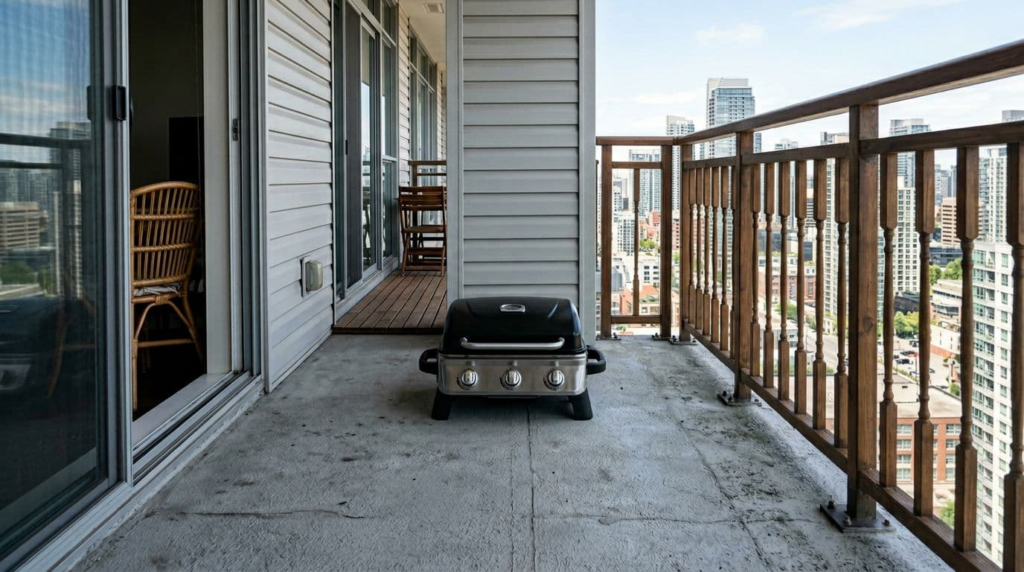
Most balcony grill rules aren’t random. They’re built around one ugly reality: balcony fires can spread fast. Railings, privacy screens, outdoor rugs, stored boxes, and even decorative plants can become fuel. Add wind, and a small flare-up can turn into a building problem.
Here’s the important nuance: many US rules come from model codes (like the International Fire Code and NFPA guidance). Cities and counties choose what to adopt and how to enforce it. Then your building piles on its own policies, often stricter, because property owners care about liability and insurance.
If you want the cleanest “why” behind these rules, NFPA’s own explanation of grill placement is worth a skim because it connects the distance rules to real fire behavior, not vibes. See NFPA’s fire code grill requirements overview.
The 10-foot rule, why gas and charcoal grills are usually banned on apartment balconies
The headline rule you’ll hear most is the “10-foot rule.” In many multifamily settings, charcoal and propane grills are prohibited on balconies and also prohibited within about 10 feet of combustible construction.
Combustible is simpler than it sounds. It’s anything that can catch and burn. Think wood railings, vinyl siding, composite decking, patio chairs, cardboard boxes, outdoor curtains, and that doormat you forgot is basically kindling when grease hits it.
Gas and charcoal create two problems at once: open flame plus fuel. Propane adds storage risk (tanks), and charcoal adds ember risk (ash that stays hot longer than you think). That’s why apartment buildings tend to treat them like a hard no, even when residents are careful.
If your balcony has wood, vinyl, fabric, or clutter within arm’s reach of the grill, the “10-foot rule” starts to make emotional sense fast.
The electric exemption, what “listed” means and the sprinkler wrinkle
Many model-code style rules carve out an exception for electric grills, especially small portable ones, because they don’t use open flame or stored fuel. You’ll often see language about a grill being “listed,” meaning it’s been evaluated by a recognized testing lab (most commonly UL in the US).
In practice, you’re looking for a UL listing mark (or another accepted mark) on the grill’s label, cord tag, or in the manual. You’re also looking for basic constraints that show up again and again in building policies, like “small, portable” and sometimes a cooking surface limit (you’ll often see figures around 200 square inches referenced in policies, even though the exact number varies).
Sprinklers complicate things. Some jurisdictions allow more flexibility in sprinkler-protected buildings, and some building managers will mention that as a reason they allow certain setups. Still, sprinklers don’t magically override a lease ban. If your lease says no grills, it’s still no grills.
Why electric grills are the apartment-friendly option
Electric grills tend to be the “least bad” option for apartments. They’re not perfect, but they match what landlords and city inspectors worry about: ignition sources and fuel storage.
They’re also easier to live with day to day. No tank refills, no charcoal bags, no ash disposal, and less smell traveling through hallways. That’s why many apartment and condo guides steer residents toward electric first. For a practical example of how often complexes allow them, see electric grill guidance for apartments and condos.
No open flame and no fuel storage, why that matters to landlords and cities
Landlords don’t just worry about the moment you cook. They worry about what you store. Propane cylinders in closets, spare charcoal on balconies, lighter fluid under the sink, those are all risks that stack up over time.
Electric grilling keeps the “fuel” on the building side, through wiring and breakers that already exist to run appliances. That’s a big reason many properties treat electric grills as acceptable while banning propane and charcoal outright.
Still, don’t assume “electric” equals “approved.” Some cities and buildings go stricter than national-style guidance, and some owners ban anything that looks like outdoor cooking.
Smoke, grease and heat are still real, even with electric
Electric doesn’t mean smokeless. Grease hitting a hot surface can smoke, especially if you crank heat and skip cleaning the drip tray. That smoke can drift up to the neighbor above you, and complaints are often what triggers enforcement.
Heat can also damage surfaces. Place a hot grill too close to siding, railings, or a plastic table and you can warp, discolor, or melt materials. You won’t always start a fire, but you can still cause expensive damage.
The big three checks before you buy an electric grill for your balcony
Before you spend money, do a fast “fail any one, stop” scan. This takes five minutes and can save you fines, a lease violation, or a forced return.
Here’s the simple logic: policy, product, place. You need all three.
Start with your lease and building policies
Open your lease PDF and use search. Look for: grill, barbecue, open flame, balcony, patio, cooking appliances, propane, charcoal. If you’re in a condo, check HOA rules too.
If you don’t see a clear answer, email property management. Keep it specific so they can’t dodge it. Use something like:
“Hi, I’m planning to buy a small UL-listed electric tabletop grill for my balcony. Are electric grills allowed on balconies in our building, and are there any placement or clearance rules I need to follow (distance from railings, walls, furniture)? Thanks.”
A quick email trail beats a hallway conversation later, especially if a neighbor complains.
Confirm the product is UL listed, then double-check your local ordinance
Don’t trust the product title on a marketplace listing. Look for a real listing mark on the grill, the rating label, or the manual. In the US, UL is common, and you may also see other nationally recognized testing labs.
Next, do a fast local check. The quickest routes are (1) your city fire department website, (2) a municipal code search page, or (3) a call to the non-emergency line asking what rules apply to multifamily balconies.
Some places publish clear, resident-friendly PDFs. New York City, for example, has a detailed guide that covers multiple grill types and storage rules, which is helpful even if you don’t live there because it shows how strict a city can get. See NYC’s barbecue safety toolkit.
Use your electric grill safely on a balcony without annoying your neighbors
Safe balcony grilling is mostly boring habits. That’s good news. You don’t need special skills, you need repeatable setup and cleanup.
A lot of balcony incidents come from two things: poor placement and walking away “for just a second.” Keep your routine tight and you’ll avoid most problems.
Safe placement rules: clearance, stable surfaces and the “never leave it” habit
Start with clearance. A practical baseline is 24 inches from walls, railings, furniture, curtains, and plants, and more if you can manage it. If your manual calls for greater spacing, follow that instead.
Next, put the grill on a stable, non-combustible base. Concrete is great. A sturdy metal stand works. A wobbly plastic side table is asking for trouble, especially when you bump it while flipping food.
Stay with the grill the whole time, and stay until it cools. Unattended cooking is a repeat offender in fire reports because small issues grow fast when nobody is watching.
Keeping a small ABC fire extinguisher nearby is a smart extra layer, not a substitute for good behavior. If you want a quick reminder of how quickly grill fires can become building-wide issues, this multifamily-focused explainer is blunt for a reason: multifamily grill fire code guidance.
Electrical setup that prevents shocks and trips: GFCI outlets, cords and wattage
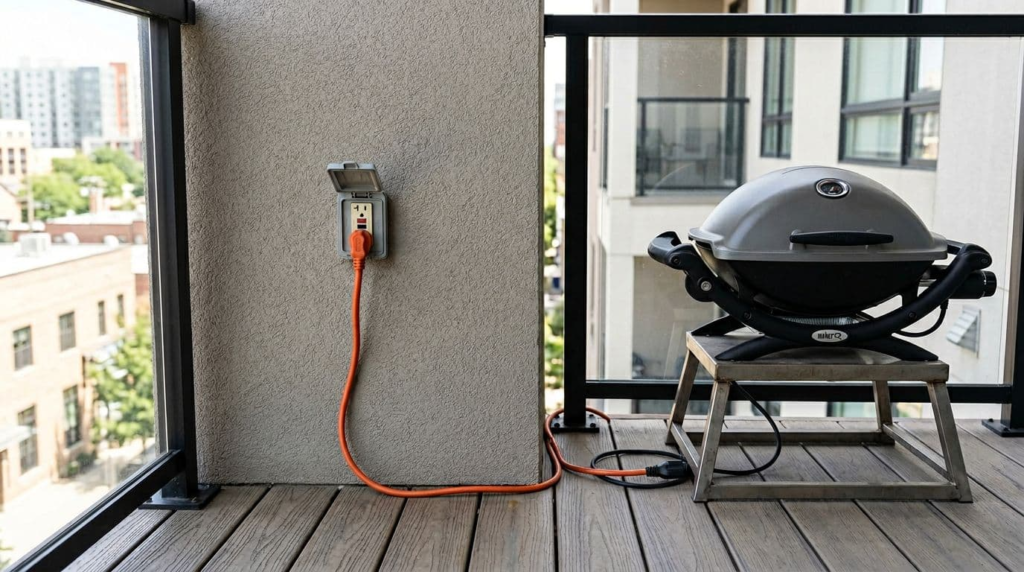
Outdoor outlets should be GFCI-protected (ground-fault circuit interrupter). In plain terms, a GFCI cuts power fast if it senses current going somewhere it shouldn’t, like through moisture or a damaged cord. If your balcony outlet has “test” and “reset” buttons, it’s usually GFCI.
Avoid thin indoor extension cords. Also don’t pinch cords in doors or windows. If you must use a cord, keep it short, outdoor-rated, grounded, and sized for the grill’s load.
Most electric grills pull serious power, often around 1,500 W to 2,200 W. That’s why breakers sometimes trip, especially if you’re also running a portable AC, space heater, or toaster oven on the same circuit. If the breaker trips, don’t keep resetting it. Instead, unplug other high-draw devices, try a different circuit, or downshift to a smaller grill.
If you’re considering grilling away from an outlet (or you get frequent trips), a battery with enough continuous watt output can help, but you need to size it correctly. This is the same logic used to run other heavy appliances. A practical starting point is understanding continuous watts versus surge watts, and that’s covered well in Oasthar’s guide to best portable power stations for balcony electric appliances.
Best electric grills for apartment balconies in 2026
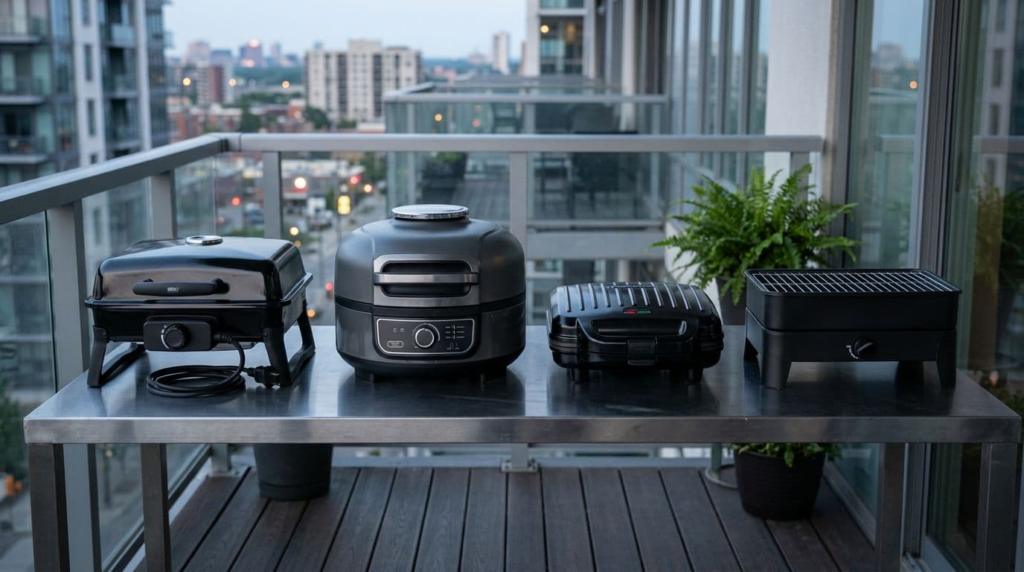
You’re buying for three things: heat performance, smoke control, and footprint. After that, it’s cleanup and weight.
Here are solid 2026-appropriate picks that tend to work well for apartment life, as long as your building allows them and the unit is properly listed:
- Weber Pulse 1000 or 2000: Best for premium build and better temp control; the 2000 gives you more room but takes more space.
- Weber Q 2400: Best for a classic outdoor-grill feel without propane; strong cooking area, but preheat can take time.
- Ninja Woodfire Outdoor Grill: Best if you want extra flavor, but expect more aroma and potential neighbor sensitivity since it can create smoke-style output.
- George Foreman Indoor/Outdoor: Best for fast, simple cooking and easy cleanup; searing isn’t as aggressive as heavier units.
- Hamilton Beach 25361 (compact budget pick): Best when you want something small, basic, and affordable; you trade away some build heft and heat retention.
Before you hit buy, measure your balcony depth and confirm where the outlet sits. Small differences decide whether the setup feels clean or cramped. If you want a broader balcony-grilling primer from an electric-grill brand perspective, this guide is a decent cross-check: apartment balcony grilling tips.
Electric Grill on Balcony FAQ
Can I use a George Foreman on my balcony?
Often, yes, if your building allows electric grills and you follow clearance rules. Make sure it’s a listed model and you keep it on a stable, non-combustible surface.
Do electric grills taste different?
They can. You’ll usually get less smoke flavor than charcoal or gas, but you can still get great browning with preheat and dry, oiled food surfaces.
What if my landlord says no?
Treat it as final unless you get written approval later. Your best fallback is a designated community grilling area or an off-site spot that meets distance rules.
Can I use an extension cord with an electric grill?
Try not to. If you must, use a short, heavy-duty, outdoor-rated, grounded cord sized for the grill’s wattage, and keep it where nobody trips.
Are small propane tanks allowed on apartment balconies?
Usually no. Even “small” tanks can be restricted in multifamily buildings, and many leases ban propane on balconies regardless of size.
Conclusion
Balcony grilling doesn’t have to feel like guessing a password. You’ll stay on the safe side if you follow a simple order: check your lease first, confirm any local restrictions, then buy a properly listed electric grill that fits your space. After that, set it up with real clearance, use a GFCI outlet, and keep the area clean so grease smoke doesn’t travel.
Most importantly, stay with the grill until it’s fully cooled, because “I’ll be right back” is how minor problems turn into major ones. If the rules are unclear, ask building management in writing, or call your local fire department’s non-emergency line for the final word. Your future self (and your neighbors) will appreciate the extra minute.