

Bad welders waste your time. You fight the arc, chase settings, and rework beads that should’ve been done once. This guide is built to help you buy the best welders for the way you actually work, not the way a spec sheet pretends you work.
Disclosure: As an independent reviewer, we may receive an affiliate commission on qualifying purchases made through our links. This helps support our research and testing team at OASTHAR. Learn more about our testing process.
Some machines shine for quick repairs on 120 V power. Others are all about clean TIG control, aluminum flexibility, or doing MIG, stick, TIG, and even plasma cutting in one box.
Below, you’ll get a short TL;DR, then full reviews, a comparison table, and a buying checklist you can use before you spend.
RELATED: The 8 Best Rollator Walkers for 2026, Tested and Reviewed
Best welders at a glance
- Best Overall: Lincoln Electric EASY MIG 140
- Best Home Use: Arccaptain MIG200 Fit
- Best Aluminum: Arccaptain AC DC TIG200P
- Best Car Bodywork: YESWELDER MCT520
- Best Budget: FORNEY Easy Weld Flux-Cored
- Best Portable: Lincoln Electric 90i MIG
- Best Beginners: Hobart Handler 140EZ MIG Welder
Learn more about how we test welders
Price and Customer Reviews
You don’t shop in a lab, so we don’t judge in a bubble. We research welders across major retailers (for example, Walmart, Target, and specialty tool stores), then read large batches of customer reviews. The goal is simple: match what people experience in garages and job sites to what the machine promises on paper.
Arc Consistency and Setup
A welder can look great on specs and still feel “off” in real use. We focus on how often users report stable arcs, predictable starts, and less fiddling. Simple controls matter, especially early on. If a machine helps you land close to the right settings fast, you weld more and troubleshoot less.
Process Flexibility
One-process machines can be perfect if they do one thing well. Still, multi-process welders can save space and money, as long as switching modes feels clear. We look for practical flexibility: support for gas MIG and flux-core, TIG options (lift or HF), stick capability, and plasma cutting where included.
Material and Real-World Capacity
We track what thickness ranges the machines are built to handle, then compare that to what owners say they successfully weld day-to-day. Mild steel repairs, brackets, tubing, and basic fab are the common use cases. When aluminum support is included, we also factor in spool gun support and how easy it is to switch.
Controls, Displays and Tuning
Good control is the difference between “it sticks together” and “it looks right.” We prioritize useful adjustment options like infinite voltage control, synergic MIG modes, pulse settings for TIG, and clear displays. You should be able to tune the weld without hunting through confusing menus or guessing what the machine is doing.
Build Quality and Accessories
A machine that feeds wire consistently and survives normal bumps will keep you welding longer. We pay attention to drive systems, metal cases, and cable quality based on repeated feedback patterns. We also list what comes in the box, because missing essentials (like clamps, regulators, or torches) can change the true cost fast.
Star rating: 4.9/5
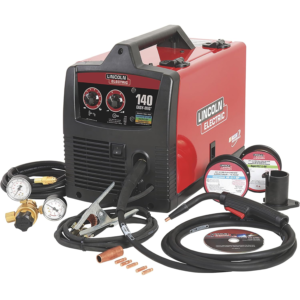
If you want one welder that just fits normal life, this is the easy pick. The Lincoln Electric EASY MIG 140’s superpower is balance. It’s simple enough to learn on, yet capable enough to keep around once you’re past the beginner stage.
You get a clean two-knob setup for wire speed and voltage. That matters because it keeps you out of menu mazes. Instead, you spend your time making beads, not studying the panel. In use, the goal is a smooth arc with minimal spatter, and this model is built around that everyday consistency.
It also makes sense for real shops because it runs on standard 120 V input power. That means you can plug in where you already work, whether that’s a garage, a small farm shop, or a driveway repair. Output goes up to 140 amps, and it’s rated to handle material thickness up to 5/16-inch, which covers a big chunk of typical home and repair projects.
For reliability, it leans on practical build choices. The heavy-duty adjustable wire drive helps reduce tangles and feeding issues. The metal case adds protection when your shop isn’t gentle. You also get a brass-to-brass gun connection designed to improve conductivity, which supports a steadier weld.
If you want to check brand support and current details, start at the official Lincoln Electric product and support site.
Processes: MIG (gas capable) | Input power: 120 V | Max output: up to 140 A | Max thickness: up to 5/16-inch | Aluminum option: spool gun support
Reasons to Buy
- Easy two-knob control
- Runs on 120 V outlets
- Handles up to 5/16-inch
- Metal case durability
- Spool gun upgrade path
Reasons to Avoid
- Not built for heavy industrial use
- Aluminum needs extra spool gun
Who should buy it: This fits if you want one reliable MIG welder for home projects, light fabrication, and repairs. It’s also a strong starting point if you’re learning and don’t want a complicated interface slowing you down.
Star rating: 4.7/5
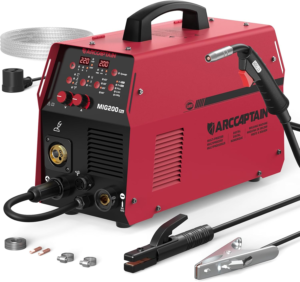
If your projects bounce between repair work and fabrication, a single-process machine can feel limiting fast. The Arccaptain MIG200 Fit’s superpower is range. You get a multi-process setup that covers a lot of jobs without feeling like a science project.
This is positioned as a 6-in-1 style machine, supporting gas MIG, gasless flux-core, stick, lift TIG, spot welding, plus spool gun support for aluminum work. That mix is the real value. You can run flux-core outside, switch to gas MIG when you want cleaner beads, and still have stick and TIG options when the job calls for them.
The synergic MIG system is a big part of why this model feels beginner-friendly. You pick your wire size and shielding gas, then the machine matches recommended current and wire feed speed. After that, you can still tweak current to suit your technique. It’s the best of both worlds: quick setup, plus room to dial it in.
Wire support is broad in a practical way. It supports .023, .030, and .035 solid wire, plus .030 and .035 flux-core, and even .035 and .040 aluminum wire. That means you can move between thinner work and heavier repair without feeling boxed in.
On the control side, you get smart features that help results stay consistent: burnback adjustment, adaptive crater control, and pre-flow and post-flow options. 2T and 4T modes help on longer passes, and the machine can store 10 preset parameter groups, which is great if you repeat the same jobs.
For portability, it includes a handle and shoulder strap, so it’s easier to carry for garage work, outdoor repairs, or farm fixes. Safety protection includes VRD Plus and coverage for overcurrent, overvoltage, overload, and overheating.
You can find Arccaptain’s lineup and support resources on the official Arccaptain website.
Processes: MIG, flux-core, stick, lift TIG, spot, spool gun | Controls: synergic MIG + manual | Presets: up to 10 | Wire support: .023 to .040 (varies by type) | Portability: handle + shoulder strap
Reasons to Buy
- Strong multi-process range
- Synergic MIG saves time
- Wide wire compatibility
- Presets for repeat jobs
- Carry strap convenience
Reasons to Avoid
- More settings to learn
- Aluminum needs spool gun
Who should buy it: This makes sense if you want one welder to cover many jobs and you don’t want to buy multiple machines. It’s also a good fit if you’re improving fast and want a machine that won’t feel “maxed out” right away.
Star rating: 4.6/5
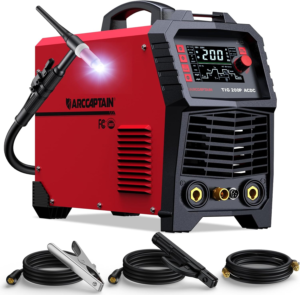
When you care more about control than speed, TIG becomes the move. The Arccaptain AC DC TIG200P’s superpower is true AC/DC TIG flexibility, with extra waveform and pulse tools aimed at cleaner results, especially on aluminum.
AC TIG capability matters because it opens the door to aluminum and magnesium work. Then DC TIG covers steel, stainless, and even copper. Instead of owning separate boxes for different metals, you can swap processes and keep the workflow consistent.
This model also leans into tuning options. You get 7-in-1 style support that includes DC TIG, DC pulse TIG, AC TIG, AC pulse TIG, plus square and triangular wave options, and it also supports stick and spot TIG. Those waveform choices aren’t just “nice to have.” They change how heat flows and how the puddle behaves.
Triangular wave reduces heat input, which is helpful on thinner metal. Square wave flips polarity quickly to keep the weld pool stable, and it also helps clean aluminum oxide. Pulse settings help tighten beads and reduce distortion, so parts stay closer to the shape you want.
The interface is built around clarity. A large LED display shows parameters, while the MCU control system lets you adjust items like pre-flow, peak current, base current, pulse frequency, and AC balance without getting lost. You also get 2T, 4T, and spot torch control options for different welding rhythms.
Material range is listed as aluminum from 0.5 mm to 5 mm, and other metals from 0.5 mm to 10 mm. It runs on 110 V and 220 V input power, and it weighs 12 kg, which helps if you move tools around your shop.
For official product listings and compatible accessories, you can start with Arccaptain’s welder catalog.
Processes: AC/DC TIG, pulse, stick, spot | Waveforms: square, triangular | Input power: 110 V/220 V | Weight: 12 kg | Material range: aluminum 0.5 to 5 mm
Reasons to Buy
- True AC/DC TIG
- Waveform tuning options
- Pulse helps reduce distortion
- Clear LED display
- Runs on 110/220 V
Reasons to Avoid
- More advanced learning curve
- Not aimed at fast MIG work
Who should buy it: This is for you if you want cleaner TIG results, especially on aluminum, and you like having controls that let you shape heat and puddle behavior. It’s also a smart move if you want one TIG-focused machine that can still handle stick work.
Star rating: 4.5/5
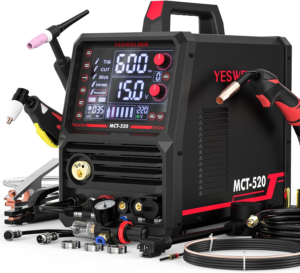
If you’re trying to outfit a small shop without stacking machines everywhere, this combo is the space saver. The YESWELDER MCT520’s superpower is all-in-one capability, because it welds across several processes and also adds plasma cutting.
It’s a true multi-process setup that supports MIG, flux-core, TIG, stick, and cut. Instead of swapping machines and re-routing cables every time you change jobs, you can switch modes and keep moving. For many home users, that’s the real win: less setup, more time working.
The smart MIG system helps keep the learning curve under control. In synergic mode, voltage automatically matches wire feed speed. If you prefer manual control, you can switch and fine-tune both. It supports multiple gas types and wire sizes like 0.8 mm, 0.9 mm, and 1.2 mm, which gives you room to match the setup to the job.
For aluminum, it supports a spool gun and includes one-button activation that shifts the machine into the right mode. On the TIG side, it includes an HF DC TIG function that gives a non-touch high-frequency arc start, and it supports up to 200 amps, covering a wide thickness range depending on setup.
Plasma cutting is the other big reason people look at this unit. The plasma function delivers 20 to 50 amps output, with clean cuts up to 5/16-inch at 110 V and 1/2-inch at 220 V, plus higher maximum capacity depending on power. It uses non-hazardous compressed air across several metals, which keeps consumables and shop requirements straightforward.
Usability features round it out: a clear digital display, real-time gas check, and built-in protection against overvoltage, overcurrent, and overheating. The package includes MIG, TIG, and plasma torches, drive rolls, adapters, and hoses, so you’re not stuck shopping for basics on day one. To verify current lineup details, start at the official YESWELDER store and product pages.
Processes: MIG, flux-core, TIG, stick, plasma | Smart MIG: synergic + manual | TIG start: HF DC | Plasma output: 20 to 50 A | Cut capacity: up to 5/16-inch (110 V), 1/2-inch (220 V)
Reasons to Buy
- Welding plus plasma cutting
- Synergic MIG simplifies setup
- HF TIG non-touch start
- Spool gun aluminum support
- Strong protection features
Reasons to Avoid
- More complex than MIG-only
- Needs air for plasma cutting
Who should buy it: This fits if your projects include both welding and cutting, and you want one machine that handles the common processes. It’s also a good match if your shop space is tight but your job list is not.
Star rating: 4.3/5
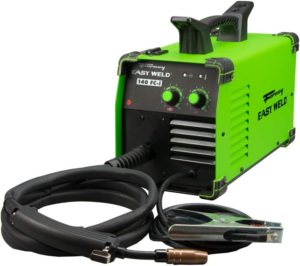
If you want to start welding without adding shielding gas and extra gear, flux-core is the easiest ramp. The FORNEY Easy Weld Flux-Cored machine’s superpower is approachability, because it keeps setup simple but still gives you real control.
It runs .030-inch flux-core wire and offers infinite voltage plus wire feed speed control. That pairing matters, because it helps you tune heat and fill without being stuck in a few coarse settings. Since it doesn’t require gas, it’s also a cleaner fit for quick home projects where you want to set up fast and put the welder away just as fast.
Power is solid for this class. It’s a 140-amp output unit, and it’s positioned to weld up to 1/4-inch of mild steel. That covers common tasks like patching, brackets, basic fabrication, and repair work on thicker steel you actually see in a garage.
Portability is a key benefit. It weighs 19 lb, so you can move it around without turning “grab the welder” into a whole event. It runs on standard household power with a 20-amp breaker, and it accepts both 2 lb and 10 lb wire rolls, so you can scale up once you start welding more often.
In the box, you get an 8-foot MIG gun, an 8-foot ground clamp, and a 20-amp to 15-amp adapter, all housed in an all-metal case.
For brand info and support resources, start with Forney Industries’ official site. If you’re curious about the company’s production updates, Forney also shares shop news like manufacturing facility upgrades.
Process: flux-core | Wire size: .030-inch | Output: 140 A | Max thickness: up to 1/4-inch mild steel | Weight: 19 lb
Reasons to Buy
- No gas required
- Easy for beginners
- Lightweight for garages
- Infinite voltage control
- Accepts 10 lb rolls
Reasons to Avoid
- Flux-core fumes and spatter
- Not a TIG-ready platform
Who should buy it: This works well if you want an affordable, simple welder for home repairs and learning. It’s also a strong choice if you know you’ll stick with gasless flux-core and don’t want to pay for features you won’t use.
Star rating: 4.1/5
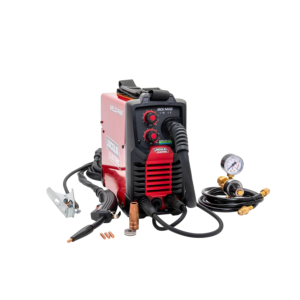
Some welders live on one bench forever. Others need to move, because your work moves. The Lincoln Electric 90i MIG’s superpower is portability, thanks to a compact inverter design and a shoulder strap that makes it easy to carry.
It plugs into any 120 V outlet, so you can weld in more places without special wiring. That’s a big deal for maintenance work, home repairs, and mobile setups where the job is wherever the metal is.
Controls stay simple and friendly. You get a two-knob layout for wire speed and voltage, which keeps setup fast. At the same time, infinite welding voltage gives you room to fine-tune the arc behavior. Because it uses an inverter power source, it’s built for smooth performance and improved efficiency, and users often look for that steady feel when they’re welding thinner material.
Wire options also add flexibility. It can run both flux-core wire and solid MIG wire. That means you can switch based on whether you’re inside with gas or outside without it (your setup will decide what makes sense).
Durability gets attention too. A metal protective case helps it handle everyday use. In the box, it ships with a welding gun, nozzle, contact tip, and work cable with clamp, so you can get started without chasing basics.
Capacity guidance is straightforward: it can handle flux-core up to 1/4-inch and MIG up to 3/16-inch.
For official company info, you can reference Lincoln Electric’s company page. If you want a second official source for specs and support pages, Lincoln also maintains a regional site at Lincoln Electric’s official web portal.
Process: MIG (solid), flux-core | Input power: 120 V | Design: inverter | Portability: shoulder strap | Capacity: flux-core up to 1/4-inch
Reasons to Buy
- Very easy to carry
- Simple two-knob controls
- Runs on 120 V power
- Inverter smoothness
- Metal protective case
Reasons to Avoid
- Smaller range than 240 V units
- Not a true multi-process
Who should buy it: This is a good fit if you need a lightweight MIG you can move around the shop or take to a job site. It’s also a practical choice if you want something simple that still gives you fine tuning.
Star rating: 4.0/5
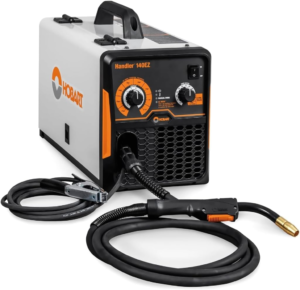
If welding feels like constant knob twisting, you’re not alone. The Hobart Handler 140EZ’s superpower is faster setup, thanks to an “easy mode” control style that helps you get close to correct settings with quick knob turns.
Once you start welding, the arc is designed to stay smooth and stable across different thicknesses. That consistency matters because it helps you build confidence. It also supports steel, stainless, and aluminum, plus it’s spool gun ready, which makes aluminum switching more straightforward than machines that need extra interface steps.
Control flexibility is stronger than you might expect from a “make it easy” machine. Infinite voltage control lets you fine-tune for cleaner beads and less spatter. There’s also a quick-select drive roll with three grooves for different wire sizes, supporting both solid and flux-core wire.
Build quality is a key part of why people choose Hobart. The industrial cast aluminum wire drive system is built for consistent wire feeding, especially during longer welding sessions where cheap drives start acting up.
Power and capacity are also practical for home use. It runs on 120 V input power and is positioned to handle material from 24-gauge up to 3/16-inch.
In the box, you get a 10-foot HR100 gun, a 10-foot work cable with clamp, a dual-gauge regulator, and a material thickness guide.
Process: MIG | Input power: 120 V | Capacity: 24-gauge to 3/16-inch | Controls: easy mode + infinite voltage | Aluminum option: spool gun ready
Reasons to Buy
- Very fast initial setup
- Smooth stable arc
- Spool gun ready
- Strong wire drive system
- Useful included accessories
Reasons to Avoid
- Not for thick steel jobs
- Needs spool gun for aluminum
Who should buy it: This is a strong match if you want MIG with less setup stress, especially while you’re learning. It also works well when you jump between different thicknesses and want the arc to stay predictable.
All recommended welders in one comparison table
Here’s a quick side-by-side view to help you spot the right fit faster.
| Welder | Best for | Processes (as covered here) | Power input | Notable capacity or range |
|---|---|---|---|---|
| Lincoln Electric EASY MIG 140 | Best overall | MIG (spool gun capable) | 120 V | Up to 5/16-inch |
| Arccaptain MIG200 Fit | Best value | MIG, flux-core, stick, lift TIG, spot, spool gun | Varies by setup | Wire support .023 to .040 (type dependent) |
| Arccaptain AC DC TIG200P | Best TIG control | AC/DC TIG, pulse, stick, spot | 110 V/220 V | Aluminum 0.5 to 5 mm |
| YESWELDER MCT520 | Welding plus cutting | MIG, flux, TIG, stick, plasma | 110 V/220 V use cases | Plasma up to 5/16-inch (110 V), 1/2-inch (220 V) |
| FORNEY Easy Weld Flux-Cored | Best budget | Flux-core | Household power | Up to 1/4-inch mild steel |
| Lincoln Electric 90i MIG | Best portable MIG | MIG, flux-core | 120 V | Flux-core up to 1/4-inch, MIG up to 3/16-inch |
| Hobart Handler 140EZ | Easiest setup | MIG (spool gun ready) | 120 V | 24-gauge to 3/16-inch |
The takeaway: if you want one do-it-all MIG for most home needs, the Lincoln EASY MIG 140 is the cleanest choice. If your work flips between processes, Arccaptain MIG200 Fit and YESWELDER MCT520 give you the broadest coverage.
What to look for in a welder
Match the process to your real projects
MIG is the go-to for quick, clean steel work, especially in a garage. Flux-core is simpler to start and works well outdoors, but it tends to throw more spatter. TIG is slower, but it gives you control and cleaner results on thin material. Stick is great for rougher repairs and dirtier steel.
If you keep bouncing between these needs, a multi-process machine saves space. Just be honest about how often you’ll switch modes.
120 V vs 220 V power
A 120 V welder is easier to live with because you can plug it in almost anywhere. That’s why so many beginner-friendly picks stay in this range. On the other hand, 220 V machines typically offer more headroom for thicker material and longer sessions.
Some models support both 110 V and 220 V, which is handy if you might upgrade your shop power later.
Controls that help, not confuse
Two-knob MIG controls can be a blessing when you’re learning. Synergic MIG is also useful because it gets you close fast, then you tweak from there. TIG-focused machines often add pulse and waveform options, which is great when you want precise heat control, but it’s more to learn.
A simple rule: buy the controls you’ll actually use.
Wire drive quality and feeding consistency
Wire feeding problems ruin welds fast. Better drive systems help keep your arc stable and your bead consistent. If you weld for longer stretches, a sturdy wire drive can matter as much as the max amp rating.
Aluminum plans
If aluminum is even a “maybe,” look for spool gun support on MIG units or true AC TIG capability for TIG units. MIG aluminum often depends on a spool gun to keep soft wire from tangling. AC TIG is the classic route for aluminum control, especially on thinner pieces.
Safety and protection features
Overheating protection, overcurrent protection, and overvoltage protection help prevent damage. For stick modes, VRD-style protections can add peace of mind. None of this replaces safe habits, but it does reduce the odds your machine gets knocked out by a bad day.
Quick reality check: the “best” welder isn’t the one with the most modes. It’s the one you can set up fast, run consistently, and keep using as your projects grow.
Why Trust OASTHAR?
I’m Shashini Fernando, an associate editor who specializes in power tools and workshop gear, plus consumer tech accessories and home DIY equipment. For this 2026 welder list, you benefit from a review process built on patterns, not opinions.
You’re not getting a single person’s one-weekend experience. Instead, you’re getting a synthesis of what hundreds of real users report after living with these machines. That includes what goes right (easy setup, stable arcs, useful controls) and what tends to go wrong (feeding issues, confusing modes, missing accessories). The result is a shortlist designed to help you buy with fewer surprises.
Best welders FAQs
What is the best welder overall?
The Lincoln Electric EASY MIG 140 is the best overall pick here because it balances simple setup, dependable performance, and 120 V convenience.
Should you start with MIG or flux-core?
If you want the easiest setup with no gas, start with flux-core. If you want cleaner beads with less spatter (and you can run shielding gas), MIG is usually the better long-term path.
Do you need a spool gun for aluminum MIG welding?
Often, yes. Many MIG welders support aluminum best with a spool gun because aluminum wire is soft and can feed poorly through a long gun liner.
What does “synergic MIG” mean?
Synergic MIG links settings for you. When you pick wire size and gas type, the machine auto-matches a recommended voltage and wire feed speed, then you fine-tune from there.
Is a welder-plasma combo worth it?
It is if you cut metal often and want to save space. You’ll need compressed air for plasma cutting, and you’ll also want to confirm your input power options (110 V vs 220 V) for the cut thickness you expect.
Final verdict
If you want one machine you can plug in and trust for most home welding, pick the Lincoln Electric EASY MIG 140. If you need the widest job coverage for the money, the Arccaptain MIG200 Fit is the smartest value play. For aluminum-focused TIG control, the Arccaptain AC DC TIG200P stands out, while the YESWELDER MCT520 is the best fit when cutting is part of your normal workflow. No matter which direction you go, choose the welder you’ll actually use often, because consistency beats specs every time.