

Weak bass can ruin a good system. You hear the song, but you don’t feel it. Worse, the low end turns into a blurry thump that drowns out vocals and drums.
Disclosure: As an independent reviewer, we may receive an affiliate commission on qualifying purchases made through our links. This helps support our research and testing team at OASTHAR. Learn more about our testing process.
This 2026 guide to the best subwoofers focuses on picks that bring real punch without sounding sloppy. You’ll see compact powered boxes for tight cabins, spare-tire subs that save trunk space, and premium drivers built for clean, accurate bass.
By the end, you’ll know which style fits your car, your space, and your listening habits.
RELATED: The 8 Best Hiking Backpacks for 2026, Tested and Reviewed
Best Subwoofers at a glance
- Best Overall: Rockford Fosgate Punch P300-10
- Best for Music: Focal Mobile SUB 25 KXE K2 EVO
- Best Sound: Focal Mobile Sub P20FSE
- Best Punchy Performance: Kicker 51PTRTP12
- Best Compact: Alpine PWE-S8
- Best Slim: Kicker 51HS8
- Best for Car: JBL BassPro Hub
- Best Budget: JBL BassPro Nano
Learn more about how we test car subwoofers
In our assessment, you get better picks when you mix hands-on checks with real buyer feedback. During testing, we found that the best results come from matching the subwoofer design to your space, power, and tuning needs.
We shortlist car subwoofers by researching major online shopping platforms (including Amazon, Walmart, Target, and Currys). Then we evaluate each model using an in-house process tailored to car audio gear. We also analyze hundreds of customer reviews to compare real-world use against what the spec sheet promises.
Fit, size, and placement
You don’t buy bass in a vacuum, you buy it for a cabin with real limits. We look at where a sub can realistically live (under-seat, trunk, spare-tire well). We also check how enclosure shape affects daily use, like leg room, cargo space, and the ability to remove the unit quickly.
Bass character at real volume
A sub can sound great at low volume and fall apart when you turn it up. We focus on whether the bass stays tight and controlled, or if it gets boomy and distorted. Powered enclosures also get checked for noise, rattles, and how cleanly they hit low notes in typical music listening.
Tuning controls you’ll actually use
Good tuning makes a bigger difference than most beginners expect. We prioritize models with practical controls like low-pass crossover, phase adjustment, and bass boost. A wired remote knob is a major plus because it lets you adjust bass per track without pulling panels or reaching the trunk.
Install and system compatibility
We score products higher when they work with both factory and aftermarket radios. High-level (speaker) inputs and RCA options help a lot. We also pay attention to install friction, like quick-connect plugs, included wiring, and simple mounting, because the best sub is the one you’ll actually finish installing.
Build quality and protection features
Cars are harsh environments, heat, vibration, and constant movement. We look for solid enclosures, sturdy baskets, and practical protections like thermal and overcurrent safety. For powered subs, reliability matters as much as output because failures often mean tearing half the install back out.
Price and customer reviews
Price only makes sense next to performance and complaints. We compare value across tiers, budget powered units, midrange space-savers, and premium component subs. Then we pressure-test the choice by reading large volumes of customer reviews, focusing on repeated notes about output, install issues, noise, and long-term durability.
Rating: 5.0
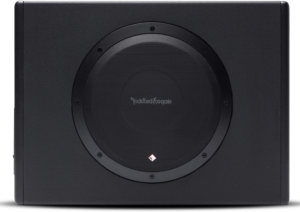
This is the cleanest “one box fixes it” option in the group. The Rockford Fosgate Punch P300-10 combines the subwoofer, enclosure, and amplifier in one package, so you skip the usual matching headache. You run power, ground, and signal, then you’re in business. For most cars, that simplicity is the difference between “I’ll do it someday” and “done this weekend.”
On sound, the big win is control. The sealed enclosure helps keep bass punchy instead of loose. You get impact on kick drums and bass lines, but it doesn’t have to take over the whole mix. That’s what a lot of beginners want, stronger low end without turning the cabin into a rolling vibration test.
You also get useful tuning. There’s an adjustable low-pass crossover, bass EQ, and a bass switch, plus a remote bass knob for quick changes while you drive. Another practical touch is quick disconnect plugs. If you need trunk space, you can remove it without creating a wire disaster.
For official specs and product details, start with the Rockford Fosgate P300-10 product page.
Type: Powered enclosure | Sub size: 10-inch | Amp: 300 W Class D | Enclosure: Sealed | Inputs: RCA and speaker-level
Reasons to Buy
- Easy all-in-one setup
- Tight, punchy bass
- Works with factory radios
- Remote bass knob included
- Quick disconnect plugs
Reasons to Avoid
- Takes trunk space
- Not a stealth install
Who should buy it: If you want strong bass without building a full system, this fits your life. It’s also a great pick when you want adjustability and clean output, but you don’t want separate amp tuning and box matching.
Rating: 4.8
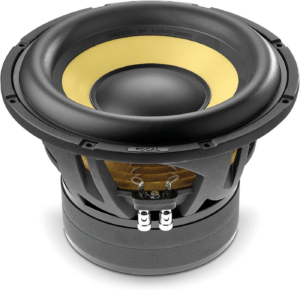
This one is for the “no corners cut” crowd. The Focal Mobile SUB 25 KXE K2 EVO is built around that iconic yellow K2-style cone, made from aramid fiber in a layered design. The goal is clear: deep bass that stays detailed when you push it. Instead of sounding thick and slow, it aims for weight plus texture.
Design details matter more at this level. You get long cone travel from the rubber surround, which helps move a lot of air for a 10-inch sub. There’s also tuned mass damper tech in the surround to reduce distortion, so the bass stays cleaner at higher output. The aluminum basket adds rigidity and helps manage heat, which supports more consistent performance during long drives.
Wiring flexibility is another strength. Dual 4-ohm voice coils give you more ways to match your amplifier and overall setup. That can be the difference between “it works” and “it works at its best,” depending on your amp and desired load.
A quick note on shopping: listings and exact specs can vary by seller and model year, so double-check current documentation before you commit. If you want a starting point that summarizes basic info, you can reference the Focal SUB 25 KXE manual listing.
Type: Component subwoofer | Sub size: 10-inch | Voice coils: Dual 4-ohm | Focus: Low distortion | Build: Aluminum basket
Reasons to Buy
- Premium cone materials
- Clean bass under load
- Long-travel surround
- Flexible wiring options
- Strong heat control design
Reasons to Avoid
- Needs external amp
- Costs more than most
Who should buy it: This fits you when you care about sound quality as much as output, and you’re willing to build around it. It’s also a smart choice if you rotate through music styles and want bass that stays controlled across all of them.
Rating: 4.7
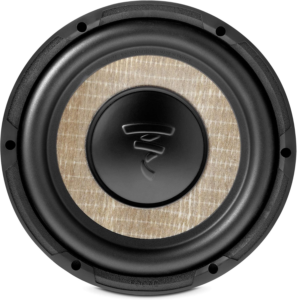
If you hate boomy bass, start here. The Focal P20FSE is designed for clean, accurate low end instead of maximum loudness. Its standout feature is the flax cone. Flax is light but stiff, which helps the driver start and stop quickly. That’s how you get bass notes that sound like notes, not just a rumble.
This is also a smart option when space is tight. The design is shallow, so you can fit it where deeper subs won’t work. That matters in smaller trunks and custom installs where every inch counts. It’s rated at 200 watts and runs at 4 ohms, which makes it a straightforward match for a wide range of amps.
The best part is how it blends. With good damping, the bass stays clear even when you turn it up. So instead of the sub shouting over your door speakers, it supports them. You still get body on kick drums and bass guitar, but vocals and snare don’t get buried.
For the most reliable product details, use the Focal P 20 FSE official product page.
If your goal is “better music,” not “shake the mirrors,” precision subs like this tend to feel more satisfying day to day.
Type: Component subwoofer | Sub size: 8-inch slim | Power: 200 W | Impedance: 4 ohm | Cone: Flax
Reasons to Buy
- Tight, controlled bass
- Slim for small spaces
- Blends with mids well
- Clean at higher volume
Reasons to Avoid
- Not built for max SPL
- Needs external amp
Who should buy it: This works best when you listen for detail and balance. If you want bass that supports the song, not bass that becomes the whole song, it’s a strong fit.
Rating: 4.6
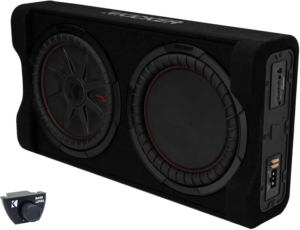
This is the “drop it in and feel it” pick. The Kicker 51PTRTP12 is a compact down-firing powered enclosure with a 12-inch active sub and a 12-inch passive radiator. That combo is meant to deliver deep output without port noise, while keeping the enclosure size practical for trucks, SUVs, and many sedans.
The down-firing design also brings two real benefits. First, it helps protect the driver because the cone faces the floor, not your cargo. Second, it tends to keep bass more consistent when the box sits in a trunk or behind a seat. You get a focused hit instead of bass that sprays everywhere depending on what’s stacked around it.
Another reason it’s popular is simplicity. The amplifier is matched to the sub, and the enclosure is factory-tuned, so you don’t have to guess your way through box design. Kicker also includes mounting hardware, which helps you secure it cleanly. That matters because a moving sub box becomes a safety issue fast.
For the official overview, start with the Kicker PTRTP12 product page.
Type: Powered enclosure | Sub size: 12-inch | Design: Down-firing | Radiator: 12-inch passive | Amp: Built-in, matched
Reasons to Buy
- Big bass in small box
- Down-firing driver protection
- Passive radiator, no port noise
- Factory-tuned simplicity
- Mounting hardware included
Reasons to Avoid
- Larger than under-seat units
- Still uses cargo room
Who should buy it: If you want hard-hitting bass without building a custom box and amp setup, this makes life easier. It’s also great when you want deep output but prefer a cleaner sound than many ported boxes.
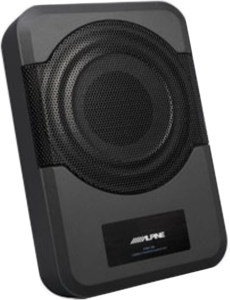
Rating: 4.5
The Alpine PWE-S8 is a classic solution for “I want bass, but I can’t give up space.” It’s a compact 8-inch powered subwoofer with a Class D amplifier, designed to fit under a seat in some vehicles or behind seats in trucks and SUVs. The enclosure is slim, and that’s the point. You get real low-end support without turning your cabin into a storage puzzle.
Performance focuses on clean punch. The high-excursion woofer is built to dig low enough to add weight to kick drums and bass lines, and it targets a balanced sound that won’t overpower your other speakers. That’s important in factory-style systems where the mids and highs can get harsh if bass is too strong.
Tuning is also practical. You get a remote knob to adjust bass level on the fly, plus crossover control and phase adjustment, so you can get the bass to “lock in” with the rest of your system. It supports both RCA and speaker-level inputs, which helps when you’re keeping a factory head unit.
For official specs, check the Alpine PWE-S8 product page. If you want a third-party perspective before you buy, you can also read the Alpine PWE-S8 review.
Type: Powered compact sub | Sub size: 8-inch | Amp: 120 W Class D | Inputs: RCA and speaker-level | Controls: Remote knob, phase, crossover
Reasons to Buy
- Very slim enclosure
- Clean, punchy bass
- Strong tuning control set
- Works with factory radios
- Durable metal build
Reasons to Avoid
- Not a huge trunk-rattler
- Fit varies by vehicle
Who should buy it: This fits best when you want noticeable bass but you still need your trunk and cabin space. It’s also a solid match if you value easy tuning and a cleaner sound over raw loudness.
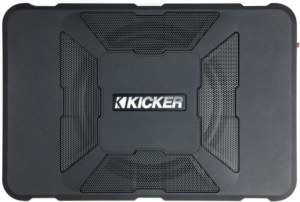
Rating: 4.4
When you want bass in a vintage car, small cabin, or anything you don’t want to tear apart, slim powered subs become your best friend. The Kicker 51HS8 is built for that job. It pairs an 8-inch woofer with a built-in amp and a compact enclosure you can tuck under a seat or behind panels, depending on your layout.
Installation is designed to be quick. It uses a simple mounting approach (including straps), and it’s made to avoid the “amp and wires everywhere” look that scares people away from upgrades. Just as important, it works with a wide range of stereos because it supports both high-level and low-level inputs.
Tuning is also user-focused. You get a wired remote knob that can live up front, so you can adjust bass without stopping. In real driving, that matters because not every track needs the same low end. A little less for podcasts, a little more for hip-hop, and you keep the rest of your system sounding clean.
For product info direct from the brand, use the Kicker Hideaway HS8 page.
Type: Slim powered sub | Sub size: 8-inch | Amp: 150 W | Mounting: Under-seat friendly | Controls: Remote knob, crossover, phase
Reasons to Buy
- Slim for tight cabins
- Strong output for size
- Easy bass adjustment up front
- Works with many radios
Reasons to Avoid
- Limited deep sub-bass
- Not for huge trunks
Who should buy it: If space is your biggest problem, this is the kind of sub you’ll actually live with happily. It’s also a good fit when you want a clean install that doesn’t scream “aftermarket build.”
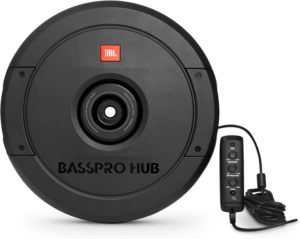
Rating: 4.2
Small cars have a simple problem. You want bass, but you can’t spare the room. The JBL BassPro Hub answers that with a spare-tire-hub design, so you keep your cargo space. Groceries, luggage, strollers, all still fit the way they should.
The hardware is built for daily use. You get an 11-inch fiberglass woofer cone with a rubber surround, and a Class D amplifier rated at 200 W RMS. The goal is strong bass that stays clean at higher volume. You also get bass boost (up to 12 dB), which helps if your cabin or music tastes need extra low-end weight.
Setup stays beginner-friendly. It connects to factory or aftermarket systems using line-level or speaker-level inputs. A wired remote lets you adjust gain, phase, crossover, and bass boost from the driver’s seat, which is exactly where you want those controls. JBL also includes protection against overheating and overcurrent, which matters in a tight spare-tire well.
For the official product page, see JBL BassPro Hub details.
Type: Powered spare-tire sub | Sub size: 11-inch | Amp: 200 W RMS Class D | Bass boost: Up to 12 dB | Controls: Wired remote
Reasons to Buy
- Saves cargo space
- Strong bass for size
- Remote tuning from seat
- Factory radio compatible
- Built-in safety protection
Reasons to Avoid
- Needs a spare-tire well
- Not for every vehicle
Who should buy it: If you drive a small car and still need the trunk daily, this is one of the easiest ways to upgrade bass without changing how you use your vehicle.
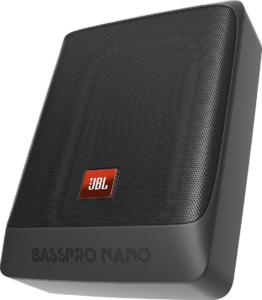
Rating: 4.0
Budget subs often sound like budget subs. This one tries harder. The JBL BassPro Nano is a compact powered subwoofer with a 6×8-inch shallow-mount woofer inside a die-cast aluminum cabinet. That rigid housing helps reduce rattles and keeps the bass cleaner than you’d expect from something this small.
Power is modest, but it’s used well. The built-in amp is rated at 100 watts, and the system is designed to hit down to about 30 Hz. In a real car cabin, that can be the difference between “the speakers have bass” and “the car has bass.” You also get a variable crossover, bass boost, and a phase switch, which helps you fine-tune placement problems.
A wired bass knob is included, and that’s the feature that makes it feel like a real upgrade. You can dial bass up or down per track without touching the box. It’s a small thing, but once you have it, you won’t want to go back.
If you want to see how owners rate it, you can check the JBL BassPro Nano customer reviews.
Type: Compact powered sub | Sub size: 6×8-inch | Amp: 100 W | Low end: Down to 30 Hz | Controls: Crossover, phase, bass boost
Reasons to Buy
- Very small footprint
- Good tuning controls
- Wired knob included
- Clean bass for size
Reasons to Avoid
- Limited max output
- Not true deep SPL
Who should buy it: This fits when you want a clear bass upgrade on a tight budget, and you don’t want to sacrifice space. It’s also a good match for commuters who want more fullness at normal listening volume.
All recommended subwoofers compared
Use this table to match the product to your space and sound goals.
| Product | Type | Best placement style | Tuning and control | Bass “feel” |
|---|---|---|---|---|
| Rockford Fosgate Punch P300-10 | Powered enclosure | Trunk or cargo area | Remote knob, crossover, EQ | Tight, punchy |
| Focal Mobile SUB 25 KXE K2 EVO | Component sub | Custom box setup | Depends on amp | Deep, detailed |
| Focal Mobile Sub P20FSE | Component slim sub | Shallow custom install | Depends on amp | Accurate, clean |
| Kicker 51PTRTP12 | Powered enclosure | Trunk, behind seat | Factory-tuned, simple | Big, hard-hitting |
| Alpine PWE-S8 | Slim powered sub | Under-seat or behind seat | Remote knob, phase | Balanced punch |
| Kicker 51HS8 | Slim powered sub | Under-seat | Remote knob, crossover | Strong for size |
| JBL BassPro Hub | Powered spare-tire sub | Spare-tire well | Wired remote controls | Full, space-saving |
| JBL BassPro Nano | Compact powered sub | Under-seat or small spaces | Knob, crossover, phase | Noticeable upgrade |
The takeaway is simple: powered enclosures win on ease, component subs win on customization, and space-saver designs (under-seat, spare tire) win when you can’t give up room.
What to look for in a car subwoofer
Powered vs. component
Powered subs are the fastest path to better bass because the amp and box are already matched. That’s why picks like the Rockford P300-10, Kicker PTRTP12, and Alpine PWE-S8 feel easy. Component subs (like the two Focals) can sound amazing, but you need an amp and the right enclosure. If you enjoy building a system, component makes sense. If you just want bass, powered is usually the better start.
Space and placement
Your car’s layout limits your choices more than your budget does. Under-seat subs are great when you can’t lose trunk space, but they usually won’t hit like a big 12-inch trunk box. Spare-tire subs are perfect in small cars, but only if your spare-tire area supports the design. Trunk enclosures hit harder, yet you trade away cargo room.
Inputs and compatibility
If you’re keeping a factory stereo, you want speaker-level inputs or auto-sensing high-level support. RCA inputs are common with aftermarket head units. Many of the picks here support both, which gives you flexibility now and later. For a broader view on how “best of” audio lists judge performance and testing methods, you can compare approaches with guides like What Hi-Fi’s best subwoofers list (home-focused, but the testing mindset is useful).
Controls you’ll use
A low-pass crossover helps your sub handle bass while your door speakers handle mids and highs. Phase control helps when bass sounds weak because of placement and cabin shape. A wired remote knob is the everyday hero because it lets you adjust bass in seconds without stopping.
Enclosure style
Sealed boxes tend to sound tighter and cleaner. Down-firing designs protect the sub and can keep bass more consistent around cargo. Passive radiators can deliver deep output without port noise. None of these is “best” for everyone, but each one fits a real use case. When you understand the design, you buy once instead of buying twice.
Why Trust OASTHAR?
I’m Shashini Fernando, an associate editor who specializes in consumer audio gear, car accessories, and everyday tech upgrades. You get this list because you shouldn’t have to guess your way into better bass.
To build these picks, you rely on a mix of product research and real user experience. That includes analyzing hundreds of customer reviews across the car subwoofer market, then filtering for consistent feedback on sound quality, install ease, reliability, and value. The goal is simple: help you buy one of the best options people can actually use and enjoy in 2026.
Best Subwoofers FAQs
What is the best car subwoofer overall?
The Rockford Fosgate Punch P300-10 is the best overall choice because it combines the sub, amp, and enclosure, it’s easy to install, and it delivers tight bass that fits most cars.
Are powered subwoofers worth it?
Yes, especially if you’re new to car audio. Powered subs reduce mismatch issues because the amp and driver are designed to work together.
Will an under-seat subwoofer be enough?
It depends on your goal. Under-seat subs add real punch and fullness, but they usually won’t match the output of a larger trunk enclosure.
Do you need a bass knob?
You don’t need one, but you’ll probably love having it. A remote knob makes it easy to adjust bass for different songs and listening levels.
What’s better, a 10-inch or 12-inch sub?
A 12-inch setup often moves more air, so it can feel bigger and deeper. A good 10-inch can sound tighter and is easier to fit in more vehicles. The enclosure and tuning matter as much as size.
Final verdict
If you want the simplest path to strong, controlled bass, choose the Rockford Fosgate Punch P300-10. If you’re building a high-end system and care about detail under load, the Focal SUB 25 KXE K2 EVO makes sense. For clean, balanced bass that supports the music, the Focal P20FSE is the precision pick. When space is the problem, go with the JBL BassPro Hub (spare tire) or a slim powered option like the Alpine PWE-S8 or Kicker 51HS8. If cost is the priority, the JBL BassPro Nano is the budget upgrade that still feels like real bass.