

If you’re searching for the best cold press juicers, you’re probably trying to drink healthier without turning your kitchen into a second job. That’s the right goal, and the wrong juicer can ruin it fast.
Disclosure: As an independent reviewer, we may receive an affiliate commission on qualifying purchases made through our links. This helps support our research and testing team at OASTHAR. Learn more about our testing process.
Cold press (slow) juicers run at low RPM, so they squeeze produce gently. As a result, you usually get smoother juice, better flavor, and less foam than you do with loud, high-speed machines.
This guide breaks down seven standout options for 2026, with clear “who it’s for” advice, real tradeoffs, and a quick comparison so you can choose with confidence.
RELATED: The 7 Best Electric Ranges for 2026, Tested and Reviewed
Best cold Press juicers at a glance
- Best Overall: Nama J2 Cold Press Juicer
- Best for Small Counters: Nutribullet Slow Juicer
- Best for One Cup: Hurom HP Slow Juicer
- Best for Leafy Greens: Tribest Greenstar Elite Masticating Juicer
- Best Quiet Cold: Hurom H-AA Slow Juicer
- Best Value: AMZCHEF Slow Masticating Juicer
- Best Budget: Omega Cold Press 365 Juicer
How you should think about cold press juicers
Cold press juicers are slow on purpose. Instead of shredding produce at high speed, they use an auger (or gears) to press juice out. That slower motion helps keep the juice cooler, which is part of why people like the taste and texture.
Still, “cold press” doesn’t automatically mean “easy.” The best experience usually comes down to a few practical details:
You’ll notice prep time first. A wide feed chute can save you a lot of chopping, while a smaller chute is fine if you juice simple recipes or don’t mind cutting apples and carrots down to size.
Cleanup is the next make-or-break factor. Some machines reduce parts, others rely on better brushes and easier disassembly. If cleaning feels annoying, your juicer tends to end up in the cabinet.
Finally, match the machine to what you actually juice. Leafy greens and wheatgrass can be tough for some designs. Meanwhile, fruit-heavy blends are easier for most slow juicers.
If you also make smoothies and frozen drinks, it helps to know where a blender fits better than a juicer. You can compare the two styles in OASTHAR’s top blender buying guide, then decide which tool makes the most sense for your routine.
If you want a habit you’ll keep, prioritize three things: easy feeding, easy cleaning, and a design that fits your counter.
Learn more about how we test cold press juicers
In our assessment, you get the clearest “best of” list when you combine hands-on checks with wide research. During testing, we found that the small annoyances (feeding, cleaning, clogging) matter as much as juice quality.
We start by researching major shopping platforms such as Amazon, Walmart, Target, and Currys. Next, we evaluate each juicer using a consistent in-house process tailored to cold press juicers, and we analyze hundreds of real customer reviews to compare lived experience against the marketing claims.
Juice yield and pulp dryness
We look for strong juice extraction across common produce types, including hard veggies and leafy greens. A key signal is dry pulp, since wetter pulp often means you’re leaving juice behind. We also note how often you need to re-run pulp, how smooth the juice pours, and whether fiber tends to slip through when you want a cleaner glass.
Texture, foam and flavor
Cold press juicers usually win on texture, but not all of them strain equally well. We pay attention to foam levels, separation in the cup, and how the juice feels after sitting for a bit. We also watch for “heated” taste, which can show up when a machine introduces too much friction or air during extraction.
Feeding, prep time and anti-clogging
A wide chute can cut prep time a lot. So, we measure real-life feeding speed, not just chute size on paper. We also check clog behavior, especially with fibrous greens, celery, and ginger. Reverse functions, better filters, and smart auger designs can prevent annoying stop-and-start juicing.
Noise and kitchen friendliness
Noise matters because many people juice early. We look for motors that stay calm and steady, and we factor in vibrations and rattles too. A quieter machine isn’t just nicer, it’s also easier to use consistently because it doesn’t feel like a whole production every time you want one glass.
Cleaning time and daily maintenance
We track how many parts you touch during cleaning, how hard pulp is to remove, and whether the machine rinses clean quickly. Dishwasher-safe parts help, but “dishwasher-safe” doesn’t always mean “dishwasher-friendly” if pulp gets trapped in fine mesh. Good brushes and fewer parts often beat fancy claims.
Price and customer reviews
We weigh the feature set against typical pricing tiers (which change often), then cross-check with real buyer feedback. Customer reviews help you see patterns, like long-term durability, breakage points, stain resistance, and whether warranty support actually feels helpful. This keeps the list grounded in what owners deal with after the honeymoon phase.
Star rating: 5.0/5
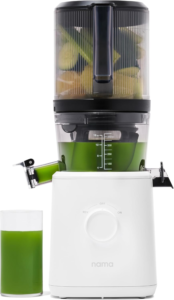
This is the “load it and walk away” pick. The Nama J2’s standout strength is its self-feeding hopper, which lets you add a full recipe at once, including whole apples and greens, then let the machine pull ingredients down on its own. It feels closer to an appliance you live with, not a gadget you babysit.
Performance-wise, it’s a slow masticating design that runs around 50 RPM with a 200 W motor. That low speed helps with gentle pressing and aims for higher yield with less pulp. It’s built to handle fruits, vegetables, and leafy greens, plus extras like nut milk and sorbet, which makes it a stronger “one machine for the week” choice.
Daily use also looks well thought out. The hopper holds about 35 oz, which supports bigger batches. Cleanup is designed to be simple with snap-on parts, a cleaning brush, and a pullback section that helps clear pulp faster. Assembly can feel tricky once, but it usually gets easier after you learn the alignment.
For official specs and what’s included, see the Nama J2 Cold Press Juicer product page.
Type: slow masticating | Speed: ~50 RPM | Motor: 200 W | Hopper: ~35 oz | Warranty: up to 15 years
Reasons to Buy
- Hands-free self-feeding hopper
- Low-pulp, high-yield focus
- Large batch hopper size
- Quieter than most blenders
- Long warranty coverage
Reasons to Avoid
- First-time assembly learning curve
- Bigger than mini models
Who should buy it: If you want juicing to feel automatic, this fits. It’s also the right choice when you juice multiple times a week and don’t want to stand there pushing produce down every minute.
Star rating: 4.7/5
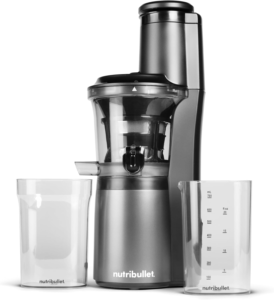
This is the compact pick that still feels capable. The Nutribullet Slow Juicer keeps its footprint small, but it avoids the “toy appliance” vibe by using a slow masticating system and sturdy parts. If counter space is tight, it’s an easy style of juicer to live with.
Feeding is practical because the chute is about 3 inches wide, so you can drop in larger pieces like whole apples or thick carrot sections. It runs around 65 RPM with a 150 W motor, aiming for calm extraction and lower noise than high-speed juicers. Inside, you get a steel-tipped auger and a stainless sieve, which both signal better durability for daily use.
It’s also friendly when things go wrong. A reverse function helps clear jams, and a no-drip spout keeps the counter cleaner while you mix juice before pouring. Cleanup should feel manageable since parts come apart easily, many are dishwasher-safe, and there’s a brush for stubborn pulp spots. The box includes a 24 oz juice cup, a pulp container, and a small recipe guide.
For the brand’s current lineup and details, check the Nutribullet juicer collection page.
Type: slow masticating | Speed: ~65 RPM | Motor: 150 W | Feed chute: ~3 inches | Extras: reverse, no-drip spout
Reasons to Buy
- Compact, counter-friendly build
- Reverse clears stuck produce
- No-drip spout helps mess
- Wide enough feed chute
- Stainless and steel internals
Reasons to Avoid
- Less ideal for huge batches
- Still needs some prep
Who should buy it: If you want a smaller juicer that doesn’t feel flimsy, start here. It works well for apartment kitchens, shared counters, and anyone who wants fewer “kitchen takeover” appliances.
Star rating: 4.6/5
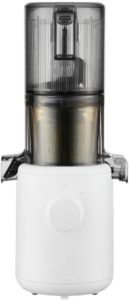
If you make one glass at a time, size matters. The Hurom HP is designed for personal juicing, and it stays small enough to keep out on the counter without feeling in the way. It’s about 4 inches wide and weighs under 8 lb, so it’s easy to move and store.
It uses Hurom’s slow squeeze approach and runs at just 43 RPM, which is very slow even in this category. That helps keep juice smooth and reduces heat buildup. The auger and strainer are made from tougher materials than typical plastic, and everything is BPA-free, which is reassuring if this becomes a daily habit.
The clever part is the no-strainer chamber approach. The strainer is built into the chamber, and the two-part auger does filtering while crushing. That usually means fewer parts to clean and a simpler rinse routine. The hopper is smaller than Hurom’s larger models, so you may need to cut harder produce, but that’s part of why it stays so compact.
Hurom lists details on the official HP Slow Juicer page.
Type: slow squeeze | Speed: ~43 RPM | Footprint: ~4 inches wide | Weight: under 8 lb | Design: integrated strainer chamber
Reasons to Buy
- Great for single servings
- Very compact and light
- Fewer parts to clean
- Smooth juice, low foam
- BPA-free materials
Reasons to Avoid
- Smaller hopper size
- Some produce needs chopping
Who should buy it: This fits a solo routine. If you want fresh juice without committing to a big machine, it’s an easy match, especially when storage and cleanup are top priorities.
Star rating: 4.5/5
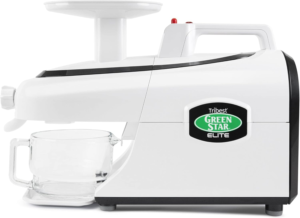
Leafy greens can humble a lot of juicers. The Tribest Greenstar Elite is built for that exact job, using a twin gear system that slowly crushes produce more like chewing than grinding. If celery, kale, and wheatgrass are your staples, this style of machine often makes the most sense.
Those stainless steel gears run around 110 RPM, keeping heat lower and reducing air mixing. In real use, the big win is pulp output. The pulp tends to come out very dry, which is what you want when you’re chasing yield from fibrous greens. Juice freshness can also benefit because slower pressing usually reduces oxidation compared with high-speed designs.
It’s also not just a juicer. With included screens and parts, you can make things like nut butters, sorbets, baby food, and even dough or pasta with optional attachments. In the box, you get fine and coarse screens, blank plates, a glass juice pitcher, plungers, a drip tray, plus cleaning tools. The tradeoff is counter space and cleaning time since there’s more hardware involved.
The warranty is a standout, up to 15 years, which is rare in this category. For official product info, see the Tribest Greenstar Elite product page.
Type: twin gear masticating | Speed: ~110 RPM | Best at: leafy greens | Build: stainless gears | Warranty: up to 15 years
Reasons to Buy
- Excellent leafy greens yield
- Very dry pulp output
- Heavy-duty, BPA-free parts
- Multi-use food processing
- Long warranty coverage
Reasons to Avoid
- Needs more counter space
- Longer cleaning routine
Who should buy it: If green juice is your main thing, this earns its spot. It’s also a strong pick if you want one machine that can branch into nut butters and frozen treats later.
Star rating: 4.4/5
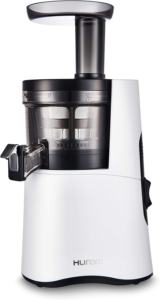
If you juice while the house is still asleep, noise becomes a dealbreaker. The Hurom H-AA focuses on a calm, low-drama experience. It uses a 150 W motor and a slow squeeze style that sounds more like a soft hum than a loud spin cycle.
Because it presses gently, it tends to reduce foam and aims to pull more juice from the same produce. It’s also designed for more than basic fruit juice. You can run leafy greens and harder veggies, and it can also handle nuts for plant milk. A blank strainer expands the menu into sorbet or ice cream right in the chamber, which is a nice bonus if you want more use out of the machine.
You also get pulp control via a lever and different strainers. That means you can go smoother when you want “store-like” juice, or leave more texture when you’re making thicker veggie blends. Parts are BPA-free and made from strong plastic, and the overall body stays compact enough for smaller kitchens.
Hurom’s official site is the best place to confirm what comes in the box and what accessories are current, since bundles can change. Start at Hurom America’s homepage.
Type: slow squeeze | Motor: 150 W | Noise: very quiet | Extras: blank strainer option | Pulp control: lever plus strainers
Reasons to Buy
- Very quiet for mornings
- Pulp texture control options
- Can make nut milk
- Sorbet with blank strainer
- Compact kitchen-friendly size
Reasons to Avoid
- Not the widest chute
- More parts than mini units
Who should buy it: This fits early risers and noise-sensitive homes. It’s also a good match if you want juice quality first, but still like the idea of sorbet and plant milk in the same machine.
Star rating: 4.2/5
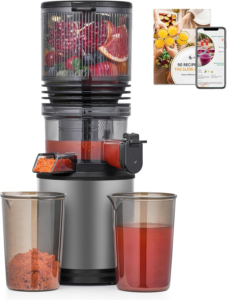
Prep work is where many people quit. The AMZCHEF Slow Masticating Juicer fights that problem with an extra-wide feed chute, around 6 inches wide, so you can drop in larger pieces and sometimes whole fruits without constant chopping.
Inside, it uses a triple stainless steel filter system that breaks produce down in stages. In practice, that aims for more juice, less pulp, and a smoother pour. It also helps reduce clogging, which matters when you run fibrous ingredients or switch between soft fruits and harder veggies in the same session.
The motor is another reason it lands as a value pick. It uses a quiet DC motor that stays under about 55 dB, which should feel reasonable for morning use. Batch makers also get a benefit from the 2,000 ml capacity, which is useful if you’re juicing for more than one person or filling multiple bottles at once.
The stainless steel body resists stains and fingerprints, which helps it look cleaner on the counter. Cleanup should be straightforward because parts come apart easily, although the exact ease can vary by batch and recipe type.
Type: slow masticating | Feed chute: ~6 inches | Motor noise: under ~55 dB | Capacity: ~2,000 ml | Filter: triple stainless system
Reasons to Buy
- Wide chute, less chopping
- Quiet DC motor design
- Smooth juice, less pulp
- Large family batch capacity
- Resists stains and prints
Reasons to Avoid
- Bigger footprint than minis
- Some produce still needs prep
Who should buy it: If you hate chopping and want to make larger batches, this is an easy fit. It’s also a good option when you want a wide-chute design without moving into the most expensive tier.
Star rating: 4.0/5
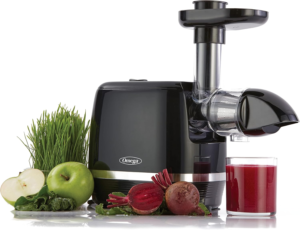
If you want cold press juice without spending big, the Omega Cold Press 365 is the budget-friendly entry point in this lineup. It runs slowly, around 90 to 110 RPM, and focuses on gentle pressing to keep juice cooler and smoother.
A standout feature is the triple-stage auger system. That design strains better, breaks down fiber more effectively, and aims for a smoother texture in the glass. It also helps with tougher ingredients like wheatgrass, kale, and ginger, which can taste rough when the juice comes out too pulpy.
The motor is also described as surprisingly quiet, which matters more than you’d think once juicing becomes routine. There is a tradeoff though: the feed chute is smaller than some newer wide-chute models, so you’ll chop larger fruit more often. If you’re fine with that, you still get solid yield for the price.
Cleanup stays simple. Most parts are dishwasher-safe, and you can also rinse by hand without a long scrub session.
Type: cold press slow juicer | Speed: ~90 to 110 RPM | Auger: triple-stage | Chute: smaller size | Cleaning: dishwasher-safe parts
Reasons to Buy
- Budget-friendly cold press entry
- Quiet motor for mornings
- Smooth juice from tough greens
- Solid feel for the price
- Easy cleaning routine
Reasons to Avoid
- Smaller feed chute
- More chopping required
Who should buy it: This works when you want to try cold press juicing without spending premium money. It’s also a practical backup juicer for simple recipes and smaller kitchens.
All 7 recommended cold press juicers compared
Here’s a side-by-side view of the details that usually matter most when you’re choosing.
| Rank | Juicer | Best for | Speed / Motor (stated) | Feeding + convenience (stated) |
|---|---|---|---|---|
| #1 | Nama J2 | Hands-free, daily batches | ~50 RPM, 200 W | Self-feeding hopper, ~35 oz, easier cleanup tools, up to 15-year warranty |
| #2 | Nutribullet Slow Juicer | Tight counters | ~65 RPM, 150 W | ~3-inch chute, reverse function, no-drip spout, 24 oz cup included |
| #3 | Hurom HP | One cup routines | ~43 RPM (motor not stated here) | Very small body, fewer parts, integrated strainer design |
| #4 | Tribest Greenstar Elite | Leafy greens | ~110 RPM (motor not stated here) | Twin gears, multi-use parts, more counter space, up to 15-year warranty |
| #5 | Hurom H-AA | Quiet juicing | 150 W (RPM not stated here) | Pulp control, blank strainer for sorbet, can do nut milk |
| #6 | AMZCHEF | Less chopping, big batches | Noise under ~55 dB (RPM not stated here) | ~6-inch chute, triple stainless filter, ~2,000 ml capacity |
| #7 | Omega Cold Press 365 | Lower budget | ~90 to 110 RPM (motor not stated here) | Triple-stage auger, smaller chute, dishwasher-safe parts |
The quick takeaway is simple: pick based on your routine. Hands-free and batch size point to the Nama J2, leafy greens point to Tribest, and tight counters point to Nutribullet or Hurom HP.
What to look for in a cold press juicer
Buying a juicer is easy. Keeping it on your counter for months is the hard part. These are the factors that decide which one you’ll actually use.
Size, footprint and capacity
Start with space. A compact model can be the difference between “daily habit” and “stored in the closet.” If you juice for one, a small unit like the Hurom HP style makes sense. If you fill bottles for the day, larger hoppers and bigger containers save time.
Capacity also changes your workflow. A large hopper (like the Nama J2’s stated ~35 oz) supports true batch juicing. Meanwhile, a big juice container helps avoid mid-session pauses.
Feeding design, chute width and prep time
Chute width has a direct effect on how annoying juicing feels. A 6-inch chute can cut prep fast because you’re not slicing everything into sticks. Smaller chutes aren’t “bad,” but they demand a different attitude. You’ll chop more often, and you’ll want to choose produce that fits your patience level.
Self-feeding hoppers also change the vibe. They reduce the need to push produce down constantly, which is one of the most common friction points for beginners.
Speed (RPM), motor power and what they mean day-to-day
Low RPM is a big reason people choose cold press machines. Slower speeds tend to be calmer, quieter, and gentler on the juice. Still, don’t fixate on RPM alone. Auger design, filter quality, and how the machine handles fiber matter just as much.
Motor watts can hint at capability, but the full design matters more than a single number. A well-built 150 W slow juicer can be more pleasant than a larger motor that clogs or vibrates.
Leafy greens vs fruit-heavy recipes
Be honest about what you’ll juice. If you mainly do apples, oranges, and soft fruits, most cold press juicers can handle that without drama. If you’re serious about celery, kale, and wheatgrass, twin-gear machines like the Tribest style tend to extract more and leave drier pulp.
Hard roots like ginger also test a juicer. Strong filters and better augers help keep the juice drinkable instead of gritty.
Noise level
Noise isn’t just comfort, it’s consistency. A quiet machine makes it easier to keep your routine when others are sleeping. Look for stated low dB levels when available, or models described as quiet and steady rather than high-speed and aggressive.
If you live with roommates or kids, this factor jumps up the list fast.
Cleaning effort and part count
Cleaning is the silent killer of good intentions. Fewer parts usually means faster cleanup. Integrated strainer designs can help, and so can good brushes and easy disassembly. Dishwasher-safe parts are nice, but you still want a design that rinses quickly in the sink.
Also pay attention to pulp traps. Fine mesh can make great juice, but it can also hold onto fiber and turn cleanup into a scrub session.
Safety, materials and BPA-free parts
You’re processing food every day, so materials matter. BPA-free plastics are common in better brands, and stainless steel filters and tips can improve durability. Check what touches juice, not just what looks premium on the outside.
Warranty and long-term ownership
A long warranty doesn’t guarantee a perfect experience, but it often signals confidence in the build. If you plan to juice for years, warranty length matters more than small feature differences.
Both Nama and Tribest list warranties up to 15 years in the stated details above, and that’s a big deal in this category.
Why Trust OASTHAR?
I’m Shashini Fernando, an associate editor who specializes in consumer tech and product categories that sit at the edge of “health gear” and everyday home gadgets, including kitchen appliances and smart wellness devices.
You benefit from a process that mixes in-house testing with heavy research. Each pick is checked for real-life use, then compared against hundreds of customer reviews (real owners) across the cold press juicer market. That’s how you end up with a list that reflects what people actually deal with after week one
Best Cold Press Juicers FAQs
What is the best cold press juicer overall?
The Nama J2 Cold Press Juicer is the best overall pick here because the self-feeding hopper saves time, it supports big batches, and it’s backed by a long stated warranty.
Are cold press juicers really better than centrifugal juicers?
Cold press juicers run slower, so they tend to produce smoother juice with less foam and less heat. Centrifugal juicers can be faster, but they’re often louder and can create more froth.
Which juicer is best if you only make one glass?
The Hurom HP Slow Juicer fits one-cup routines best because it’s compact, lightweight, and designed with fewer parts to clean.
What’s the best cold press juicer for leafy greens?
The Tribest Greenstar Elite stands out for greens because the twin gears crush fibrous produce effectively, and it’s known for very dry pulp output.
How do you avoid clogs when juicing celery and greens?
Feed slowly, alternate soft and fibrous items, and use reverse if your model has it. A design that resists clogging (like multi-stage filters or twin gears) also helps.
Final Verdict
If you want one easy answer, choose the Nama J2 and move on. It’s the best match for most people because it reduces effort, supports bigger batches, and feels built for long-term use.
If your kitchen is small, the Nutribullet Slow Juicer gives you a strong balance of size, convenience features, and everyday toughness. If you’re a one-glass person, the Hurom HP keeps it simple and easy to clean.
Green-juice fans should focus on the Tribest Greenstar Elite because it’s purpose-built for leafy produce. And if noise is your top concern, the Hurom H-AA is the calmer, quieter option.
Pick the one that fits your counter and your routine, then stick with it. Consistency beats perfection, and the right juicer makes healthy habits feel normal.