

If you’re wondering whether the Sonos Era 100 is worth the money, the short answer is yes, if you want a compact speaker that sounds bigger than it looks. This review walks through the design, sound, features, setup, and value so you can decide if it fits a small room, a Sonos setup, or your first proper home audio upgrade.
If you want the fast take, this is one of the easiest Sonos speakers to recommend. It’s not the cheapest box on the shelf, but it sounds better than the old Sonos One, feels more refined, and gives you more ways to play music.
RELATED: Apple HomePod 2 Review (2026): Best Great Sound, Tight Limits
Quick Summary
The Sonos Era 100 is the kind of speaker that makes a strong first impression and keeps earning it. The design is cleaner, the stereo sound is fuller, and the setup is still dead simple if you already live in the Sonos world.
The biggest wins are sound quality, ease of use, and flexibility. You get Wi-Fi, Bluetooth, AirPlay 2, Sonos app control, and line-in support with the right adapter. The biggest misses are still clear, though, because you don’t get Google Assistant or Dolby Atmos.
Compared with the older Sonos One, this is the better everyday speaker. It sounds wider, bass has more weight, and the controls feel more modern. If you liked the Sonos One but wanted more punch and a better interface, this is the upgrade path.
If the Sonos One was the starter speaker, the Era 100 is the one that feels finished.
Specifications
Here’s the quick spec sheet that matters most.
| Spec | Sonos Era 100 |
|---|---|
| Size | 7.2 inches tall, compact bookshelf form |
| Weight | 4.5 lbs |
| Drivers | 1 larger mid-woofer, 2 angled tweeters |
| Amplification | 3 Class-D digital amplifiers |
| Wireless | Wi-Fi 6, Bluetooth 5.0 |
| Voice support | Sonos Voice Control, Amazon Alexa |
| Google Assistant | Not supported |
| Line-in | USB-C line-in with separate adapter |
| Controls | Touch controls, volume swipe strip, Bluetooth button, mic switch |
| Power | AC powered |
| Stereo sound | Yes, from a single speaker |
| App support | Sonos app for music services, grouping, EQ, tuning |
That spec mix tells you what this speaker is about. It’s a home speaker first, not a portable one, and it’s built to sit in a room and sound bigger than its footprint.
Design, Comfort & Build Quality
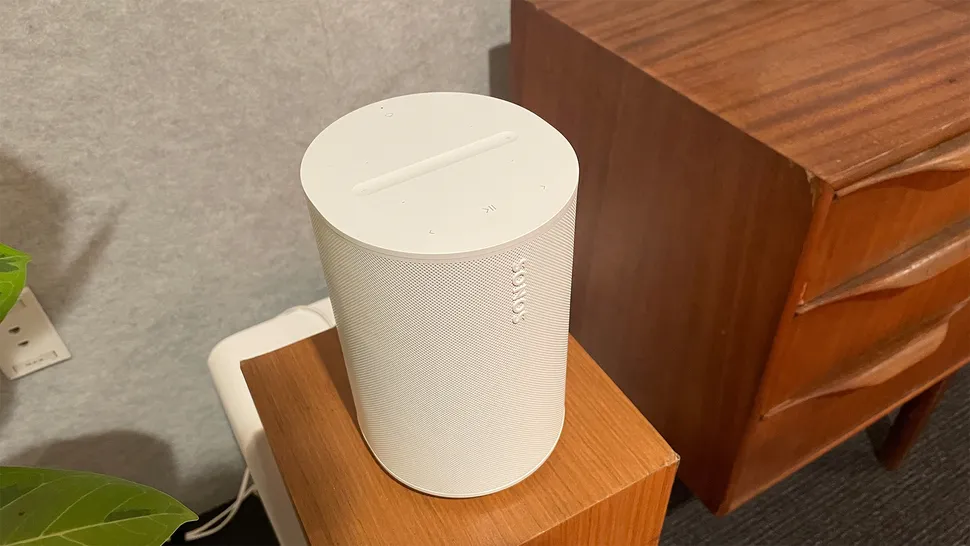
The Era 100 ditches the boxy look of the Sonos One and moves to a softer, more rounded shape. That sounds cosmetic on paper, but it matters in real rooms. The speaker looks less dated, fits more naturally on a shelf, and doesn’t shout for attention.
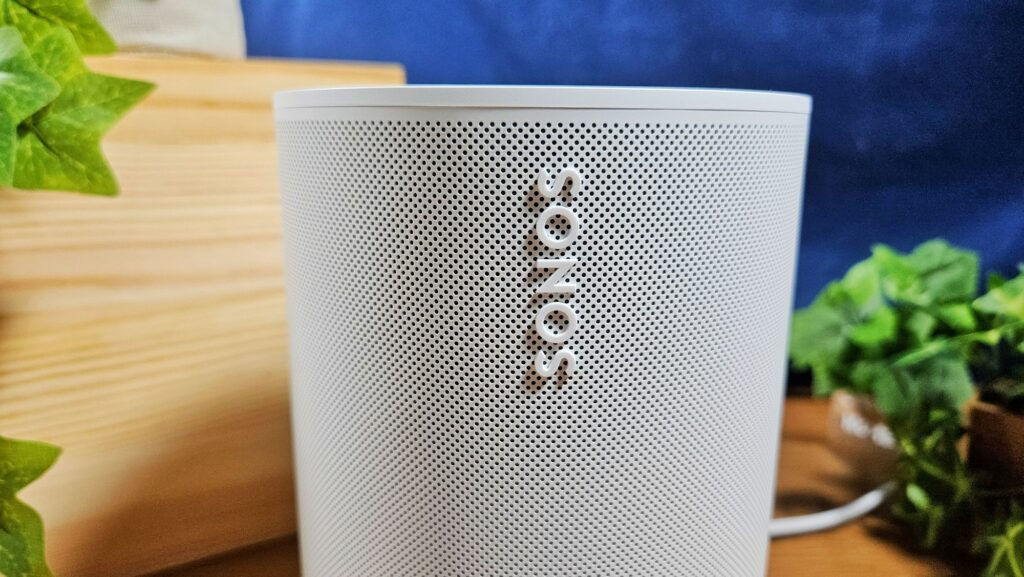
The matte finish and eco-friendly grille give it a polished feel without making it look fragile. It feels like something you can drop onto a sideboard, bookshelf, or desk and forget about until it starts playing. That’s a good thing.
What changed from the Sonos One?
The Sonos One was fine, but it always felt a little plain. The Era 100 looks more modern, and the hardware change is more important than the styling. Sonos added a second tweeter, a larger woofer, and a layout that supports stereo sound from one speaker.
That matters because you hear the upgrade every day. Voices sound more open, music has more room to breathe, and the speaker feels less like a single point in space. If you’re moving up from an older Sonos speaker, that shift is easy to notice.
How the controls and privacy features work
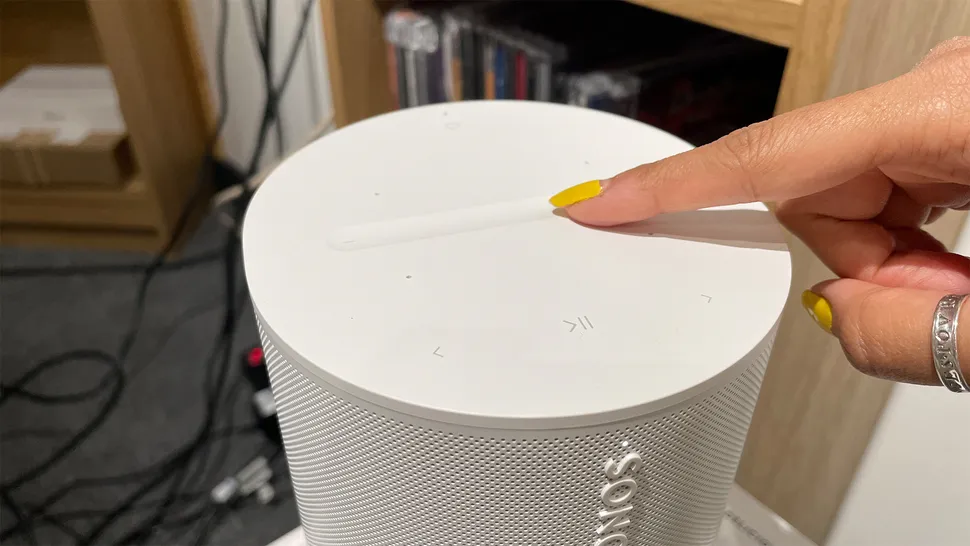
The controls are better thought out than before. You get touch controls on top, a swiping-style volume strip, a Bluetooth button on the back, and a physical microphone switch.
That last part is the one you’ll probably care about most. If you want the mics off, you can switch them off without digging through an app. The controls feel immediate, not fussy, and that makes a difference when you’re living with the speaker every day.
Sound Quality
This is where the Era 100 earns its place. It sounds bigger than its size, and that’s the whole trick. Sonos gave it a larger mid-woofer and two angled tweeters, so a single speaker can produce stereo sound without sounding cramped.
The bass is fuller than the Sonos One, but it doesn’t get sloppy. Mids are clean, which is why vocals land so well. Treble has enough detail to keep acoustic tracks and bright recordings from sounding dull. Put together, the soundstage feels wider than you’d expect from a compact speaker.
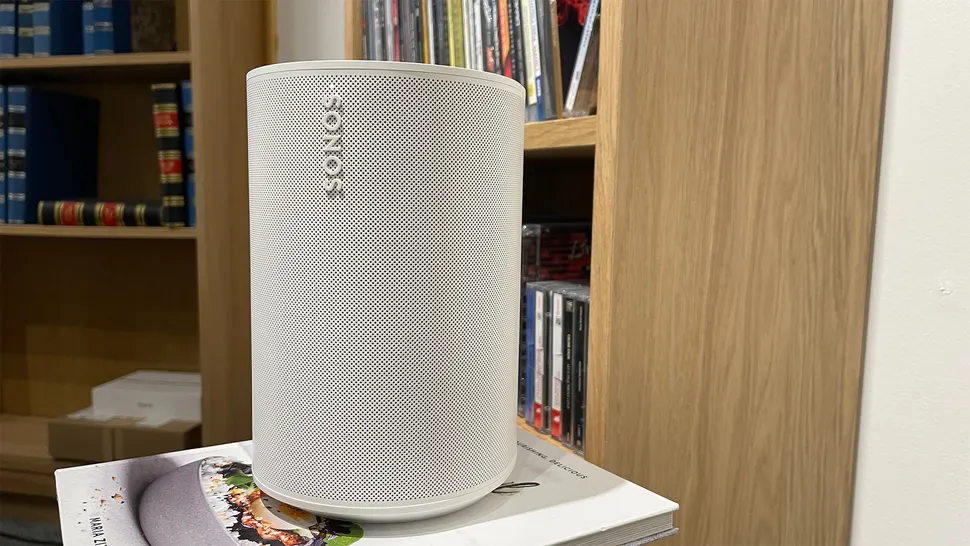
The best part is that it doesn’t collapse when you push it. At higher volume, it keeps its shape. Bass stays controlled, vocals stay intelligible, and busy tracks don’t turn into mush. That makes it a better fit for real listening, not just quick demos.
For a broader look at the speaker’s official positioning and owner feedback, Sonos has its own Era 100 reviews page.
How it handles bass-heavy songs and vocals
Low-end tracks have enough weight to sound satisfying, but they don’t swamp the rest of the mix. That gives you a nice middle ground. You get punch without bloat.
Vocals are the real highlight. They come through warm and clear, with enough body to sound natural. On layered tracks, the speaker keeps separation better than you might expect from something this small. It’s the sort of speaker that makes you notice detail without turning listening into homework.
Why Trueplay matters in your room
Trueplay is one of those features that sounds nice in theory and matters more once you use it. Your room changes the sound, whether you like it or not. Walls, furniture, corners, and open space all shape how the speaker behaves.
With tuning, the Era 100 adjusts better to the room you actually live in. iOS users get more precise tuning, while Android users get the simpler quick tuning mode. Either way, it helps balance the speaker so it doesn’t sound too boomy in one room and too thin in another.
Features
The Era 100 is more than a good-sounding box. The Sonos app pulls in major streaming services, supports speaker grouping, and gives you control over EQ and playback. That’s the core of the Sonos appeal, and it still works well here.
If you want to build a larger setup later, this is where the speaker starts making sense. You can group it with other Sonos speakers, use it in multi-room playback, or pair two units together for stereo. That kind of flexibility is part of the reason Sonos still has such a loyal following.
What you can do in the Sonos app
The app is where the speaker becomes a system. You can add music services, control volume, build rooms, and tweak EQ without much friction. It also makes it easy to grow into a bigger setup over time.
There is one catch. The Sonos app works best when you’re on the same home network, so it’s not the kind of speaker you casually manage from anywhere. For home use, that’s fine. For off-site control, it’s less useful.
Voice control and missing options
Sonos Voice Control is on board, and Alexa is supported too. That covers the basics well enough for music, volume, and simple smart-home tasks.
The missing piece is Google Assistant. If that’s your preferred assistant, the Era 100 is going to feel like a compromise. Sonos made a choice here, and it narrows the appeal for some homes. If you don’t care about Google Assistant, the loss is easier to live with.
Connectivity & Controls
The Era 100 gives you a few ways to play audio, and that’s one reason it feels more versatile than older Sonos models. Wi-Fi is the main route, Bluetooth is there when you want a quick connection, and AirPlay 2 is the obvious win if you’re deep into Apple gear.
Bluetooth is useful when you want the speaker to act like a simple standalone box. Wi-Fi is better for the full Sonos experience, including app control and multi-room playback. AirPlay 2 sits nicely in the middle for iPhone, iPad, and Mac users who want easy casting without thinking too hard.
If portability matters more than room-filling sound, you’re probably looking in the wrong place. In that case, best Bluetooth speakers on Oasthar is the better lane.
Bluetooth, Wi-Fi, and AirPlay 2 explained simply
Bluetooth is the easy mode. Wi-Fi is the richer mode. AirPlay 2 is the Apple-friendly shortcut.
That’s the cleanest way to think about it. The Era 100 doesn’t force you into one path, and that flexibility is a big part of its appeal.
Line-in for wired audio setups
The USB-C line-in option is handy, but there’s a catch, because you need a separate adapter. Once you have it, you can connect a computer or another audio source.
That opens up some useful setups, especially if you want a desk speaker or a wired backup option. Still, this is not the speaker’s natural home. It’s best when it’s doing Sonos things over Wi-Fi, not pretending to be a studio monitor.
Room Performance
The Era 100 works best in small to medium rooms where you can give it a little breathing space. On a shelf, side table, or cabinet, it sounds open and balanced. Put it too close to a wall and you can still make it work, but you’ll hear the room more than the speaker.
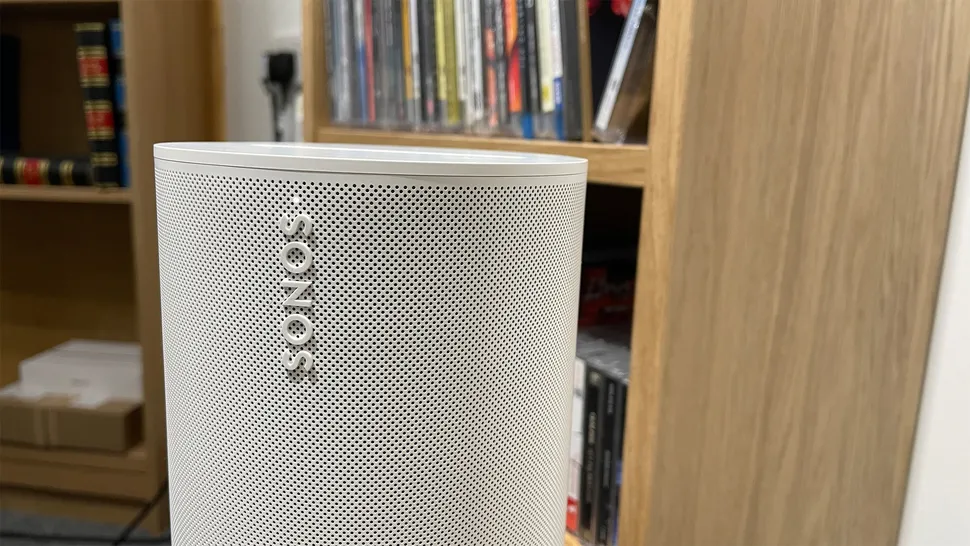
A single unit is enough for plenty of people. If you want strong music playback in a bedroom, office, kitchen, or compact living room, one speaker does a lot already. It fills space well and doesn’t sound thin or boxed in.
A pair makes sense when you want a bigger stereo image. Two Era 100 speakers give you better separation and a fuller front of room. That’s the move if you care about soundstage and have the budget to match.
Price & Value
Current US pricing sits around $199 to $219 for the standard Era 100, with the newer Era 100 SL sitting lower if you don’t need mics. That puts the speaker in a serious but still reachable spot for a premium compact speaker.
At this price, it has to justify itself against cheaper Bluetooth speakers and against the older Sonos One. It does. The sound is better, the hardware is better, and the feature set is stronger. It also feels more future-proof than the old model.
If you’re buying into Sonos for the first time, this is a much easier sell than a bigger, more expensive speaker. If you already have Sonos gear, it’s an easy way to add a room without messing up the rest of your setup.
Who is it for?
Buy if:
- You want a compact speaker with proper stereo sound.
- You already use Sonos and want an easy room addition.
- You care about clear vocals, fuller bass, and simple app control.
- You want Wi-Fi, Bluetooth, AirPlay 2, and multi-room support in one box.
Don’t buy if:
- You need Google Assistant.
- You want Dolby Atmos or spatial audio.
- You want a battery-powered speaker you can carry around.
- You only need a cheap casual Bluetooth speaker for occasional use.
That’s the clean split. If your priorities line up with home listening, the Era 100 makes sense. If you want portability or voice assistant flexibility, you should keep looking.
FAQs
What makes the Sonos Era 100 better than the Sonos One?
You get stereo sound, a larger woofer, extra tweeters, Bluetooth, USB-C line-in support, and a cleaner design. It’s a proper upgrade, not a light refresh.
Does the Sonos Era 100 sound good in a small room?
It sounds excellent in a small to medium room. You get rich bass, clear vocals, and a wide soundstage, though max volume can get a little compressed.
Can you use the Sonos Era 100 without Wi-Fi?
You can use Bluetooth or wired line-in with the right adapter, but the speaker is built around Wi-Fi and the Sonos app for full control and multi-room use.
Does the Sonos Era 100 support Google Assistant?
No, it doesn’t. You get Amazon Alexa and Sonos Voice Control instead, which is a real downgrade if you relied on Google Assistant before.
Is the Sonos Era 100 worth buying for the price?
It is, if you want a compact speaker with strong sound, easy setup, and Sonos multi-room features. If you want Dolby Atmos, you’ll need the Era 300.
Final Verdict
The Sonos Era 100 is an easy speaker to respect. It sounds bigger than it looks, the design feels more refined than the old Sonos One, and the setup is still as painless as Sonos usually makes it.
Its biggest weakness is not about sound, it’s about features. No Google Assistant and no Dolby Atmos will matter to some buyers. If those gaps don’t bother you, the rest of the package is strong.
For most people who want a compact home speaker with real audio quality, this is a smart buy. It fits small rooms well, works cleanly in a Sonos system, and gives you enough flexibility to stay useful for a long time.