

If your lawn has dry patches, thinning grass, or water pooling on top, you may be dealing with thatch buildup, and that’s exactly where the best lawn dethatchers can help.
Disclosure: As an independent reviewer, we may receive an affiliate commission on qualifying purchases made through our links. This helps support our research and testing team at OASTHAR. Learn more about our testing process.
Once that layer gets thick, your grass struggles to breathe. Water and fertilizer also have a harder time reaching the roots, so your lawn can look stressed even when you’re doing “everything right.”
This guide breaks down seven dethatchers for real needs, from compact walk-behind electrics to wide tow-behind units for big properties. You’ll see what each one does well, what to watch out for, and which type fits your yard.
RELATED: The 8 Best Cordless Hedge Trimmers for 2026: Expert-Reviewed, Compared, and Ranked
Best lawn dethatchers at a glance
- Best Overall: Sun Joe AJ805E
- Best Compact: YARDCARE Electric 2-in-1
- Best Powerful: BUCOTOD Lawn Dethatcher
- Best for Big Yards: Brinly 48-in
- Best Easy-Use: Sun Joe AJ801E
- Best Heavy-Duty: Agri-Fab 45-0295
- Best Budget: MZK 15-Inch
Learn more about how we test lawn dethatchers
In our assessment, you get the best results when a dethatcher matches your lawn size, thatch level, and tolerance for setup and cleanup. During testing, we found that small design choices (depth range, bag size, handle feel) often matter as much as raw power.
Lawn size and coverage per pass
Coverage comes down to working width and how well the tool keeps consistent contact with the ground. In testing, you want a machine that doesn’t force extra passes just to “get it all.” Wider tow-behinds save time fast, while 12 to 16-inch electrics can be the sweet spot for typical suburban lawns.
Thatch pickup and tine performance
A dethatcher is only as good as what it pulls up. We focus on tine design and how well the unit lifts matted debris without skipping. Spring-steel tines tend to keep steady contact, especially across uneven spots. With tow-behind models, tine flex and replaceability matter more because you’ll cover more ground.
Depth control and adjustability
Depth control is your main “aggression” dial. In testing, you want a range that supports light seasonal cleanup plus deeper work when the lawn feels spongy. More settings help, but only if changes are easy and repeatable. Poor depth control can mean either wasted time (too shallow) or stressed grass (too deep).
Power and user effort
For corded electrics, we look at motor strength on tough thatch and whether the machine bogs down. For tow-behinds, we look at how smoothly the frame rolls and whether the tines chatter or dig in. The goal is simple: you finish the job without feeling like you wrestled the tool the whole time.
Cleanup and storage
We test bag size, how often it clogs, and how annoying it is to remove and reattach. Foldable handles and compact storage matter more than most people expect, especially if you’re working out of a garage. A dethatcher you can store easily is one you’ll actually use on schedule.
Price and customer reviews
We shortlist dethatchers by researching major retailers and maker listings, then we compare specs against real-world feedback. We also analyze hundreds of customer reviews to see if performance matches promises, especially around durability and ease of assembly. This helps you avoid models that look great on paper but frustrate owners over time.
For a helpful explainer on what thatch really is (and what people often get wrong), see Wisconsin Horticulture’s guide to thatch management.
Star rating: 4.8 / 5
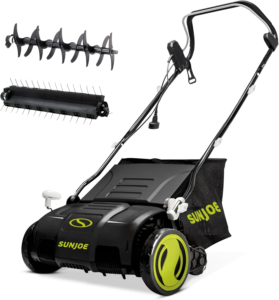
This is the “most people should start here” pick. The AJ805E’s superpower is balance: strong corded power, a wide working path, and a setup that stays simple. You get the feel of a serious lawn tool without the extra hassles that can come with heavier, more specialized machines.
Power comes from a 13-amp motor, and you clear a 15-inch path per pass. That width helps you move across the yard at a steady pace, instead of inching along. It also runs as a true two-in-one machine, so you can dethatch to pull up buildup, then switch to scarifying when you want to encourage thicker growth.
Depth control is another reason it lands at #1. You get a five-position setup with separate ranges for dethatching and scarifying, so you can stay conservative on a stressed lawn, then get more aggressive when conditions call for it. Air boost technology (spring steel tines) aims to keep pickup consistent, which matters when the lawn isn’t perfectly level.
Power: 13-amp corded | Width: 15-inch | Depth (dethatch): 0 to 0.4 in | Depth (scarify): -0.4 to 0 in | Bag: 13.2-gallon
Reasons to Buy
- Strong “do-it-all” balance
- Two-in-one dethatch, scarify
- Wide 15-inch working path
- Five-position depth control
- Low-maintenance corded power
Reasons to Avoid
- Cord management takes planning
- Bagging adds stops on heavy thatch
Who should buy it: If you want one machine that covers most lawns well, this is the easy choice. It fits small to mid-sized yards best, especially when you want noticeable results without moving up to a tow-behind system. You can check the manufacturer listing for the AJ805E on Sun Joe’s official product page.
Star rating: 4.6 / 5
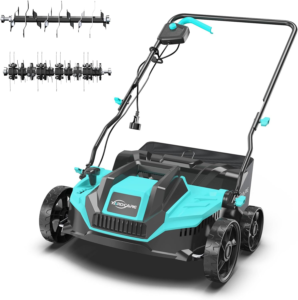
If you want something that stores easily and maneuvers around obstacles, YARDCARE’s compact approach makes a lot of sense. The superpower here is simple: it stays small enough for tight areas, but it doesn’t feel underpowered when you actually start pulling debris.
You get a 14-inch working width, which is a sweet spot for narrow side yards, fenced corners, and lawns with lots of landscaping. Even with that smaller footprint, the motor is rated at 13 amps with up to 3,600 RPM, so it’s still built to dig in and lift thatch instead of just combing the surface.
The depth ranges also give you precision. Scarifying runs from -0.47 inches to -0.12 inches, while dethatching runs from -0.24 inches to 0.39 inches. That spread helps you fine-tune seasonal maintenance, especially if parts of your lawn are thinner or more sensitive than others.
Cleanup stays manageable with a 10.5-gallon collection bag, and the wheel setup (7-inch front wheels, 5.5-inch rear wheels) helps stability as you push. Small details like tool-free knobs and a foldable handle matter more on compact machines because you’re likely storing it in a tight garage spot.
Power: 13-amp corded | Speed: up to 3,600 RPM | Width: 14-inch | Bag: 10.5-gallon | Depth ranges: separate scarify and dethatch
Reasons to Buy
- Easy to maneuver in tight areas
- Strong motor feel for size
- Separate depth ranges for tasks
- Foldable handle for storage
Reasons to Avoid
- Smaller bag fills faster
- Not as fast as 48-inch tow-behinds
Who should buy it: This fits you if your yard is small, segmented, or full of obstacles. It’s also a smart choice if you want a two-in-one unit but don’t want a bulky machine taking over your storage space. A common first-timer mistake is going too deep right away. Start conservative, then step down only if the lawn still feels spongy after a pass.
Star rating: 4.5 / 5
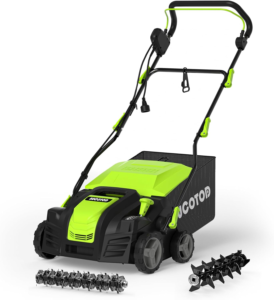
If your lawn has stubborn thatch and you want a corded unit that feels “all muscle,” BUCOTOD is the pick. Its superpower is raw electric strength paired with wide coverage, so you can work aggressively without shrinking your pace.
It runs a 15-amp copper motor that reaches up to 3,500 RPM, which helps when you hit thicker mats of dead material. Combine that with a 16-inch rake path, and you’re clearing a wider strip per pass than many walk-behind electrics. In practice, that saves time while still keeping the tool manageable.
Like several top picks here, it’s a true two-in-one. You can swap blades to switch between dethatching and scarifying. That flexibility matters when your lawn needs more than cleanup. Some seasons are about pulling debris, while others are about encouraging thicker growth by working closer to the soil line.
Depth adjustment runs across five positions, ranging from -0.47 inches to 0.4 inches. That gives you room to stay gentle on thin areas, then get more aggressive where thatch is clearly blocking water. A 55 L collection bag helps reduce cleanup runs, and dual safety switches add peace of mind. The handle adjusts in three positions, which helps if you’re taller or shorter and want better control.
Motor: 15-amp copper | Speed: up to 3,500 RPM | Width: 16-inch | Depth: -0.47 to 0.4 in | Bag: 55 L
Reasons to Buy
- Strong 15-amp motor feel
- Wide 16-inch coverage
- Two-in-one blade setup
- Large 55 L bag capacity
Reasons to Avoid
- Corded use needs planning
- Aggressive settings can stress thin grass
Who should buy it: This makes sense when you have a medium yard with heavy thatch and you want faster progress per pass. It’s also a good fit if you like dialing in depth and treating problem areas differently from the rest of the lawn. For practical guidance on managing thatch (and when it’s actually a problem), Penn State offers a clear primer in Managing Thatch in Lawns.
Star rating: 4.4 / 5
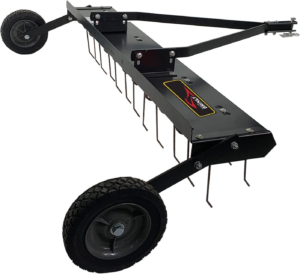
Brinly’s tow-behind dethatcher is about one thing: coverage. The superpower is speed across large lawns, because you let your mower do the pulling while the dethatcher handles the raking. If you’ve ever tried to push a walk-behind across a big yard, you already know why this style exists.
You get a full 48-inch working width, so each pass clears a wide lane. Once it’s hitched to your riding mower or lawn tractor, you cut your total time by reducing overlaps. It uses 24 triple-coil spring steel tines (3/16-inch diameter), arranged in two rows. Each tine flexes independently, which helps it keep contact even when the lawn dips or bumps.
Durability matters more on tow-behinds because they see more yard time. The all-steel frame is built for repeated seasonal use, and the 8-inch Never-Flat transport wheels sit in line with the tray to help balance and leveling. There’s also a safety rod designed to catch a tine if one breaks, which is a small detail but a reassuring one.
You’ll still need to think about your lawn’s condition and timing. Tow-behinds can cover so much ground that it’s easy to overdo it in one session if you set the tines too aggressively. Start lighter, then increase only if you need it.
Type: tow-behind | Width: 48-inch | Tines: 24 triple-coil spring steel | Wheels: 8-inch Never-Flat | Frame: all-steel
Reasons to Buy
- Huge 48-inch coverage
- Minimal physical pushing
- Flexing tines track uneven ground
- Durable steel construction
Reasons to Avoid
- Needs a riding mower or tractor
- Storage space required
Who should buy it: This is for you if you maintain a large property and want to finish dethatching in a fraction of the time. It’s also a great match if you already own a riding mower and prefer tow-behind tools. You can verify current details on Brinly’s official DT-48BH product page.
Star rating: 4.3 / 5
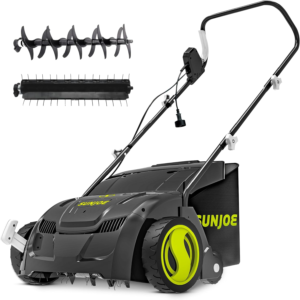
If you want corded simplicity with a proven design, the AJ801E keeps lawn care straightforward. Its superpower is clean, consistent pickup in a compact electric unit, especially when you want a plug-in tool that avoids gas hassles altogether.
It runs a 12-amp motor and clears a 12.6-inch path per pass. That’s narrower than the AJ805E, so it can take longer on larger lawns. On the other hand, that smaller width can feel more controllable around edges and tighter areas. You also get air boost technology with 27 spring steel tines, which helps lift embedded thatch without endless repeat passes.
Depth control covers five positions, ranging from -0.4 inches to 0.4 inches, so you can tune how aggressive the tool feels. Another key point is that it includes both a dethatching cylinder and a scarifying cylinder with 20 slicing blades, so it’s not just about pulling debris. You can also switch over and encourage thicker growth under the surface.
Cleanup is handled by a detachable 8-gallon collection bag. That size is fine for light seasonal work, but if your lawn has years of buildup, expect frequent emptying. Still, the overall routine stays simple: plug in, set depth, make passes, and bag the debris.
Power: 12-amp corded | Width: 12.6-inch | Tines: 27 spring steel | Depth: -0.4 to 0.4 in | Bag: 8-gallon
Reasons to Buy
- Simple corded start-and-go use
- Two cylinders included
- Strong pickup with spring tines
- Good control for small yards
Reasons to Avoid
- Narrower path takes longer
- Smaller bag needs more stops
Who should buy it: This fits you if you want a lighter-duty, no-fuss electric dethatcher for routine maintenance. It also works well if you prefer a narrower machine that’s easier to guide around landscaping. If you’re trying to choose between Sun Joe’s popular models, this side-by-side breakdown can help: Sun Joe AJ805E vs AJ801E comparison guide.
Star rating: 4.1 / 5
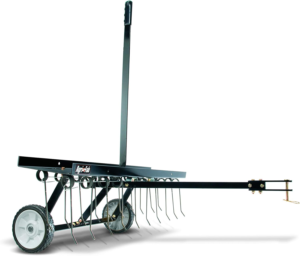
Agri-Fab’s heavy-duty tow dethatcher is built for property owners who want rugged parts and wide coverage. The superpower is durable tine construction paired with a wide working width, so you can treat large areas efficiently while still digging into the layer that’s holding your grass back.
It uses 24 heat-treated spring steel tines that are rust-proof and replaceable. That replaceable design matters because tow units do a lot of work, and tines are a wear item. The job here isn’t just surface scratching. It’s lifting dead, matted grass and loosening hard-packed spots enough to improve airflow and water absorption.
The working width is 48 inches, which is why it’s a serious time-saver on big lawns. You hook it to a lawn or garden tractor and let the machine cover ground. It also includes a transport handle so you can raise and lower the tines while moving across driveways and sidewalks. That small convenience saves wear and reduces frustration.
For rolling comfort, it uses 7-inch semi-pneumatic wheels to glide over uneven terrain. It’s also made in the USA and backed by a 3-year limited warranty, which is a strong signal for long-term ownership.
Type: tow-behind | Width: 48-inch | Tines: 24 heat-treated spring steel | Wheels: 7-inch semi-pneumatic | Warranty: 3-year limited
Reasons to Buy
- Replaceable, heavy-duty tines
- Wide 48-inch pass coverage
- Handy transport handle
- Long 3-year warranty
Reasons to Avoid
- Requires a towing mower/tractor
- Can feel like overkill for small lawns
Who should buy it: This is a good fit if you maintain a large yard or acreage and care about durability. It’s also ideal if you want replaceable tines and a long warranty, so you can plan on using it season after season. If you want a deeper look at how this model is built, see this third-party write-up: Agri-Fab 45-0295 review and breakdown.
Star rating: 3.9 / 5
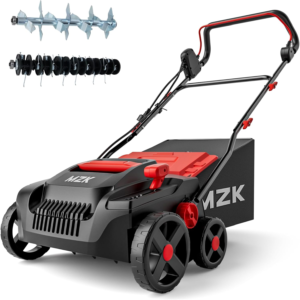
If you want a budget-friendly corded option that still includes the features people actually use, MZK’s 15-inch model stands out. The superpower is value: solid motor speed, a wide pass, and adjustable depth, without stepping up to premium pricing tiers.
It runs on a copper motor rated up to 3,700 RPM, and that speed helps when you roll into thicker thatch. The working width is 15 inches, which is plenty for most small to mid-sized yards. You’ll make steady progress without needing a huge machine.
Depth adjustment ranges from -0.47 inches to 0.24 inches, which gives you useful control. Shallow settings work for routine seasonal cleanup, while deeper settings help with compacted spots and heavier buildup. It also has a quick-switch two-in-one blade system, so you can move between dethatching and scarifying without tools.
A 45 L collection bag lets you run longer before emptying, and the machine is listed at 27.5 lb, so it’s easier to steer than heavier units. Storage is simpler too because the handle folds. Dual safety switches help prevent accidental starts, which is a nice touch for a value pick.
Speed: up to 3,700 RPM | Width: 15-inch | Depth: -0.47 to 0.24 in | Bag: 45 L | Weight: 27.5 lb
Reasons to Buy
- Strong value for the feature set
- Wide 15-inch working path
- Useful depth range for the price
- Foldable handle, easier storage
Reasons to Avoid
- Budget build feel vs premium units
- Bag still fills quickly on heavy thatch
Who should buy it: This fits you if you want a capable corded dethatcher without paying extra for a brand name. It’s also a smart pick if you only dethatch once or twice a year and want something lightweight and easy to store.
All recommended picks compared
Here’s a fast side-by-side to help you match the tool to your yard and your patience level.
| Product | Best for | Type | Working width | Power/drive |
|---|---|---|---|---|
| Sun Joe AJ805E | Most lawns, most people | Corded walk-behind | 15 in | 13-amp electric |
| YARDCARE Electric 2-in-1 | Tight spaces and small yards | Corded walk-behind | 14 in | 13-amp electric (up to 3,600 RPM) |
| BUCOTOD Lawn Dethatcher | Heavy thatch, faster passes | Corded walk-behind | 16 in | 15-amp electric (up to 3,500 RPM) |
| Brinly 48-in | Large lawns | Tow-behind | 48 in | Tractor/mower tow |
| Sun Joe AJ801E | Simple seasonal maintenance | Corded walk-behind | 12.6 in | 12-amp electric |
| Agri-Fab 45-0295 | Big coverage, heavy-duty build | Tow-behind | 48 in | Tractor/mower tow |
| MZK 15-Inch | Budget-friendly electric option | Corded walk-behind | 15 in | Electric (up to 3,700 RPM) |
Takeaway: if you want the easiest “one and done” choice, go AJ805E. If your yard is large enough to justify tow-behind, the 48-inch units make the work feel dramatically shorter.
For current lawn maintenance timing and planning, this broader reference from Extension educators is also useful: Alabama Extension home lawn maintenance guide.
What to look for in a lawn dethatcher
Pick the right width first
Working width sets your pace. A 12.6 to 16-inch walk-behind is practical for many suburban lawns. If you maintain a large property, a 48-inch tow-behind changes the whole job because you finish in fewer passes. Wider isn’t always better, though. Tight gates, trees, and odd shapes can make a smaller deck easier to live with.
Decide between walk-behind and tow-behind
Walk-behind electric models keep setup simple. You plug in, set depth, and go. Tow-behinds require a riding mower or tractor, plus storage space. In exchange, you trade pushing effort for towing, and you cover a lot more ground per minute.
Make depth control non-negotiable
Depth is how you protect your grass while still getting results. Look for clear ranges and multiple settings. In real use, you’ll often start shallow and step down slowly. A good depth system feels predictable, not vague. Separate depth ranges for dethatching and scarifying are a bonus when you want more control.
Understand dethatching vs scarifying
Dethatching focuses on lifting the thatch layer. Scarifying cuts closer to the soil to encourage growth patterns that can thicken turf. Two-in-one machines let you choose the approach based on your lawn condition. If you only want seasonal cleanup, dethatching alone may be enough. If you’re trying to improve density, scarifying can be the extra push.
If you want another plain-English explanation of thatch and when to manage it, Penn State’s guide is worth a read: how to manage thatch in lawns.
Pay attention to cleanup and bag size
Bags keep cleanup cleaner, but they also add stops. Smaller bags fill quickly in heavy thatch, while larger bags can extend your run time. Also consider how easy the bag is to remove and reattach. If it’s annoying, you’ll dread using it.
Don’t ignore safety and comfort details
Dual safety switches help prevent accidental starts. Adjustable handles matter more than you’d think, because dethatching is a push-and-walk job. Better ergonomics can mean straighter passes and less fatigue. Wheels also matter. Larger wheels usually track bumps more smoothly.
Check warranty and parts availability
Tow-behind tines wear over time, so replaceable tines are a real advantage. Warranties vary by model and brand, so confirm current terms before you buy. A longer warranty can be meaningful if you dethatch large areas every season.
Why Trust OASTHAR?
I’m Shashini Fernando, an associate editor who specializes in consumer product research across home tools, outdoor equipment, and practical tech. You’re not getting a single-person opinion here. Each pick is shaped by in-house evaluation and by analyzing hundreds of customer reviews from real users across the lawn dethatcher market.
You also benefit from how we build lists. We research major retailers and maker listings, compare published specs, then pressure-test those claims against what owners report after weeks and months of use. That’s how this 2026 list stays grounded in what actually works.
Best Lawn Dethatchers FAQs
What is the best lawn dethatcher overall?
The Sun Joe AJ805E is the best overall choice for most people. You get a strong 13-amp motor, a 15-inch working width, two-in-one capability (dethatch and scarify), and useful depth control.
How do you know you have too much thatch?
If water sits on top of the lawn, the turf feels spongy, or grass thins out even with regular care, thatch may be blocking airflow and moisture. For a deeper explanation, see Wisconsin Horticulture’s thatch management article.
Do you need to dethatch every year?
Not always. Some lawns build thatch quickly, others don’t. Your mowing habits, grass type, and growth rate all play a role. If you’re pulling up lots of debris every time, plan on seasonal maintenance. If not, you may only need it occasionally.
Is a tow-behind dethatcher better than an electric one?
It’s better for coverage, not always for control. Tow-behinds (like Brinly and Agri-Fab) shine on large lawns because you cover 48 inches per pass. Electric walk-behinds shine when you need precision, tighter turns, and easier storage.
What’s the difference between dethatching and scarifying?
Dethatching lifts dead material from the layer above the soil. Scarifying cuts into the surface more, which can encourage thicker growth patterns. Two-in-one machines let you choose what the lawn needs that season.
Final Verdict
If you want the safest recommendation, choose the Sun Joe AJ805E because it blends power, coverage, and control in a way that suits most lawns. For tight spaces, the YARDCARE Electric 2-in-1 stays easy to handle while still feeling strong. If you’re fighting stubborn buildup, BUCOTOD brings the most aggressive electric posture of the group.
For large properties, skip the push work and go tow-behind. The Brinly 48-in is the clean “big coverage” pick, while the Agri-Fab 45-0295 focuses on heavy-duty tine construction and long-term use. If your budget is tight but you still want real features, the MZK 15-Inch is the value move, as long as you pace yourself and use depth control wisely.
Your lawn improves fastest when you match the tool to your reality, your yard size, your storage space, and how much effort you want to spend.