

If you’re staring at an electric grill and thinking, do electric grills use a lot of electricity, you’re not alone. They can pull a lot of power in the moment, but the total cost is usually small because most cooks are short.
Here’s the quick answer: most electric grills cost about $0.15 to $0.40 per hour to run, and many weeknight cooks land closer to a quarter or two in electricity. What changes the number is your grill’s wattage, how long you cook, and your local rate per kWh.
As of Feb 2026, the average US residential electricity rate is about 17.8 cents per kWh, but your rate can be much higher or lower depending on your state and utility.
RELATED: The 7 Best Electric Grills for 2026, Tested and Reviewed
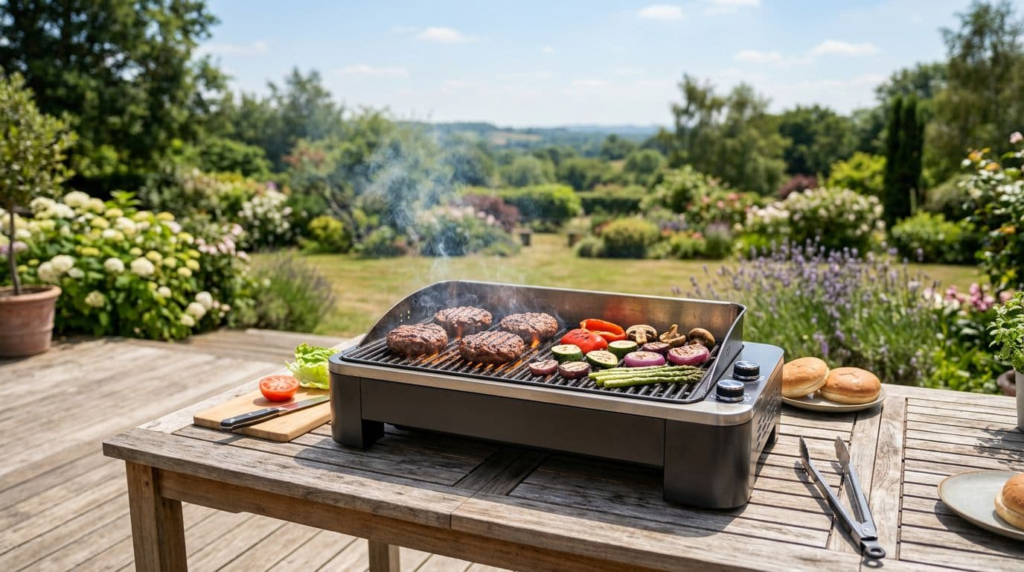
Electric grill power consumption made simple
Electric grills feel mysterious because the spec label shouts a big number like 1,800 watts. In practice, it’s simpler than it looks.
Watts are just the speed of energy use. A 1,800-watt grill uses energy faster than a 1,200-watt grill, the same way a wide-open faucet fills a bucket faster than a half-open one. However, your bill depends on the total water that flowed, not the faucet size. In other words, cook time usually matters more than the headline wattage.
To ground it in everyday stuff, lots of electric grills sit in the same neighborhood as common high-draw appliances:
- A hair dryer often runs around 1,500 watts on high.
- A typical space heater is often 1,500 watts.
- A countertop toaster oven can land in that same range, too.
So yes, an electric grill can draw “a lot” compared to a phone charger. Still, it’s not unusual compared to other heat appliances you already use without thinking.
Another helpful detail is that most electric grills don’t run at full blast the entire time. They cycle. The heating element turns on hard to preheat, then it kicks on and off to hold temp. That’s why a 1-hour cook rarely behaves like 60 straight minutes at max power, even though using the rated wattage is a safe way to budget.
If you’re shopping and want a sense of what’s normal (and what’s overkill), reviews and roundups help you spot the usual wattage bands and features side by side. One solid starting point is tested electric grill picks, since it gives you recognizable models to compare.
Typical wattage ranges you will see when shopping
Most electric grills fall into a few buckets:
- 1,200W to 1,500W: Common for portable and indoor grills. Many George Foreman style indoor grills live here, and they’re great for quick chicken, veggies, and burgers.
- Around 1,800W: A very common “full-power on a standard outlet” target for indoor-outdoor electric grills.
- Up to about 2,400W: High-performance outdoor electrics. For example, the Ninja Woodfire is commonly listed around 2,400W in its specs, and that extra headroom can help with heat recovery.
Also, some well-known grills don’t sit at 1,800W. The full-size Weber Lumin is often listed around 2,200W, while smaller versions can be lower. The main point: check the label.
Higher wattage can mean faster preheat and quicker bounce-back after you add cold food. It’s not automatically “more expensive,” though. If a hotter grill finishes the job sooner, your total energy can come out similar.
The 80% rule: will your grill trip a breaker?
Power is only half the story. Your outlet and circuit matter, too.
Most US outlets are 120V, and the basic math is:
Amps = Watts ÷ Volts
So:
- 1,800W ÷ 120V ≈ 15 amps
- 2,400W ÷ 120V ≈ 20 amps
Here’s the catch: a 15-amp circuit isn’t meant to run at 15 amps nonstop. A common guideline is the “80% rule,” meaning you try to keep continuous loads to about 80% of the breaker rating.
That’s why an 1,800W grill can be touchy on a busy circuit. If the grill shares power with a microwave, toaster oven, or space heater, the breaker might pop.
If your grill is rated over about 1,800W, plan on a dedicated 20-amp circuit if possible. At the very least, don’t share the outlet with other high-draw devices.
If your grill is near the limit of a 15A circuit, the cheapest “upgrade” is often just using a different outlet on a less crowded circuit.
The cost breakdown you can do in 30 seconds
You don’t need a smart plug or an app to estimate cost. You just need wattage, time, and your electricity rate.
Use this exact formula:
(Wattage × Hours Used ÷ 1000) × Electricity Rate = Total Cost
For the sample math below, use the Feb 2026 US average rate: $0.178 per kWh. Then swap in your own number. If you want a quick state-by-state reference point, electricity rates by state make it obvious how wide the spread can be.
Plug-and-play cost formula
Let’s say you have an 1,800W electric grill, and you cook for 45 minutes.
- Convert minutes to hours:
45 minutes = 0.75 hours - Convert watts to kW and multiply by time:
1,800W × 0.75 ÷ 1000 = 1.35 kWh - Multiply by your electricity rate:
1.35 kWh × $0.178 = $0.24
So that cook costs about 24 cents at the national average rate.

Yes, your grill’s heating element cycles on and off, so the true number may be a bit lower. Still, using the rated wattage gives you a simple, “worst-case-ish” budget number. It’s easy, and it keeps you from underestimating.
Comparison table: 30-minute burgers vs 1-hour steak sear
Here’s what the same math looks like across a few common sessions.
| Scenario | Wattage | Time | kWh used | Cost at $0.178/kWh | Cost range at $0.12 to $0.32/kWh |
|---|---|---|---|---|---|
| 30-minute burger session | 1500W | 0.5 hr | 0.75 kWh | $0.13 | $0.09 to $0.24 |
| Typical cook | 1800W | 1 hr | 1.8 kWh | $0.32 | $0.22 to $0.58 |
| 1-hour steak searing session | 2400W | 1 hr | 2.4 kWh | $0.43 | $0.29 to $0.77 |
The takeaway is pretty straightforward: even a powerful electric grill is usually well under $1 per cook, unless you’re cooking for a long time or you live where electricity is expensive.
Electric vs propane vs charcoal: which is cheapest for a normal cookout?
For a normal 1-hour cook for four people, electric is often the cheapest on fuel alone.
A practical per-session estimate looks like this:
- Electric: about $0.50 to $1.00
- Propane: about $1.50 to $3.00
- Charcoal: about $2.00 to $5.00
Those ranges move with local prices, grill size, and how you cook. Still, the pattern holds. Electric heat is usually more direct, and you waste less of it. As a result, electric can come out 4 to 5 times cheaper than propane and up to 10 times cheaper than charcoal for the same “feed a small group” session.
If you want a broader perspective on how fuel types differ in real cooking, not just cost, this guide on charcoal vs gas choices does a good job explaining what you trade for flavor and control.
Where the money really goes: preheat time and wasted heat
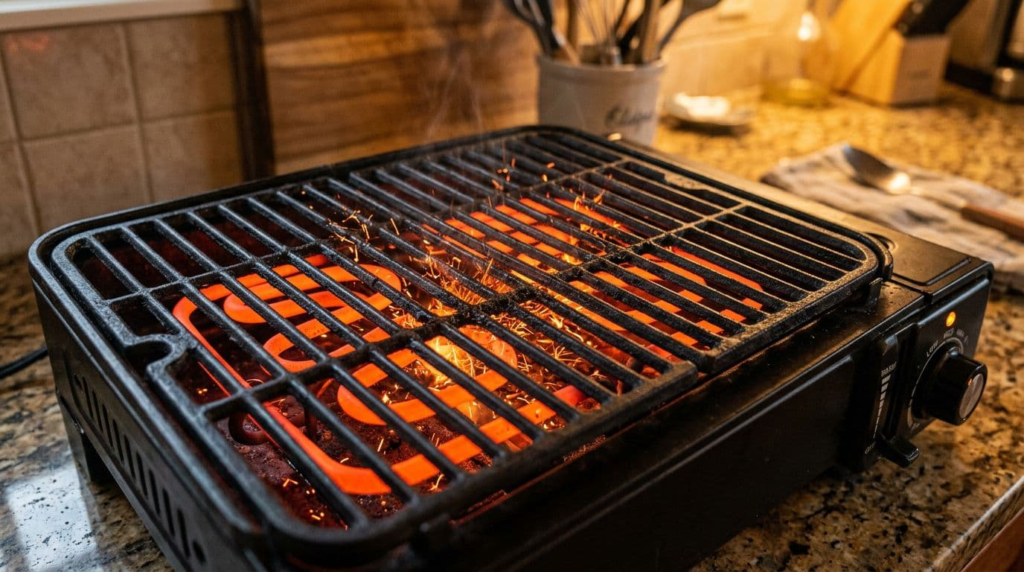
The sneaky cost driver is time spent not cooking food.
Charcoal often takes 20 to 40 minutes to get ready, and it bleeds heat into the air the entire time. Propane is faster, but it still dumps a lot of heat around the box and out the vents.
Electric grills tend to preheat in about 10 to 15 minutes, then they hold a steady temp with less fiddling. That control matters. When the grill doesn’t overshoot and undershoot, you finish faster and open the lid less.
Also, lid habits hit every fuel type. If you flip and peek constantly, cook time goes up. Charcoal and propane feel it more because they keep throwing heat into the air whether food is ready or not.
When electric is not the cheapest option
Electric doesn’t always win. A few real-world cases can tilt the math:
- Very high electricity rates: If you’re paying well above the national average, each hour costs more. Parts of California can run high, for example local rate snapshots like San Dimas, CA show how different your bill can look by region.
- Very long low-and-slow cooks: Electric grills can handle longer cooks, but hours add up. A six-hour session is a different budget than burgers.
- Cheap propane access: If you already own tanks and you refill at good prices, propane can stay competitive, especially if you grill often.
Best value depends on your habits. If you grill twice a week for 30 to 60 minutes, electric usually looks great.
Are electric grills energy efficient and what about the environment?
You might also be wondering, are electric grills energy efficient compared to flame grills. In day-to-day use, they often are, mostly because they waste less heat and they control temperature better.
That said, efficiency is not the same as climate impact. Your carbon footprint depends on where your electricity comes from, and whether you use renewable power at home. Still, better control can mean shorter cooks, less burning, and fewer do-over meals.
From a pure user angle, this is the win: consistent heat makes your cook more predictable, and it can reduce total electric grill power consumption because you spend less time chasing temperature.
One more reality check: electricity prices are under pressure in many places due to grid upgrades and rising demand. If you want context on why bills may not drop soon, this 2026 utility pricing outlook explains the trend in plain terms.
Why electric heat often wastes less energy than flame
With a flame grill, a lot of heat rushes past the food and out of the grill body. You get hot spots and cooler zones, so you tend to move food around and keep the fire running longer.
Electric models push heat into the grate and cooking surface more directly. Some use infrared-style elements to concentrate heat even more. You also get tighter temperature control, which helps you avoid overcooking. Less overcooking often means less total time, and less time means less energy.
If you have solar or a cleaner grid, electric grilling can be the greenest choice
If your home runs on solar, or your utility has a cleaner mix, electric grilling can be a strong option. You can also shift cooking to times when your solar is producing. Even without solar, choosing electric over charcoal avoids burning solid fuel, smoke, and ash right where you live.
5 practical ways to cut your electric grilling cost even more
You don’t need to treat grilling like a science project. A few habits cut time, and time is what your meter cares about.
- Preheat with a purpose: Don’t preheat for 20 minutes out of habit. Start with the manual’s suggestion, then adjust based on results.
- Pick the right power level: Full blast is great for searing, but it’s overkill for fish or veggies once the grill is hot.
- Use a simple thermometer: Pulling food at the right temp prevents extra minutes “just to be safe.”
- Keep the grill clean: Grease and buildup can cause flare-ups on some designs and slow heat transfer on others.
- Match grill size to your household: A huge grill for two people often means longer preheat and more recovery time after opening.

Your no-waste routine: lid down, smart prep and using residual heat
This is the routine that pays off fast.
Keep the lid down as much as you can. Every lid lift is like leaving the fridge door open, the system works harder to recover.
Next, do a little prep before you plug in. If it’s safe, let food sit out for about 20 minutes so it’s not ice-cold. Don’t leave meat out much longer than that.
Avoid overcrowding, too. A packed grate drops the temp, then your grill spends extra minutes climbing back.
Finally, use residual heat. Turn the grill off a couple minutes early and let carryover heat finish the job. For thick items, cook in batches by thickness so you’re not holding the grill on high while waiting for one piece to catch up.
Troubleshooting: why your electric grill trips the breaker
If your electric grill trips a breaker, it doesn’t always mean something’s broken. High draw is normal. The usual problem is the setup.
Start with the basics. Plug the grill directly into a wall outlet, and try a different outlet if you can. If it runs fine elsewhere, you were probably on a shared circuit.
Also check the grill’s plug and cord for damage. If you see melting, scorching, or cracking, stop using it and contact the manufacturer.
If breakers trip repeatedly even on a dedicated outlet, that’s the point to call a licensed electrician. Don’t keep resetting and hoping.
Overloaded circuits, GFCI outlets and extension cord mistakes
Most trips happen for three reasons:
First, the circuit is overloaded. Don’t run your grill on the same circuit as a toaster, coffee maker, microwave, or space heater.
Second, outdoor outlets are often GFCI protected. They can nuisance-trip if there’s moisture, a worn outlet, or a sensitive device. Test on a different GFCI outlet if possible, and keep connections dry.
Third, extension cords cause trouble. Thin indoor cords heat up and drop voltage, which can increase current draw and trigger trips. Only use a heavy-duty 12-gauge, outdoor-rated extension cord if the manufacturer allows it, and keep it as short as possible.
If your grill is near 1,800W or higher, treat it like a space heater, it deserves its own outlet.
Do Electric Grills Use a Lot of Electricity FAQs
How much does it cost to run an electric grill for an hour?
Most grills land around $0.15 to $0.40 per hour, depending on wattage and your kWh rate.
How much electricity does a 1500W electric grill use?
At full power, 1,500W for 1 hour uses 1.5 kWh. Multiply by your rate to get cost.
Will an electric grill raise your electric bill a lot?
Not usually. A couple cooks per week often add only a few dollars a month.
Can you use an extension cord with an electric grill?
Only if your manual allows it. Use a short 12-gauge outdoor cord, not a thin indoor cord.
Do electric grills sear as well as gas?
Some do, especially higher-power models, but many struggle with crust compared to a strong gas burner.
Conclusion
Electric grills can draw a lot of power in the moment, but your total cost stays low because cook times are usually short. For most people, you’ll see roughly $0.15 to $0.40 per hour, and a typical cook often lands around $0.20 to $0.60 depending on wattage and your local rate.
Use the simple formula, plug in your grill’s wattage, your cook time, and your kWh price, then you’ll have a number you can trust. In day-to-day use, electric is often the cheapest long-term way to grill, especially for weeknight meals where speed matters.
One last safety note: if your grill is 1,800W or higher, give it a proper outlet and avoid shared circuits.