

If you’re hunting for the best indoor electric grills for apartments, you’re probably juggling the same problem every renter and condo owner knows. Your building bans open flames, but you still want real grill flavor.
Disclosure: As an independent reviewer, we may receive an affiliate commission on qualifying purchases made through our links. This helps support our research and testing team at OASTHAR. Learn more about our testing process.
That tension is why indoor electric grills got so good by 2026. You’re seeing more infrared-style heat, tighter lids, and smarter smoke control that keeps grease from burning.
One quick truth, though: “smokeless” doesn’t mean “no air.” It usually means less burnt grease smoke, but you’ll still get steam and normal cooking vapors.
RELATED: The 7 Best Electric Grills for 2026, Tested and Reviewed
Best indoor electric grills at a glance
- Best Overall: Weber Q 1400 Electric Grill
- Best with Smart Features: GE Profile Smart Indoor Smoker
- Best for Small Kitchens: Ninja Sizzle Smokeless Indoor Grill and Griddle
- Best Multi-Tasker: Ninja Foodi Smart XL 6-in-1 Indoor Grill
- Best Budget: Hamilton Beach Electric Indoor Searing Grill
- Best Luxury: Breville The Smart Grill
How we test indoor electric grills for apartment life
In our assessment, you get the most useful “best” list when you mix real specs with real kitchens, then cross-check everything against what hundreds of owners report after the first week.
We shortlist indoor electric grills by researching major retailers (Amazon, Walmart, Target, and Currys), comparing core specs, and then analyzing large batches of customer reviews to spot repeat issues, not one-off complaints.
Searing power and max temperature
You want surface heat, not just a hot air box. In apartments, 1500W to 1800W is often the sweet spot for browning, but plate design matters just as much. We look for quick preheat, strong sizzle on contact, and fast recovery after cold food hits the grate.
Smoke control in a real kitchen
We judge smoke with fatty burgers and chicken thighs, plus a high-heat preheat. Built-in fans and filters help, but drip tray design is the real hero. A range hood makes every grill better, so we factor that into the “real life” score. For a broader testing lens, this list of tested smokeless indoor grills is a solid reference point.
Heat evenness and cooking consistency
Hot spots ruin quick dinners because you end up rotating food like it’s a puzzle. We look for even browning across the center and edges, plus stable temps when you cook a full batch. That matters most when your counter space forces you into smaller grills.
Ease of cleanup
A grill that’s annoying to wash won’t get used. We prioritize removable plates, solid nonstick, and grease channels you can actually wipe. We also pay attention to lids and undersides where old grease can hide, then smoke later.
Price and Customer Reviews
Value isn’t just the sticker price. We weigh warranty length, replacement parts, and common long-term complaints. Patterns matter: peeling coatings, loose hinges, temp dials that don’t match reality, and “smokeless” claims that fall apart with burgers. We trust verified, months-later reviews far more than first-day hype. For more on how a major outlet approaches appliance picks, see Reviewed’s indoor grill recommendations.
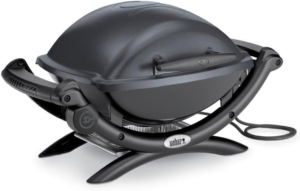
Star rating: 4.8 stars
The Weber Q 1400’s superpower is simple: it feels like a “real” grill. In ideal conditions, it can reach about 610°F, and the porcelain-enameled cast-iron grates lay down legit sear marks.
You’ll like it if you care about build quality and grill taste more than extra modes. Preheat takes a bit, and it’s not tiny, so plan your counter or balcony space. It’s electric, not magic, so you still need ventilation. If you want to sanity-check owner experiences, skim Home Depot’s Weber Q 1400 reviews.
Reasons to buy
- High-heat searing for steaks, chops, and burgers
- Cast-iron grate marks that look the part
- Durable body that doesn’t feel disposable
Reasons to avoid
- Bulky footprint for tight kitchens
- No built-in smoke filtering, so your hood matters
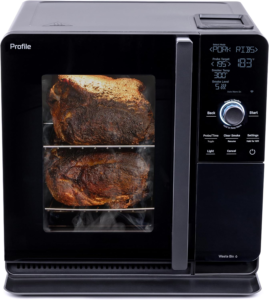
Star rating: 4.6 stars
This one’s a different kind of win. The GE Profile’s superpower is BBQ-style smoke flavor indoors with app control and active filtration, which is exactly what you want in a strict no-flame building.
It’s best when you care more about pulled pork vibes than a 10-minute sear. Think controlled cooks, set-and-check temps, and less babysitting. Weeknight speed is not the point here, and you’ll still want airflow. A quick look at Food Network’s smokeless indoor grill coverage helps frame where smart indoor cookers like this fit.
Reasons to buy
- Indoor smoke flavor without a flame
- App control for timing and temp checks
- Filtration system that targets smoke buildup
Reasons to avoid
- Not a fast sear-first grill
- Bigger and pricier than basic indoor grills
Best Indoor Electric Grill for Small Kitchens
Ninja Sizzle Smokeless Indoor Grill and Griddle
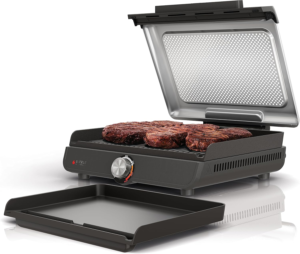
Star rating: 4.5 stars
The Ninja Sizzle’s superpower is its footprint. It stays compact, swaps between grill and griddle plates, and still reaches up to 500°F for respectable browning.
It fits best if you cook for one or two people and want something you’ll actually pull out on a Tuesday. Storage is easy, cleanup is low-stress, and it won’t dominate your counter. On the other hand, big batch cooking is not its strength.
Reasons to buy
- Compact size that suits small counters
- Interchangeable plates for burgers and pancakes
- Quick weeknight preheat for small portions
Reasons to avoid
- Limited capacity for families
- Less “outdoor grill” feel than heavier units
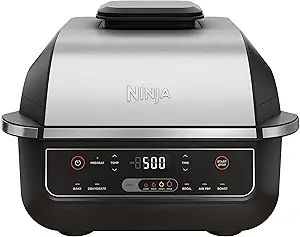
Star rating: 4.4 stars
The Foodi Smart XL’s superpower is doing more with one footprint. You get grilling plus air frying, roasting, and more, with a smart thermometer that helps you stop guessing doneness.
It’s a strong fit for families in apartments, or anyone meal prepping chicken, salmon, and veggies in bulk. The airflow system helps with smoke, but the unit is larger than a simple grill. You’ll want a dedicated spot, not a “tuck it behind the toaster” plan.
Reasons to buy
- Smart probe for repeatable results
- Multi-function cooking to save counter space overall
- Good capacity for batch meals
Reasons to avoid
- Large and tall under low cabinets
- More parts to clean than basic grills
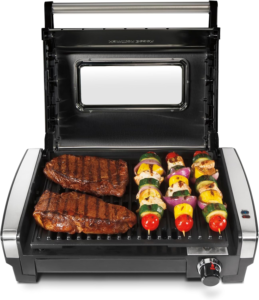
Star rating: 4.1 stars
This Hamilton Beach model wins on one thing: value that still sears. The viewing window is handy, and the lighter build makes it easier to stash after dinner.
It’s great for simple apartment staples like chicken breasts, burgers, and quick veggie sides. Don’t expect fancy sensors or premium hinges, but you can get tasty char without spending a lot. If you like crowdsourced “what people actually bought” signals, this Reddit-based indoor grill summary lines up with the idea that simple grills can still be the most-used.
Reasons to buy
- Affordable price for strong basics
- Viewing window to reduce heat loss
- Lightweight storage for small homes
Reasons to avoid
- Simpler temperature control
- Less premium build than top-tier grill
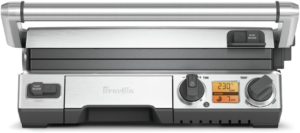
Star rating: 4.0 stars
Breville’s superpower is precision. The embedded heating elements improve heat recovery, and the hinge design lets you open it flat for a larger cooking surface when you need it.
If you cook a lot, you’ll enjoy the control and the consistent contact. For apartment life, the tradeoff is size and cleanup. It’s also pricey, and it can feel like overkill if you just want occasional burgers.
Reasons to buy
- Fast heat recovery for consistent browning
- Opens flat for more cooking room
- Strong control for frequent cooks
Reasons to avoid
- Big and heavy for small storage
- High cost compared to simpler grills
Why electric grills became the condo-friendly, low-mess standard in 2026
Condo boards and HOAs like electric grills for one simple reason: no open flame. That makes them easier to approve than propane or charcoal, especially in dense buildings where one bad flare-up can become everyone’s problem.
You also get a cleaner cooking setup. Many indoor grills tilt the plate, push drippings into a tray, and keep food out of pooled grease. Some brands even claim up to 75% fat reduction when grease drains away instead of soaking back into your food. Treat that as a best-case marketing number, but the direction is real: less grease on the plate usually means lighter meals and less smoke.
Performance improved too. Today’s better models preheat faster, hold steadier temps, and avoid flare-ups because there’s no flame to feed. In a small kitchen, that matters because you’re cooking close to cabinets, curtains, and smoke alarms. For a good outside perspective on which grills work for small living spaces, see this round-up of apartment-friendly grill picks.
Still, electric grills can’t do everything. You won’t get true charcoal smoke flavor, and you won’t cook for a 12-person party without working in batches.
What “smokeless” really means, and how to avoid setting off alarms
Most smoke comes from grease hitting very hot metal. “Smokeless” designs reduce that by routing grease away, using water trays, or pulling cooking air through a filter. Normal vapor still happens, especially with wet marinades.
Trim fat, pat meat dry, and go easier on sugar-heavy sauces at high heat. If the manual suggests water in the drip tray, do it. Even with a smokeless grill, crack a window or run your hood.
If your smoke alarm is hair-trigger, your best upgrade isn’t a new grill. It’s better airflow plus cleaner plates.
The biggest tech changes you will notice this year (infrared heat, smarter sensors, better airflow)
Infrared-style elements heat fast and brown more evenly, so your steak sears instead of steaming. Better lids also trap heat where it matters, then vent it in a controlled way.
You’ll also see more probes, sensors, and app control. In practice, that means fewer hot spots, fewer guesses, and more repeatable results when you cook the same meals every week.
Why Trust OASTHAR?
I’m Shashini Fernando, an associate editor who specializes in consumer tech and kitchen-adjacent gear, including smart home devices and countertop appliances. For this indoor electric grill list, you’re getting patterns pulled from hundreds of real customer reviews, not one person’s weekend test.
Best indoor electric grills buying checklist
Buy for your kitchen, not your fantasy cookout. In most apartments, 1500W to 1800W is your happy zone because low wattage often equals pale food and extra vapor. If you’re sensitive to smells or alarms, prioritize grills with a fan, filter, or water tray, and make sure the drip path keeps grease away from the element.
Coatings matter too. Look for plates labeled PFOA-free and pay attention to whether the surface is PTFE-based or ceramic. Either can work, but durability depends on care and heat.
App control can also be worth it, even if you hate “smart” stuff. When you’re in another room, a temp alert helps you avoid overcooking and extra smoke from drying meat.
Specs that matter most in a small space (wattage, smoke control, and coatings)
Aim for high heat and a plate that drains well. Check whether parts are dishwasher-safe, but assume you’ll still hand-wipe the lid and edges. If you see a model praised for smoke control in multiple sources, that’s a good sign, and round-ups like this indoor electric grill testing guide can help you compare feature sets quickly.
Safety and building rules you can follow in 5 minutes
Use a stable, heat-safe surface and plug into a proper outlet, ideally GFCI if you’re near a sink. Skip extension cords because high-watt appliances can overheat them. Keep the grill away from curtains, paper towels, and low cabinets.
As of February 2026, there isn’t one new nationwide rule that overrides your building policy, so check your lease or HOA guidance even for electric. Place the grill under a range hood when you can, or near an open window, then let it cool fully before storing.
Most “smoke problems” are old grease problems. Clean the underside, empty the tray, and your next cook goes quieter.
Best Indoor Electric Grills for Apartments FAQs
Which indoor electric grill makes the least smoke in apartments?
If smoke is your biggest worry, the Philips Smokeless Indoor Grill HD6371/94 and Ninja Sizzle Smokeless Indoor Grill & Griddle are your safest bets, though you should still vent.
Can an indoor electric grill really sear steak well?
Yes, but pick one built for higher heat. The Philips HD6371/94 (infrared around 446°F) and Ninja Foodi 5-in-1 Indoor Grill (up to 500°F) sear best.
What’s the best indoor grill for small kitchens and counters?
Go compact and simple. The Ninja Sizzle Smokeless saves space and heats fast, while the Hamilton Beach Indoor Electric Grill stores easily and stays straightforward.
Is the Ninja Foodi indoor grill worth it versus basics?
If you want one appliance to do more, yes. It grills, air fries, roasts, bakes, and dehydrates, plus it’s designed to keep smoke lower indoors.
Can you use the Weber Q1400 indoors or only outside?
You can use it indoors, but it fits condo life best on a balcony or patio. It cooks evenly and fast, although the preheat can take around 20 minutes.
Which indoor grill is best if you’re on a tight budget?
The Hamilton Beach Indoor Electric Grill is the value pick. It can reach about 450°F for solid searing, but it’s less convincing on thick steaks.
Which indoor electric grill gives you the most precise control?
The Sage (Breville) Smart Grill Pro wins on control, with accurate temperature settings and a probe for doneness. The trade-off is size, weight, and price.
How do you keep smoke alarms from going off while grilling?
Choose a lower-smoke model, preheat properly, trim excess fat, and use your range hood. Even “smokeless” grills can puff a little at max heat.
What’s the easiest indoor electric grill to clean quickly?
Non-stick, removable plates make life easier. The Philips HD6371/94 and Ninja Foodi 5-in-1 clean up well, although the Ninja can get messy inside.
How many people can most indoor electric grills feed at once?
Most apartment-friendly models comfortably feed 2 to 4 people per batch. Compact grills cook great, you just run more rounds when you’re hosting.
Conclusion
You’re not buying an indoor grill to break building rules. You’re buying it to eat better, with less mess, and without stressing your neighbors. Pick the model that matches how you cook, not just what looks good in photos, and remember that “smokeless” still needs ventilation.
Studio Dweller, Ninja Sizzle; Family Cook, Ninja Foodi XL; Purist, Weber Q 1400.
Once you’ve chosen, commit to the boring part: quick cleanup and an empty drip tray. That’s what keeps the smoke down and the grilled flavor up, week after week.