

If you’re shopping for the best hot water heaters, you’re probably trying to avoid a familiar headache, running out of hot water mid-shower, waiting forever at the sink, or cramming a bulky tank into a space that barely fits.
Disclosure: As an independent reviewer, we may receive an affiliate commission on qualifying purchases made through our links. This helps support our research and testing team at OASTHAR. Learn more about our testing process.
In 2026, you’ve got more good options than ever, but they don’t all solve the same problem. Some are built for whole-home demand, others shine as small point-of-use fixes, and a few are meant to travel with you.
This guide from the OASTHAR Product Research and Testing Team breaks down seven standouts, what they do best, and what to watch before you commit.
RELATED: The 8 Best Rollator Walkers for 2026, Tested and Reviewed
Best hot water heaters at a glance
- Best Overall: Rinnai RXP199iN
- Best Budget: Eccotemp i12-NG
- Best for Outdoor: Camplux AY132B
- Best for Bathroom: EcoSmart ECO 11
- Best Tankless Heater: Stiebel Eltron Tempra 24 Plus
- Best for Indoor: Rinnai V65iP
- Best for Camping: GE 30 Electric Water Heater
Learn more about how we test hot water heaters
You don’t need a lab coat to pick a good water heater, but you do need a consistent way to judge them. We test hot water heaters by researching major online retailers and manufacturer listings (including Walmart, Target, and UK retailers like Currys), then comparing specs to what real owners report after weeks and months of use. We focus on patterns that show up across hundreds of reviews, not one-off stories.
Performance under real demand
First, you want hot water that keeps up. We look at capacity (for tanks) or flow rate (for tankless), plus how units behave when demand jumps. Review patterns matter here because a spec sheet can’t tell you if temperatures swing when someone runs a second faucet.
Temperature stability and control
Next, we check how each model manages water temperature. Some units use flow control or modulation to prevent sudden cold spikes. We also consider how easy it is for you to set and keep a comfortable temperature without constant fiddling.
Efficiency and energy use
Efficiency only helps if it matches your usage. We compare UEF ratings when provided, and we pay attention to how tankless units heat only when needed versus tanks that maintain stored hot water. Owner feedback helps confirm whether efficiency claims line up with daily use.
Install fit and footprint
A water heater that doesn’t fit your space becomes a project fast. We look at mounting style, venting needs (or lack of venting), and whether the unit is suited for indoor, outdoor, or point-of-use installs. We also weigh how often reviewers mention installation friction.
Safety and long-term reliability
We prioritize models with clear safety protections (like overheat shutdowns) and design choices that support a longer service life (like corrosion protection in tanks). We also watch for repeat complaints, such as nuisance shutdowns, leak reports, or error codes.
Price and customer reviews
Finally, we judge value by comparing what you pay to what you get, then validating the “worth it” factor through customer sentiment. We read large batches of reviews to see where expectations match reality, and where they don’t. That’s how you avoid paying more for features you won’t use.
Star Rating: 4.9 out of 5
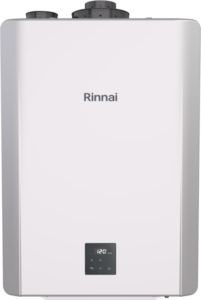
This is the “don’t mess around” pick. The Rinnai RXP199iN brings high flow and strong efficiency together, so your house can run more like a hotel, multiple showers, sinks, and appliances, without the usual temperature drama.
Output is the headline. It can deliver up to 11.1 GPM, and because it heats water on demand, you’re not waiting for a tank to recover. The difference shows up on busy mornings. Instead of planning showers around the water heater, you just use the house normally.
Efficiency and placement flexibility are the second win. It’s rated at UEF 0.98 and is ENERGY STAR certified, and it supports natural gas or propane. You can also install it indoors or outdoors with Rinnai’s Versa Vent system, which helps when your utility room is tight or your venting options are limited.
The features that seal it are the smart ones, especially built-in recirculation with Smart Circ technology that learns usage patterns to reduce wait times. If you’ve ever run a faucet just to “get to the hot,” you already get why that matters. For official specs and install details, start with the Rinnai RXP199iN official product page.
Type: Gas tankless | Max flow: Up to 11.1 GPM | Efficiency: UEF 0.98 | Fuel: Natural gas or propane | Placement: Indoor or outdoor (with Versa Vent)
Reasons to Buy
- Strong whole-home hot water
- Very high efficiency rating
- Built-in recirculation features
- Flexible indoor or outdoor placement
- Handles demanding climates well
Reasons to Avoid
- Higher up-front cost
- Install planning can be more involved
Who it’s for: This fits you best if your home has real hot water traffic, meaning multiple bathrooms, a big family, or overlapping routines. It also makes sense if you’re tired of waiting for hot water and want a smarter system that reduces those dead seconds at the tap.
Star Rating: 4.6 out of 5
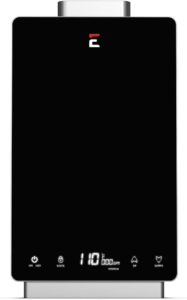
If you want tankless convenience without turning your utility area into a renovation zone, the Eccotemp i12-NG is the kind of simple that feels refreshing. It’s built to fire up only when you open a hot tap, so you’re not paying to keep stored water hot all day.
Performance is solid for its class. It’s rated at 4.0 GPM with 80,000 BTU per hour, which makes it a practical match for one to two hot water applications at a time (depending on your incoming water temperature and demand). In an apartment, condo, cabin, or smaller home, that’s often the sweet spot. You get tankless comfort without paying for capacity you’ll never use.
Control is designed to stay low stress. The unit uses fully automatic controls, and an LED display gives you a quick read on what’s happening. You also get an energy-saving mode and child lock technology, which helps if you’ve got kids who love buttons.
Installation details matter with indoor gas tankless models, and this one keeps it approachable with standard 1/2-inch NPT fittings, horizontal venting, and a 110V plug to power the exhaust fan and controls. For the manufacturer’s walkthrough and feature breakdown, use the Eccotemp i12-NG product listing. If you want a deeper setup view, the brand also publishes an i12 installation guide.
Type: Indoor gas tankless | Rated flow: 4.0 GPM | Input: 80,000 BTU/hr | Controls: LED display, auto controls | Power: 110V (fan and controls)
Reasons to Buy
- Heats only when you need it
- Simple controls and LED display
- Works well in smaller homes
- Energy-saving mode included
Reasons to Avoid
- Not ideal for heavy multi-shower demand
- Venting requirements still apply
Who it’s for: This is a strong pick if you want a straightforward indoor tankless system for a smaller space. It’s also a good match if you value “set it and forget it” operation more than premium smart features.
Star Rating: 4.5 out of 5
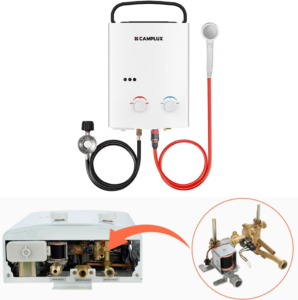
The Camplux AY132B is all about hot water on your terms. You’re not installing it permanently. You’re carrying it, hanging it, and using it where a normal water heater can’t go, camping spots, RV setups, outdoor showers, and pet wash stations.
Portability is the core feature. It weighs about 14 pounds, includes a built-in handle, and is designed to set up quickly. You get on-demand hot water at 1.32 GPM, with a maximum output of 34,000 BTU per hour, so water heats fast once it’s running.
What makes it more usable than some portable units is the low pressure start. It can start with as little as 3.0 PSI of water pressure, which helps when you’re off-grid or pulling from lower pressure sources. That’s the difference between “nice idea” and “actually works when you need it.”
Setup is also friendlier than most. The box includes a 5-foot gas regulator, shower hose, and a standard garden hose connection, so you’re not stuck hunting for basic adapters. Safety is covered with CSA certification and built-in protections that handle problems like overheating, flame failure, and low water flow.
For the official product details, see the Camplux AY132 portable water heater page.
Type: Portable propane tankless | Flow: 1.32 GPM | Output: 34,000 BTU/hr max | Min pressure: Starts at 3.0 PSI | Weight: About 14 lbs
Reasons to Buy
- Truly portable and light
- Hot water without a tank
- Works with low water pressure
- Accessories included for quick setup
Reasons to Avoid
- Not designed for full-home use
- Outdoor use focus only
Who it’s for: This is for you if you need hot water in motion, camping, RV life, or backyard utility tasks. It’s also a smart backup option if you want an emergency hot water solution that doesn’t rely on your home’s main heater.
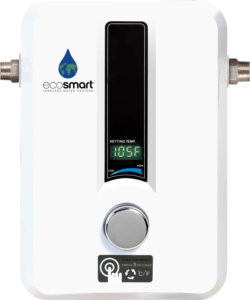
If your main annoyance is the wait, not the amount of hot water, point-of-use tankless is the cleanest solution. The EcoSmart ECO 11 is designed to sit close to the fixture that needs hot water, under a sink, near a bathroom, or right where the lag happens.
That placement matters because it cuts the “cold pipe” time. Hot water shows up faster, and you waste less water while waiting. You also lose less heat on the trip, which is an underrated comfort upgrade in larger homes.
The unit is compact and wall-mountable, and EcoSmart claims it’s up to 93 percent smaller than a traditional tank. It uses an engineered polymer shell that won’t rust or corrode, which is exactly what you want for something that may live in a cramped cabinet space.
Efficiency is another strong point. It uses self-modulating technology, so it pulls only the power it needs in that moment. With UEF up to 0.96, you’re not paying standby losses. Control is also precise, with a digital interface that adjusts temperature in 1-degree increments from 80°F to 140°F. Internally, copper immersion heating elements respond quickly, and a stainless steel heat exchanger helps transfer heat evenly.
For official specs and sizing guidance, see the EcoSmart ECO 11 product page.
Type: Electric point-of-use tankless | Efficiency: UEF up to 0.96 | Temp range: 80°F to 140°F | Control: 1-degree digital adjustment | Housing: Rust-resistant polymer shell
Reasons to Buy
- Faster hot water at the tap
- Very compact footprint
- No standby heat loss
- Fine temperature control
Reasons to Avoid
- Not meant to cover a whole home
- Output depends on install conditions
Who it’s for: This is ideal if you’ve got one problem area, like a far bathroom sink, an office kitchenette, or a guest bath that always runs cold first. You’ll feel the upgrade every day because it attacks the waiting time directly.
Star Rating: 4.3 out of 5
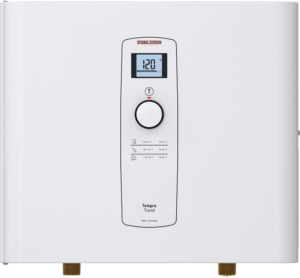
Electric tankless can be hit or miss when your demand changes fast. The Tempra 24 Plus is the kind of unit you choose when you care more about a steady shower than chasing the cheapest price.
Its standout feature is advanced flow control. When demand increases, the unit can slightly adjust flow to help keep temperature stable instead of letting the water swing hot and cold. That matters most in real homes, where someone flushes a toilet, starts a dishwasher, or turns on another tap at the worst time.
Power puts it into whole-home territory for the right setups. This model runs at 24 kW on 240V, and it auto modulates, meaning it draws the energy it needs in the moment rather than running full blast all the time. That’s the balance you want from electric tankless, strong performance without waste.
The physical design is also easy to live with. It’s compact and wall-mounted, and it doesn’t require venting, which keeps installation cleaner than gas tankless. In day-to-day use, it runs quietly, and the digital display makes temperatures easy to read. Preset memory buttons speed up adjustments, and some installs can limit output to 109°F for added control.
If you want a quick third-party overview of real-world ownership themes, check the ShopSavvy TLDR review for Tempra 24 Plus.
Type: Electric tankless | Power: 24 kW | Voltage: 240V | Temp stability: Advanced flow control | Install: Wall-mounted, no venting
Reasons to Buy
- Strong temperature stability
- No venting needed
- Compact wall-mounted design
- Quiet operation
Reasons to Avoid
- Electrical requirements can be demanding
- Whole-home results depend on your setup
Who it’s for: This makes sense if you want electric tankless and you hate temperature swings. It’s also a good match when venting a gas unit would be a hassle, but you can support the electrical needs.
Star Rating: 4.2 out of 5
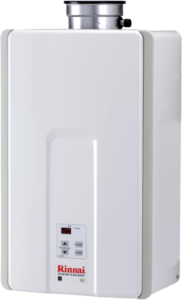
The V65iP hits a sweet spot, tankless comfort, strong enough output for normal homes, and a price tier that feels more reachable than premium flagships. If you want long showers without watching the clock, this is the kind of upgrade you feel right away.
Because it heats on demand, you’re not limited by tank size. Rinnai rates it for a maximum output around 6.5 GPM, which can support multiple fixtures in many households without feeling strained (exact results still depend on incoming water temp and how many things run at once).
Efficiency is also part of the appeal. The unit has a UEF of 0.8, and it heats only when needed, so it’s not burning energy to keep stored water hot. It runs on propane, which can be a practical choice if that’s what your home uses, and it’s designed for indoor installation with a compact footprint. It’s also certified for manufactured homes, which adds flexibility if you’re working with specific housing requirements.
You get modern support features too. Built-in diagnostics help monitor performance, and Wi-Fi capability works with Rinnai controllers for tighter temperature control. Temperature comes preset at 120°F, with professional adjustment available when needed. For official details and compatibility notes, see the Rinnai V65iP product page. If you want a homeowner-style perspective, this Tiny Living Life V65iP review is a helpful read.
Type: Propane tankless | Max flow: Up to 6.5 GPM | Efficiency: UEF 0.8 | Controls: Wi-Fi capable (with controllers) | Certs: Manufactured home certified
Reasons to Buy
- Endless hot water feel
- Compact indoor footprint
- Solid output for small to medium homes
- Helpful diagnostics support
Reasons to Avoid
- Not as efficient as top condensing models
- Still needs proper venting and install planning
Who it’s for: This fits if you want propane tankless for a small to medium home and you’d rather spend for consistent comfort than extra premium features. It’s also a good “remodel-friendly” option when you need compact size.
The Best Hot Water Heater for Camping
GE 30 Electric Water Heater
Star Rating: 4.0 out of 5
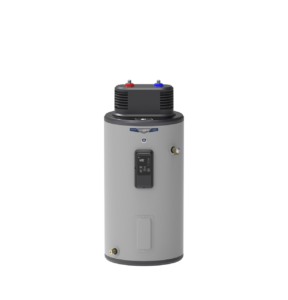
Sometimes the simplest solution is still the right one. The GE 30 electric tank is a budget-friendly pick that focuses on predictable hot water with fewer moving parts than tankless setups.
The big selling point is that it delivers the capacity it promises. It’s a true 30-gallon tank, and it can deliver up to 54 gallons in the first hour, which matters when you’ve got back-to-back showers or a busy morning routine. Recovery speed helps too, thanks to dual 5,500W heating elements that heat water quickly after heavy use.
A small design detail also helps the experience. New water feeds from the bottom of the tank, which supports steadier temperatures instead of that “it started hot, then faded” feeling partway through a shower. Control stays straightforward with an adjustable thermostat that runs from 90°F to 150°F, so you can set it to your comfort level (and follow local safety guidance).
Installation is built around common standards. It supports 240V hardwire compatibility and standard water hookups. Durability features include an anode rod to fight corrosion, a rust-proof drain valve, and automatic safety shutoff.
For model details, see the GE 30-gallon short electric water heater product page.
Type: Electric tank | Capacity: 30 gallons | First-hour rating: Up to 54 gallons | Elements: Dual 5,500W | Temp range: 90°F to 150°F
Reasons to Buy
- Predictable hot water supply
- Strong first-hour delivery
- Straightforward controls
- Fits smaller households well
Reasons to Avoid
- Can run out during heavy demand
- Takes space compared to tankless
Who it’s for: This is a good match if you want a reliable, lower-cost water heater for one to three people. It’s also a smart pick when you want familiar tank behavior and don’t want to deal with tankless venting, flow limits, or extra controls.
All recommended hot water heaters compared
Here’s a quick side-by-side to help you narrow the field.
| Product | Category fit | Output style | Efficiency (UEF) | Install and placement notes |
|---|---|---|---|---|
| Rinnai RXP199iN | Whole-home tankless | Up to 11.1 GPM | 0.98 | Gas (NG or propane), indoor or outdoor with Versa Vent, built-in recirculation |
| Eccotemp i12-NG | Smaller indoor tankless | 4.0 GPM, 80,000 BTU/hr | Not listed here | Gas (natural gas), indoor, uses horizontal venting, 110V powers fan and controls |
| Camplux AY132B | Portable outdoor hot water | 1.32 GPM, 34,000 BTU/hr | Not listed here | Portable propane, starts at 3.0 PSI, includes hoses and regulator |
| EcoSmart ECO 11 | Point-of-use tankless | Point-of-use (fixture-level) | Up to 0.96 | Electric, mounts near a faucet, no standby heat loss |
| Stiebel Eltron Tempra 24 Plus | Electric tankless | 24 kW (flow varies by setup) | Not listed here | Electric 240V, no venting, advanced flow control for steadier temps |
| Rinnai V65iP | Budget propane tankless | Up to 6.5 GPM | 0.8 | Propane, compact indoor design, Wi-Fi capable with controllers |
| GE 30 Electric Water Heater | Budget tank | 30-gallon tank, up to 54 first-hour gallons | Not listed here | Electric 240V hardwire, classic tank footprint |
Takeaway: If you need whole-home performance, start with the Rinnai RXP199iN. If you’re fixing a “wait time” problem at one faucet, EcoSmart ECO 11 is the cleanest solution. If you just want affordable and familiar, GE’s 30-gallon tank stays practical.
What to look for in a hot water heater
Buying a water heater feels simple until you realize how many “right answers” exist. Use these checks to match the heater to your home, not to a marketing label.
Tank vs tankless
A tank water heater is like a full pantry. It’s ready, predictable, and easy to understand, but it can run out. Tankless is like cooking on demand, you don’t store as much, but you can keep going longer if the unit can keep up with flow.
If your issue is running out, tankless can help. If your issue is long waits at a far sink, point-of-use tankless is often the better fix than replacing the whole system.
Capacity and flow
Tank models are about gallons and recovery. If you’ve got back-to-back showers, look at first-hour delivery, not just tank size.
Tankless models are about flow rate and incoming water temperature. If you run multiple fixtures at once, you want enough GPM headroom so the unit doesn’t throttle flow or let temps drift.
For broader industry perspective while you shop, you can compare approaches in guides like This Old House’s 2026 water heater roundup and Popular Science’s hot water heater picks.
Fuel type and power
Electric tanks usually need 240V service and space for the tank. Electric tankless often demands more from your electrical system, so it’s not always a simple swap.
Gas tankless adds venting and combustion considerations, plus you may need 110V power for fans and controls. If you’re weighing tankless in general, it helps to read a dedicated overview like Popular Science’s tankless water heater guide.
Install location
A water heater that fits well costs less to live with. Whole-home tankless units free up space but may add venting complexity. Point-of-use units hide under sinks but won’t cover the full home. Portable units avoid home installs entirely, but they’re purpose-built for outdoor use.
Before you buy, measure twice and think about access too. You or a pro will eventually need to service it.
Temperature control
Precise control matters more than it sounds. A 1-degree digital setpoint is great when you’re trying to keep sinks safe for kids while keeping showers comfortable. Flow control also matters because stable temperature is what makes a shower feel “expensive,” even if the heater wasn’t.
Maintenance, safety, and reliability
With any water heater, safety shutoffs and protections should be non-negotiable. For tanks, corrosion protection helps long-term reliability. For tankless, diagnostics can cut troubleshooting time.
If you want a deeper, research-focused view of the category, Consumer Reports water heater coverage is a solid reference point.
Why Trust OASTHAR?
I’m Shashini Fernando, an associate editor who specializes in home appliances, smart home gear, and energy-saving home upgrades, and you’re reading a list built from real user experiences, not hype. For this hot water heater guide, you’re getting the results of analyzing hundreds of customer reviews and spec sheets across the most talked-about models in the category.
You’re also getting a buyer-first approach. That means clear trade-offs, plain language, and recommendations tied to common living situations, small homes, manufactured homes, busy families, and off-grid trips.
Best Hot Water Heaters FAQs
What is the best hot water heater overall?
For most people who want top performance and modern features, the Rinnai RXP199iN is the best overall pick in this guide. It pairs very high flow (up to 11.1 GPM) with high efficiency and built-in recirculation.
Should you get a tank or tankless water heater?
Go tank if you want lower complexity and predictable behavior, and your household demand is moderate. Pick tankless if you hate running out of hot water or you want to save space, but make sure the unit’s flow rate matches your real use.
What’s the point of a point-of-use tankless heater?
Point-of-use units like the EcoSmart ECO 11 cut wait time by sitting close to the faucet. They’re best when your main problem is distance, like a far bathroom sink that takes forever to heat up.
Can a portable tankless heater replace a home water heater?
No, portable models like the Camplux AY132B are made for outdoor tasks and travel. They’re great for camping and rinsing, but they’re not designed to run a full home’s plumbing system.
What temperature should you set your water heater to?
Many homes use 120°F as a common setting, but your safest choice depends on your household needs and local guidance. If you’ve got kids or older adults at home, stable temperature control matters as much as the number itself.
Final verdict
If you want one clear “buy it and stop thinking about it” pick, choose the Rinnai RXP199iN for the best mix of output, efficiency, and features. If you’re watching your spend and want something familiar, the GE 30 Electric Water Heater keeps things simple and dependable. For targeted fixes, the EcoSmart ECO 11 is the fastest way to stop wasting time (and water) waiting at the tap.
The best choice comes down to your space, your fuel options, and how your home actually uses hot water. Once you match those three, you’ll end up with a heater that feels right every single day.