

You’re not alone if you’ve waited half a day for air-dried clothes or carried a heavy laundry basket down stairs just to use a shared machine. That hassle is exactly why best portable dryers keep getting more popular in apartments, dorms, RVs, and small homes.
Disclosure: As an independent reviewer, we may receive an affiliate commission on qualifying purchases made through our links. This helps support our research and testing team at OASTHAR. Learn more about our testing process.
The tricky part is simple: not all portable dryers are built the same. Some are true tumble dryers with a drum, others are compact warm-air dryers meant for a few items, and spin dryers solve a different problem by pulling water out fast.
This guide walks you through eight standout picks for 2026, plus what to look for so you buy the right one the first time.
RELATED: The 8 Best Rollator Walkers for 2026, Tested and Reviewed
Best portable dryers at a glance
- Best Overall: Euhomy Portable Dryer
- Best Value: Panda Portable Dryer
- Best for Clothes: ROVSUN Portable Dryer
- Best for Travel: MOJOCO Portable Dryer
- Best for Apartment: Effidry S3
- Best for RV: Panda 3200
- Best for Settings Control: Black + Decker BCED37
- Best Budget: Rolitwils Portable Dryer
Learn more about how you test portable dryers
Your day-to-day experience matters more than a spec sheet. So you test portable dryers by researching listings across major online retailers and brand stores, then cross-checking claims against large batches of real customer feedback. Patterns show up fast when you read enough reviews, especially around drying time, noise, lint, and reliability.
Price and Customer Reviews
You start with price ranges and then pressure-test value using customer reviews. You’re looking for repeat complaints (burning smells, weak heat, loud rattles) and repeat praise (even drying, easy setup, consistent cycles). This keeps the picks grounded in what people live with, not just what the box promises.
Drying Performance and Time
You focus on how quickly a unit gets clothes from damp to wearable, and whether it dries evenly. Portable dryers often need smaller loads, so you watch for signs of real-world performance, like whether towels need extra time or whether lightweight items dry in one pass.
Capacity and Real Load Limits
Stated capacity and usable capacity can be two different things. You evaluate what the dryer realistically handles in one cycle, especially for common loads like T-shirts, gym wear, baby clothes, and bedding. If reviewers keep saying “works best half full,” you treat that as the real limit.
Controls and Ease of Use
You score dryers on how easy they are to run without thinking. Dials can be faster than touch panels, but smart sensors can reduce babysitting. You also pay attention to cycle flexibility, like air-dry options, temperature choices, and timer ranges.
Safety Features and Heat Management
Portable dryers run in tight spaces, so safety matters. You look for overheat protection, auto-stop behavior when the door opens, and customer notes about stable temps. Consistent heat with fewer surprises usually correlates with fewer long-term complaints.
Maintenance and Filtering
Lint is a performance killer in small dryers. You evaluate filter design (single vs multi-layer), how easy it is to remove and clean, and whether users report frequent clogs. Better filtration usually means better airflow, better drying, and fewer service headaches.
Star rating: 5.0/5
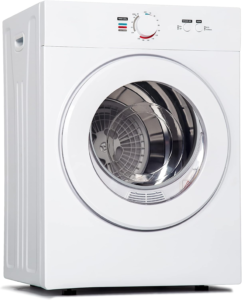
If you want one portable dryer that does almost everything well, this is the one you keep circling back to. The Euhomy hits a rare mix of practical capacity, flexible settings, and apartment-friendly day-to-day comfort. It’s the kind of machine that turns laundry from a “schedule it” chore into something you can do between meetings.
You get 1.5 cubic feet of drum space paired with an 850 W motor, and it’s designed for up to 10 lb of wet laundry. That’s a strong sweet spot for small households because it’s big enough to matter, but not so big it becomes a storage problem. It also reaches up to 140°F, so it can dry thoroughly without acting like a space heater in your room.
Control is where it stays user-friendly. You get cold, warm, hot, and air-dry modes, plus cycle times that can range up to 200 minutes depending on what you select. High and low heat can be selected independently, which helps when you’re trying to dry mixed fabrics without cooking the lighter pieces. A 105-degree wide-angle door makes loading easier in tight spaces, and the unit auto-stops if the door opens, which is the kind of safety feature you quickly appreciate.
Noise also matters when your “laundry room” is five feet from your bed. This one is described as quiet, and it includes a triple-layer lint filter and the hardware you need for flexible placement.
Capacity: 1.5 cu ft | Power: 850 W | Max temp: up to 140°F | Modes: cold, warm, hot, air dry | Timer: up to 200 min
Reasons to Buy
- Strong size-to-power balance
- Multiple heat and air modes
- Quiet, apartment-friendly use
- Wide-angle door, easy loading
- Triple-layer lint filtering
Reasons to Avoid
- Works best with smaller loads
- Venting needs planning in tight rooms
Who should buy it: This fits you if you want a true everyday dryer for an apartment, dorm, or RV, and you don’t want to constantly fine-tune every cycle. Start with the brand’s current lineup on the Euhomy portable dryer collection so you can confirm the latest specs and included accessories.
Star rating: 4.8/5
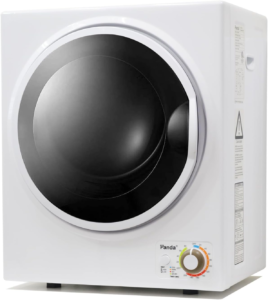
This is the value play that still feels like a “real dryer.” The Panda Portable Dryer matches the most useful size class for small living spaces, then adds the setup flexibility you need when every square foot is contested. It’s a smart option when you want solid performance without paying for fancy features you won’t use.
The core numbers are practical. You get 1.5 cubic feet of capacity, an 850 W motor, and heat up to 140°F. It’s also rated to handle up to 10 lb of wet laundry per load, which means you can run multiple outfits at a time, not just a couple of shirts. On fabrics, the mode selection keeps it flexible with cold, warm, hot, and air dry options.
Where this Panda earns its keep is livability. The three-layer filter system is designed to trap lint and hair, and it’s easy to remove for cleaning. That matters because portable dryers lose performance fast when lint builds up and airflow gets restricted. You also get a see-through door that opens to 105 degrees, which makes loading feel less cramped, and there’s auto shutoff if the door opens mid-cycle.
Placement is another big win. Depending on your space, you can set it up freestanding, stacked, or wall-mounted. That flexibility is often the difference between “I’ll use it” and “it’s in the way.”
Capacity: 1.5 cu ft | Power: 850 W | Max temp: up to 140°F | Modes: cold, warm, hot, air dry | Door: 105-degree opening
Reasons to Buy
- Strong everyday capacity
- Easy-clean lint filtration
- Flexible installation options
- Simple mode selection
Reasons to Avoid
- Not ideal for oversized bedding
- Small loads dry more evenly
Who should buy it: This fits you if you want a reliable compact dryer that’s easy to place and easy to maintain, especially in a small apartment where wall-mounting could save your floor space. To confirm current models and details, start at the Panda dryer official site.
Star rating: 4.6/5
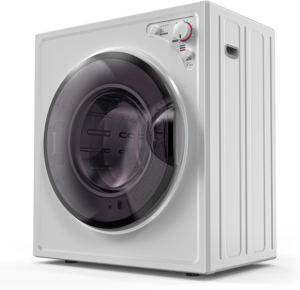
Touch panels are fine, but a classic dial is hard to beat when you just want the dryer to run. The ROVSUN Portable Dryer is all about that straightforward experience. You pick a setting, turn the knob, and move on. For many small-space setups, that simplicity is the feature.
It runs on 850 W and reaches temperatures up to 140°F for dependable drying in a compact format. For best performance, it’s designed around smaller loads, up to 5.5 lb per cycle. That load size fits daily essentials well, like T-shirts, sleepwear, workout clothes, and baby items. In other words, it’s not trying to replace a full laundry room, it’s trying to eliminate the drying bottleneck that causes clutter and damp smells.
Physical footprint and placement flexibility are also part of the appeal. With dimensions listed around 19.5 x 16.5 x 24 inches and a weight of 37 lb, you can treat it as a small appliance instead of a permanent install. Depending on your room, you can set it up wall-mounted (kit included), countertop, or freestanding on level ground.
You also get practical durability features like a stainless steel tub and a multi-filtration system that helps capture lint. For safety, it stops automatically if the door opens mid-cycle, which is the kind of detail you want in a tight space.
Power: 850 W | Max temp: up to 140°F | Load (best): up to 5.5 lb | Controls: dial knob | Placement: wall, counter, freestanding
Reasons to Buy
- Simple, familiar dial control
- Compact and placeable
- Stainless tub durability
- Auto-stop door safety
Reasons to Avoid
- Smaller load limit
- Less control detail than multi-mode units
Who should buy it: This works for you if you want a compact, no-fuss dryer for daily clothing, and you’d rather turn a dial than tap through menus. If you’re still comparing dryer types, a broader perspective on full-size performance can help you calibrate expectations, so check Tom’s Guide’s clothes dryer roundup for context on what “normal dryer” speed looks like.
Star rating: 4.4/5
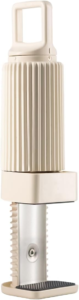
This is the pick for movement. The MOJOCO Portable Dryer is lightweight, foldable, and designed for smaller loads, so it makes sense when your living situation changes often. Think RV trips, temporary rentals, a small apartment with zero laundry space, or even a backup drying solution for a busy week.
Despite the compact build, it’s meant to do real work. It can handle up to nine clothing items at once, which is enough for a quick batch of basics, like underwear, socks, shirts, and gym wear. Drying speed is the headline. The system combines heat and airflow, and clothes can dry in as little as 50 minutes. That’s a big step up from hanging items overnight and hoping the humidity cooperates.
Noise also matters when you’re drying clothes near where you sleep or work. This unit is described as running quietly, so you can keep it going while you’re on a call or winding down. A built-in timer helps you control cycle length, and it includes LED UV to help freshen garments during drying.
Because it’s designed for smaller loads, it also uses less energy than a full-size dryer. That doesn’t make it “free to run,” but it does make it easier to justify for short, frequent cycles.
Load style: small batches | Capacity: up to 9 items | Dry time: as little as 50 min | Design: foldable, portable | Extras: timer, LED UV
Reasons to Buy
- Travel-friendly foldable design
- Fast small-load dry times
- Quiet operation
- Built-in timer control
Reasons to Avoid
- Not for heavy, bulky loads
- Best results after good spin-out
Who should buy it: This fits if your laundry needs are frequent but light, and your space is limited or temporary. If you want a second opinion on how portable dryers stack up across different styles, compare categories and trade-offs in The Spruce’s portable dryer guide.
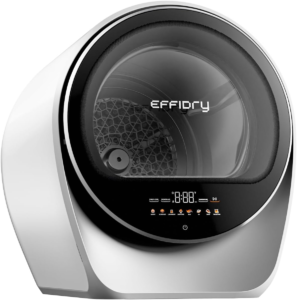
Star rating: 4.3/5
The Effidry S3 is for people who hate babysitting laundry. Its main “superpower” is how automated it feels. Instead of you guessing when clothes are dry, the dryer uses sensors to track temperature and humidity, then stops automatically when the load is done. That’s the difference between “set it and hope” and “set it and forget it.”
Power draw is listed at 150 W, and it uses dual variable frequency motors with a forward-and-reverse rotation pattern to keep clothes from clumping. The goal is consistent 360-degree drying and fluffier results, especially when you’re drying a few mixed items. The controls are modern, with an emphasis on one-click operation that handles most of the decision-making for you.
Mode variety is another big selling point. You get eight drying modes, including a silk setting for delicate fabrics. There are also three temperature levels, time-dry options, and a dedicated shoe drying function that dries the interior without rotation. That shoe mode includes an extra iron shelf made for shoes, which is a practical add-on if you deal with wet sneakers or kids’ shoes.
On maintenance, the stainless drum is supported by dual fine filters and a removable magnetized dust barrier designed to catch hair and lint. There’s also no drainage or installation required, so you plug it in and start.
Power: 150 W | Control: one-click intelligent | Modes: 8 modes + shoe mode | Sensors: humidity and temp | Filters: dual filters + dust barrier
Reasons to Buy
- Auto-stop sensor drying
- Delicate-friendly mode options
- Shoe drying function included
- Plug-and-go setup
Reasons to Avoid
- Capacity details vary by model
- Controls may feel “too smart” for some
Who should buy it: This is a strong match if you want the most hands-off experience and you often dry delicates or small loads that are easy to over-dry. Start with the official product page, then confirm what’s included in the box on the Effidry S3 listing.
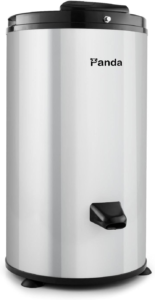
Star rating: 4.2/5
A spin dryer isn’t the same as a tumble dryer, and that’s the point. The Panda 3200 is built to remove water fast, not to finish with heated tumbling. If you handwash clothes, or you’re tired of dripping laundry that takes forever to air-dry, this type of machine can change your routine overnight.
The performance headline is 3,200 RPM. That high-speed spin pulls water out quickly, so garments come out close to dry in minutes instead of soaking wet. In real life, that means shorter hang-dry times and fewer musty odors, especially in humid apartments. It’s also a win for anyone who hates hand-wringing, because the machine does the heavy part for you.
Capacity is listed up to 22 lb, which is impressive for a compact spin unit. Durability gets a boost from a stainless steel drum and outer case, so it’s meant to handle frequent use without feeling flimsy.
Setup stays simple because it uses gravity draining. You place it on a flat surface, then position a bucket underneath to collect water. No sink hookup, no plumbing, and it plugs into a standard 110 V outlet.
If you want to understand how spin dryers differ from standard portable dryers, it helps to compare buying advice side by side. A solid reference point is BestReviews’ spin dryer guide.
Type: spin dryer | Spin speed: 3,200 RPM | Capacity: up to 22 lb | Drain: gravity drain | Build: stainless drum and case
Reasons to Buy
- Very fast water removal
- Great for handwashed laundry
- No plumbing required
- Large capacity for a spinner
Reasons to Avoid
- Not a heated tumble dryer
- You still finish by air-drying
Who should buy it: This is ideal if you wash by hand, live in an RV, or want to cut air-dry time dramatically. Pair it with a drying rack or a small warm-air dryer, and your laundry stops taking over the room.
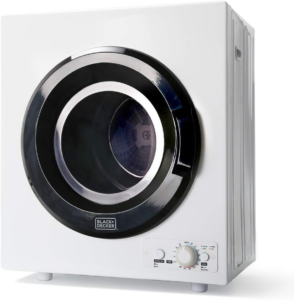
Star rating: 4.1/5
If you want a compact dryer that feels closer to a traditional machine, this is the settings-heavy pick. The Black + Decker BCED37 stands out because it gives you meaningful control over how you dry different fabrics, from everyday clothing to bulkier loads.
You get four drying modes: air dry, cool, warm, and hot. That variety matters because portable dryers can be less forgiving on mixed loads. Being able to step down the heat or use air dry helps protect lighter fabrics, while hot mode helps on towels and thicker items. It runs at 1,500 W, so it doesn’t read like an underpowered compromise, and it includes overheat protection for safer operation.
Capacity is a big part of the story. With 3.5 cubic feet of space, it can handle up to 13.2 lb per load, which puts it in a different class than the smaller 1.5 cu ft models. It’s also designed to run from a standard 120 V outlet with a regular three-prong plug, so you’re not dealing with specialty electrical work.
Included accessories sweeten the deal: a stainless steel drum, 4-inch vent hose, exhaust connector, plus lint and exhaust filters. Drying times are listed from 30 to 200 minutes, so you can choose faster runs for small loads or longer cycles for thicker items.
For a broad comparison against other portable-style dryers, including what features matter most, scan BestReviews’ portable dryer roundup.
Capacity: 3.5 cu ft | Load: up to 13.2 lb | Power: 1,500 W | Modes: air, cool, warm, hot | Timer: 30 to 200 min
Reasons to Buy
- Strong mode and heat control
- Larger capacity for bedding
- Overheat protection
- Includes venting accessories
Reasons to Avoid
- Takes more space than 1.5 cu ft units
- Higher power draw than compact models
Who should buy it: This is a good fit if you want a portable dryer that feels close to full-size behavior, especially if you dry towels, sheets, or frequent multi-outfit loads and want more control than a basic timer.
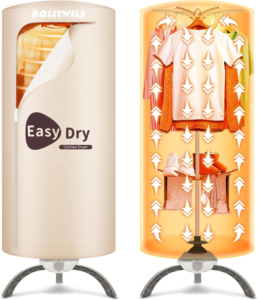
Star rating: 3.9/5
If cost and storage matter most, this is the budget compact option that keeps things simple. The Rolitwils Portable Dryer is built around a small footprint and easy storage, so it fits dorms, small apartments, RVs, and temporary setups where a traditional dryer would be a non-starter.
The design is foldable and lightweight, which makes it feel more like an accessory than a permanent appliance. When you’re done, you fold it down and tuck it away in a closet corner. That’s a big deal if you don’t want your living space to look like a laundry room.
Convenience is also part of the appeal. It includes remote control operation, so you can start, pause, or adjust settings without hovering over it. For a compact unit, it’s a nice quality-of-life touch that makes frequent small loads less annoying.
On capacity, it’s listed around 33 L (with dimensions noted as 24.5 cm in the same context), and it’s described as enough for 4 to 6 lightweight items after spin drying. Power is listed at 900 W, which is meant to work efficiently once excess moisture is removed first. Materials are described as durable plastic and alloy steel, and it includes LED UV hygiene to freshen garments during drying.
Because budget portable dryers come in many styles, you’ll get the best results when you treat this as a small-load helper, not a replacement for a full-size tumble dryer.
Power: 900 W | Design: foldable | Control: remote | Capacity note: 4 to 6 light items | Extra: LED UV hygiene
Reasons to Buy
- Low-cost entry point
- Folds away easily
- Remote control convenience
- Good for small, light loads
Reasons to Avoid
- Not built for heavy fabrics
- Needs good spin-out first
Who should buy it: This is for you if you need the cheapest, smallest way to stop air-drying everything, and you’re okay doing smaller batches. If you want context on how compact dryers compare as a category, Panda’s own comparison piece is a helpful read: portable compact dryer comparison guide.
All recommended portable dryers compared
Use this table to match your space and laundry habits to the right type of dryer.
| Product | Dryer type | Capacity (as stated) | Power (as stated) | Best fit |
|---|---|---|---|---|
| Euhomy Portable Dryer | Tumble dryer | 1.5 cu ft, up to 10 lb wet | 850 W | Best overall balance |
| Panda Portable Dryer | Tumble dryer | 1.5 cu ft, up to 10 lb wet | 850 W | Best value |
| ROVSUN Portable Dryer | Tumble dryer | Up to 5.5 lb | 850 W | Simple dial control |
| MOJOCO Portable Dryer | Portable warm-air dryer | Up to 9 items | Not stated | Travel and small batches |
| Effidry S3 | Smart dryer | Not stated | 150 W | Auto-stop convenience |
| Panda 3200 | Spin dryer | Up to 22 lb | Not stated | Fast water removal |
| Black + Decker BCED37 | Tumble dryer | 3.5 cu ft, up to 13.2 lb | 1,500 W | Big loads, more settings |
| Rolitwils Portable Dryer | Portable warm-air dryer | 33 L, 4 to 6 light items | 900 W | Tight budgets, easy storage |
Takeaway: If you want a true daily dryer, stick with the tumble models (Euhomy, Panda, ROVSUN, Black + Decker). If you want portability first, MOJOCO and Rolitwils focus on small loads. If your real problem is dripping clothes, the Panda 3200 spin dryer fixes that faster than heat ever will.
What to look for in a portable dryer
Pick the right dryer type first
Portable dryers fall into a few buckets, and choosing the wrong type is the fastest way to feel disappointed.
A compact tumble dryer has a drum and heats while tumbling. That’s the closest to a normal dryer experience. Warm-air portable dryers (often foldable) work best for small loads, especially after a good spin cycle. Spin dryers remove water fast, but they don’t finish with heated drying, so you still air-dry after.
Size and capacity that match your routine
Capacity claims can be optimistic. For the best results, plan to dry smaller batches than the max rating, especially for thicker fabrics. If you dry towels or sheets often, a larger drum like 3.5 cu ft is a real advantage. If you mainly dry daily clothing, 1.5 cu ft can be the sweet spot.
Power and heat control
More watts often means faster heat, but it can also mean higher energy use. A 1,500 W compact dryer can feel closer to full-size drying, while 850 W models aim for a balance between performance and small-space practicality. If you dry mixed fabrics, prioritize multiple modes (air, cool, warm, hot) and longer timer ranges.
Noise in small spaces
Portable dryers often run near where you sleep, work, or watch TV. Look for repeated reviewer notes about quiet operation and low rattling. Also pay attention to vibration, because a stable dryer feels quieter even when the motor is working.
Filters and cleanup
Lint management affects everything. Better filtration keeps airflow up, reduces cycle time, and helps the dryer run more consistently. Multi-layer filters are a plus, but only if they’re easy to remove and clean. If filter access is annoying, you’ll put it off, and performance will drop.
Placement and venting reality
Even “portable” dryers need a plan. Some are wall-mountable, others can stack, and some need a vent hose placed at a window or venting kit. Before you buy, think through where hot air will go and whether you can keep the space around the dryer clear.
A portable dryer only feels portable if you can actually live with the setup, including venting, noise, and where it sits between loads.
Why Trust OASTHAR?
I’m Shashini Fernando, an associate editor who specializes in consumer electronics and home tech, including compact appliances and everyday gear that has to earn its spot in small spaces. You benefit from a process that leans on scale, because you get recommendations shaped by patterns across hundreds of real customer reviews in the portable dryer market.
Instead of trusting a single opinion, you get a shortlist built from consistent feedback about drying performance, safety behavior, noise, setup pain points, and long-term reliability. That’s how you end up with picks that make sense in real apartments and real routines.
Best Portable Dryers FAQs
What is the best portable dryer overall?
The Euhomy Portable Dryer is the best overall pick here because it balances capacity, settings, safety features, and everyday usability in a compact size.
Is a spin dryer the same as a portable dryer?
No. A spin dryer (like the Panda 3200) removes water using high-speed spinning, but it doesn’t use heated tumbling to finish drying. You typically air-dry afterward, but much faster than usual.
Can a portable dryer handle towels and sheets?
Some can. Models with larger capacity, like the Black + Decker BCED37 (3.5 cu ft), are better suited for heavier items. Smaller 1.5 cu ft dryers can do towels, but you may need smaller batches and longer cycles.
Do portable dryers need venting?
Many do, especially drum-style tumble dryers. Some kits include a vent hose. Warm-air portable dryers may vent more loosely into the room, but you still need airflow and a safe, clear area.
How do you get faster drying with a portable dryer?
Keep loads smaller, remove as much water as possible first (a strong washer spin or a dedicated spin dryer helps), clean the lint filter often, and avoid stuffing the drum.
Final verdict
If you want one of the best portable dryers for daily life, pick the Euhomy Portable Dryer for the most well-rounded mix of power, modes, and comfort. If you want to spend less and still get strong everyday results, the Panda Portable Dryer is the value move, especially with flexible mounting options. For bigger loads and more control, the Black + Decker BCED37 is the step-up choice. If your pain point is soaking-wet laundry, the Panda 3200 spin dryer cuts drying time at the source.
Your best choice comes down to one thing: do you need a true drum dryer, a travel-friendly small-load helper, or a water-removal machine that makes air-drying finally tolerable? Choose based on that, and you’ll be happy with what shows up in your space.