

A good motorcycle dash cam does two jobs at once. It captures the rides you want to remember, and it protects you when something goes wrong.
Disclosure: As an independent reviewer, we may receive an affiliate commission on qualifying purchases made through our links. This helps support our research and testing team at OASTHAR. Learn more about our testing process.
This guide walks you through the best motorcycle dash cams for 2026, plus a simple buying checklist so you don’t end up with a shaky, unreliable camera that quits at the worst time.
You’ll see clear winners for different needs, from full front and rear systems to a helmet cam that also handles group comms.
RELATED: The 7 Best Garbage Disposals for 2026, Tested and Reviewed
Best motorcycle dash cams at a glance
- Best Overall: INNOVV K7
- Best Value: Thinkware F70 PRO
- Smartest Cam: Sena 50C
- Best with 360 Cam: Insta360 X5 Motorcycle Bundle
- Best with GPS: Vantrue F1
- Best Dual Setup: INNOVV K6
- Best Budget: Vsysto Dash Cam
Learn more about how we test motorcycle dash cams
At OASTHAR, you’re not getting a one-person opinion based on a single ride. You’re getting a list built from wide research, consistent criteria, and patterns that show up across real owners.
Market research
First, we research major shopping platforms (Amazon, Walmart, Target, and Currys). This helps you avoid niche products with thin support and spot models that are widely used. Broad availability also makes it easier to find mounts, replacement parts, memory cards, and updated app support later.
Price and customer reviews
Next, we analyze hundreds of customer reviews to separate marketing claims from real life use. You’ll see the same issues again and again in this category: vibration blur, random shutoffs, weak Wi-Fi apps, and water damage. We weigh those patterns heavily, because they predict what you’ll deal with.
Video clarity
Resolution helps, but it’s not everything. We focus on whether footage stays usable for real problems: reading plates, seeing road signs, and catching key moments during a close pass. Low-light performance also matters more than most riders expect, because many incidents happen at dusk, dawn, or under street lighting.
Stability and vibration handling
Motorcycles shake, and some cameras can’t cope. We look for systems known to hold up under vibration, either through stabilization modes or mounting designs that keep footage readable. If a camera only looks good on smooth roads, it doesn’t belong on a serious shortlist.
Weather, heat and durability
A motorcycle camera lives outside. So we prioritize waterproof and dustproof ratings (when provided), tough housings, and designs that handle heat and cold. Rain rides, hot parking lots, and cold starts are normal, so the camera needs to keep recording through all of it.
App controls
Finally, we look at the features that protect your files: loop recording, G-sensors that lock impact clips, and parking modes that watch your bike. We also consider how you actually access footage. If the app is frustrating or transfers are slow, you’ll put off saving clips when you need them most.
Star rating: 5.0 out of 5
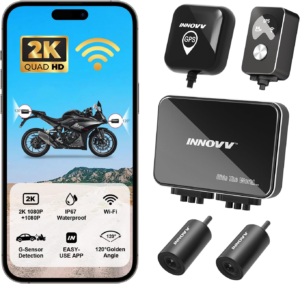
If you want the “set it and forget it” option, the INNOVV K7 is the cleanest answer. Its big superpower is balanced coverage. You get front and rear cameras recording in 2K, so you’re not stuck choosing between the view ahead and the view behind.
Wide 160-degree lenses also help reduce blind spots in traffic. That matters on a bike, because the action that changes your day often comes from the side or from behind, not straight ahead.
Stability is another reason this setup sits at the top. When you enable image stabilization, the footage drops to 1080p, but it gets smoother. On a motorcycle, that trade is usually worth it. A slightly lower resolution clip that you can actually read is better than a sharper clip you can’t use.
Security features round it out. The G-sensor can auto-save files on impact, and parking mode can keep watching when you’re away. It’s also built for weather with an IP67 waterproof rating and an aluminum body designed to handle extreme temperatures. Add 10 Hz GPS tracking plus fast 5 GHz Wi-Fi app transfers, and you’ve got a complete, daily-ready system you can rely on.
Cameras: Front and rear | Max resolution: 2K front, 2K rear | Lens angle: 160 degrees | Water rating: IP67 | Connectivity: 5 GHz Wi-Fi app
Reasons to Buy
- Strong front and rear coverage
- Helpful stabilization option
- Parking mode adds security
- 10 Hz GPS tracking
- Rugged aluminum build
Reasons to Avoid
- Stabilization drops resolution
- More involved install than single units
Who should buy it: This fits you if you ride often, park in public places, or commute in traffic. It’s also the best match when you want a complete system that doesn’t need daily attention. For official product details, start at the INNOVV official website and confirm current bundle contents.
Star rating: 4.7 out of 5
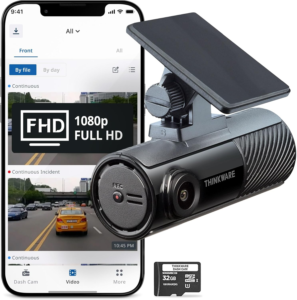
The Thinkware F70 PRO wins on value by focusing on the basics that actually protect you. It records in full HD 1080p, which is plenty for clear road detail without paying for 4K.
What makes it stand out is how it behaves when you’re not riding. Smart parking mode can detect motion or impacts and save short clips before and after an event. If your bike gets bumped in a lot, that’s the difference between guessing and knowing.
Night performance also gets attention here. Super Night Vision helps brighten darker scenes, which is useful for parking lots and dim streets. Heat protection matters too, and this model uses a super capacitor instead of a battery, so it handles temperature swings better.
You also get a three-axis G-sensor that locks important clips, plus an anti-file corruption feature designed to keep recordings from getting trashed. Wi-Fi and Bluetooth let you connect to the app for settings and downloads. There’s an optional GPS module if you want speed and red light alerts.
One important note: this is a front-only dash cam, and it’s often used in car-style setups. Fit on a motorcycle depends on your mount and power plan, so you’ll want to double-check how you’ll install it.
Video: 1080p front | Parking mode: Motion and impact capture | Power: Super capacitor | Sensors: Three-axis G-sensor | Connectivity: Wi-Fi and Bluetooth
Reasons to Buy
- Strong parking protection
- Heat-friendly capacitor design
- Clear 1080p detail
- Anti-corruption file features
Reasons to Avoid
- Front-only coverage
- Optional GPS add-on
Who should buy it: This makes sense if you want solid recording and smart parking features without spending much. It’s also a good fit when you prefer a small, discreet camera and don’t need rear coverage. For official details, see the Thinkware F70 PRO product page (availability and specs can vary by region).
Star rating: 4.6 out of 5
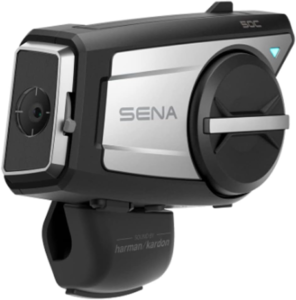
The Sena 50C is for riders who hate extra gear. Its core advantage is simple: camera plus communications in one unit. The 4K camera is integrated into the side of the system, so you don’t have to mount an action cam every time you ride.
Audio is a big part of the experience too. It comes with speakers and a mic tuned by Harman Kardon, and that shows up in calls, music, and rider-to-rider chats. Controls are designed for real riding, including glove use.
For group rides, mesh and Bluetooth intercom are the headline features. You can stay connected without constant dropouts, which is exactly what you want when your group spreads out or traffic breaks you apart.
The app adds convenience. You can preview what the camera sees, adjust settings, and switch between 4K and 1080p if you want stabilization.
If you want fewer mounts and fewer devices to charge, a camera-comm combo like this keeps your setup simple.
Camera: Integrated helmet camera | Max resolution: 4K (option to switch to 1080p) | Intercom: Mesh and Bluetooth | Audio: Harman Kardon-tuned | Controls: Voice commands plus app
Reasons to Buy
- All-in-one camera and comms
- Clear speaker and mic setup
- Mesh helps on group rides
- App preview and control
Reasons to Avoid
- Not a true front and rear dash cam
- Helmet placement affects framing
Who should buy it: This is the right pick if you ride in groups and want a single system for comms and quick video capture. You’ll also like it if you’re tired of mounting and unmounting a separate camera. For official specs, use the Sena 50C product page.
Star rating: 4.5 out of 5
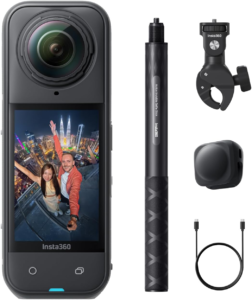
If you care as much about storytelling as protection, the Insta360 X5 motorcycle bundle is in its own lane. Its superpower is capture-first, pick-the-angle-later. You shoot full 360-degree video in 8K at 30 fps, and then you decide what view you want after the ride.
That changes how you film. You don’t have to obsess over perfect angles while riding. You mount it, record, and edit later.
The invisible selfie stick effect is another big reason riders buy into 360 cameras. Once mounted, the stick disappears from the footage, so your video can look like a floating third-person shot without a chase rider. InstaFrame mode can also auto-track you and output a ready-to-share flat video fast.
Stabilization matters even more on a bike, and FlowState stabilization plus full horizon lock keep footage smooth over bumps and in hard turns. Low-light performance gets help from the AAA chip setup that cleans up noise at night or in shaded roads. It’s waterproof up to 49 ft without a case, and the battery can run close to 3 hours, with fast charging to 80 percent in about 20 minutes. Four mics with a windguard help reduce wind noise, which is often the weak point of motorcycle footage.
If you want a deeper breakdown of how the X5 handles real-world shooting, start with this Insta360 X5 review.
Video: 8K 360-degree at 30 fps | Stabilization: FlowState with horizon lock | Waterproofing: 49 ft (no case) | Battery: Close to 3 hours | Audio: Four mics with windguard
Reasons to Buy
- Capture every angle at once
- Strong stabilization for riding
- Invisible selfie stick look
- Fast share options with InstaFrame
Reasons to Avoid
- Not a traditional dash cam system
- Editing workflow takes time
Who should buy it: This fits you if you want the best-looking motorcycle footage with the least angle stress. It’s also great when you want one camera that can handle rides, trips, and action sports beyond commuting.
Star rating: 4.4 out of 5
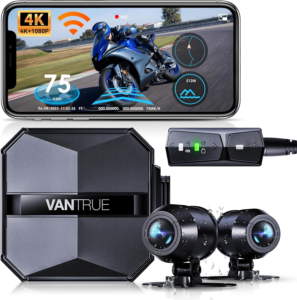
The Vantrue F1 is the pick when you want the sharpest front view without giving up rear coverage. It records the front in full 4K and the rear in 1080p at the same time, so you get high detail where it matters most.
Both cameras use a 160-degree wide view, which helps capture more of what’s happening around you. It’s also built to take weather, with an IP67 waterproof rating.
Night rides are where many systems fall apart, but the F1 uses Sony Starvis sensors to keep headlights, street lighting, and darker roads clearer than you’d expect from a compact setup.
GPS is a key part of this package. It stamps speed and route data onto your footage, and the Vantrue app can show ride stats like distance, speed, and trip time. If you ever need proof after an incident, being able to export data is a practical bonus.
The G-sensor locks clips during sudden impacts, loop recording keeps the camera running without manual cleanup, and it supports up to a 512 GB card. Wi-Fi helps you preview and download clips to your phone, and the wired remote makes it easier to save clips or take photos while riding.
Front video: 4K | Rear video: 1080p | Lens angle: 160 degrees (both) | Storage: Up to 512 GB | GPS: Included for speed and route
Reasons to Buy
- 4K front recording
- Wide coverage front and rear
- GPS ride data in footage
- Wired remote for quick saves
Reasons to Avoid
- Rear stays at 1080p
- More cables to route
Who should buy it: Choose this when you want a true dual-camera setup with a 4K front view and GPS-backed ride data. For official details, use the Vantrue F1 product page.
Star rating: 4.2 out of 5
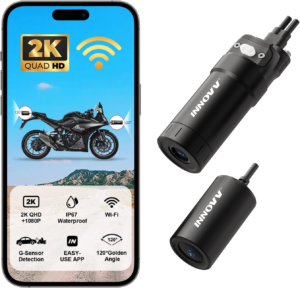
The INNOVV K6 hits a sweet spot if you want better quality than budget systems but don’t want to pay top-tier prices. The front camera records in 2K Quad HD at 30 fps using a Starvis sensor, while the rear records in 1080p.
The real design win is how compact the setup is. The DVR hardware is built into the front camera, so you don’t have an extra box to stash under your seat. That makes installation cleaner and cuts down on loose wiring.
Durability is another strong point. The body uses full aluminum alloy, so it handles heat well and feels solid in rough weather. It’s also rated IP67 waterproof and dustproof, which matches what most riders actually need for year-round riding.
Wi-Fi support and the INNOVV app (iOS and Android) let you view live footage, adjust settings, and download clips to your phone. If you’re stuck choosing between the K6 and K7, the brand itself has a useful overview on the INNOVV K6 vs K7 comparison page.
Front video: 2K at 30 fps | Rear video: 1080p | Build: Aluminum alloy | Water rating: IP67 | Design: DVR built into front camera
Reasons to Buy
- Cleaner install, no extra DVR box
- Strong front camera quality
- Tough aluminum housing
- IP67 water and dust rating
Reasons to Avoid
- Rear stays at 1080p
- Not as full-featured as K7
Who should buy it: This is a smart buy if you want a compact, durable dual-camera system and you care about a clean install. You can also start from the INNOVV dash cam collection to confirm the latest version and included accessories.
Star rating: 4.0 out of 5
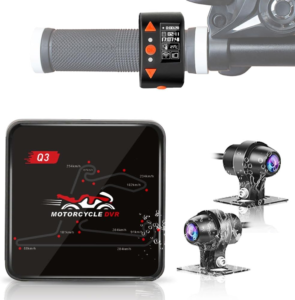
The Vsysto dash cam earns its spot because it covers the basics without draining your budget. You get a dual 1080p setup, with both cameras using a 130-degree wide-angle lens to capture more of the road.
Night rides and ugly weather are part of real life, so Starlight Night Vision is a practical feature here. Footage stays fairly clear in early mornings, late nights, and bad conditions.
Design-wise, it stays simple. There’s no screen to distract you. Instead, it connects to your phone through Wi-Fi and an app, so you can watch clips, download videos, or share footage without pulling the SD card.
Safety features are strong for the price. Loop recording overwrites old clips when storage fills up. A G-sensor automatically locks footage if it detects a crash, and a wired controller lets you manually save emergency clips with one press. Waterproof cameras round out the core needs.
Real install feedback is often where budget cams fall apart, so this kind of owner detail matters:
“Highly recommend this DVR with two 1080p cameras, front/rear. They were easy to install on my 2013 Suzuki Boulevard C90T without holes or bike modifications. I hooked the yellow wire to an ignition fuse circuit so they come on and go off automatically with the key.”
Video: Dual 1080p | Lens angle: 130 degrees (both) | Night: Starlight Night Vision | Recording: Loop plus G-sensor lock | Control: Wired emergency save button
Reasons to Buy
- Budget-friendly dual cameras
- App-based clip access
- G-sensor crash lock
- Wired emergency save control
Reasons to Avoid
- Not as sharp as 2K or 4K systems
- Official brand page can be hard to verify
Who should buy it: This is the right fit if you want basic front and rear protection, app access, and simple safety features at a lower cost. Since official brand pages vary by seller, confirm the exact kit contents and app support before you commit.
All recommended products in comparison
This table sums up the differences that matter most when you’re choosing between these options.
| Product | Capture style | Video coverage | Low-light help | Data and control features |
|---|---|---|---|---|
| INNOVV K7 | Dedicated dash cam system | Front 2K + rear 2K | Stabilization option (1080p) | 10 Hz GPS, parking mode, 5 GHz Wi-Fi app |
| Thinkware F70 PRO | Compact front-only dash cam | Front 1080p | Super Night Vision | Smart parking mode, Wi-Fi and Bluetooth, optional GPS |
| Sena 50C | Helmet camera plus comms | Helmet view (single camera) | Switch to 1080p for stabilization | Mesh and Bluetooth intercom, voice commands, app preview |
| Insta360 X5 | 360 action camera bundle | 360 capture (reframe later) | AAA chip noise cleanup | InstaFrame auto-tracking, strong stabilization, fast charging |
| Vantrue F1 | Dedicated dual dash cam | Front 4K + rear 1080p | Sony Starvis sensors | GPS stamping, app ride stats, wired remote |
| INNOVV K6 | Compact dual dash cam | Front 2K + rear 1080p | Starvis sensor (front) | DVR in front cam, Wi-Fi app control |
| Vsysto Dash Cam | Budget dual dash cam | Front 1080p + rear 1080p | Starlight Night Vision | G-sensor lock, loop recording, wired save controller |
The easy takeaway: pick INNOVV K7 if you want the most complete protection setup, pick Vantrue F1 if you want 4K front detail plus GPS, and pick Insta360 X5 if you care most about creative footage.
If you’re still deciding whether a 360 camera makes sense on a motorcycle, this best 360 cameras buying guide helps you compare the bigger options in plain terms.
What to look for in a motorcycle dash cam
Buying the right camera is mostly about avoiding the common mistakes. These are the features that decide whether footage is useful or just frustrating.
Front and rear coverage
Front and rear recording is the safest default because it covers the most common threat angles. A front-only camera can still help, but you’re accepting a blind spot behind you. If you mostly ride in traffic, rear coverage is hard to give up once you’ve had it.
Resolution vs stabilization
Higher resolution helps, but stability often matters more on a bike. Some systems drop resolution when you enable stabilization, like going from 2K down to 1080p. That’s not always a loss. Smooth video can be easier to use than shaky higher-res footage.
Field of view
A wider lens captures more context, which helps when a car drifts into your lane or you need to show position at an intersection. Many motorcycle kits sit in the 130 to 160-degree range. Too narrow and you miss the story, too wide and distant details can look stretched.
Weatherproofing and heat handling
Look for IP ratings when they’re provided, and pay attention to housing materials. Aluminum builds can help with heat. Waterproof cameras matter even if you don’t plan to ride in storms, because surprise rain happens and road spray finds everything.
Loop recording plus locked incident clips
Loop recording keeps your camera running, but it can also overwrite the clip you needed. That’s why a G-sensor that locks impact footage matters. A manual save button or wired remote is also a nice safety net, especially when you want to mark a clip right away.
Parking mode and security
If you park on the street or in shared lots, parking mode can be a quiet hero feature. It can save clips around bumps or motion so you’re not guessing later. Just remember that parking features can affect how you wire power, so plan your install early.
App experience and file access
You’ll use the app more than you think. Fast Wi-Fi transfers, stable connections, and simple clip downloads make a real difference. If pulling the SD card is the only reliable method, you’ll eventually stop checking footage at all.
GPS and ride data
GPS stamping can add speed and route to videos, and some apps show trip stats. That’s useful when you need proof after an incident, but it’s not required for everyone. If you want pure protection on a budget, spend on reliability first.
Why Trust OASTHAR?
I’m Shashini Fernando, an associate editor who specializes in consumer tech gear (including cameras, wearables, and road-ready accessories). For this motorcycle dash cam guide, you’re getting a list built from broad research and repeated real-user feedback, not a single ride impression.
You also benefit from a consistent review method. We analyze hundreds of customer reviews, compare core features across brands, and prioritize the issues that actually show up on bikes, like vibration blur, weather exposure, and file safety after an impact.
Most importantly, this list focuses on products people can realistically use in 2026 without daily hassle.
Best Motorcycle Dash Cams FAQs
What is the best motorcycle dash cam overall?
The INNOVV K7 is the best overall choice here because it combines front and rear 2K coverage, parking mode security, GPS tracking, and fast app access in one complete system.
Is 4K worth it on a motorcycle dash cam?
It can be, especially for front footage detail. Still, stability and low-light performance often matter more than pure resolution. A smooth 1080p clip can beat a shaky 4K clip when you need to read details.
Do you really need a rear camera?
Rear footage is one of the most useful views for incidents in traffic. If you commute or ride around aggressive drivers, a rear camera can be the difference between “he said, she said” and clear proof.
How important is waterproofing?
Very. Even if you avoid rain, moisture and road spray can still reach your cameras. An IP-rated system is a safer long-term buy for real riding conditions.
Can a 360 action camera replace a dash cam?
A 360 camera can capture amazing coverage, but it’s not always as simple as a dedicated dash cam kit. If your top priority is protection with parking mode and locked clips, a purpose-built dash cam system usually fits better.
Final verdict
If you want the most complete protection setup, choose the INNOVV K7 and move on with confidence. If you want strong value with smart parking features and don’t need rear coverage, the Thinkware F70 PRO is the sensible pick. If your rides are about memories as much as safety, the Insta360 X5 is the fun choice that still captures everything.
Pick the camera that matches how you actually ride, then commit to a clean install and consistent use. That’s what turns a dash cam from a gadget into real insurance you can replay.
