

Should you buy the JBL Quantum 950X at $399.95, or is it just too much headset? If you’re eyeing the JBL Quantum 950X for competitive play, late-night single-player sessions, or a noisy home setup, you’re probably chasing the same thing: better focus without giving up comfort.
This review breaks down what’s confirmed so far, and what you should watch for once it lands. You’ll get a practical look at comfort and weight, sound cues and tuning, ANC and transparency, mic clarity, wireless modes, the swappable battery system with the base station, and whether the price makes sense.
It’s also worth setting expectations. As of February 2026, it’s an announced headset with an April 2026 release, so long-term reliability and “months later” impressions will naturally be limited early on.
RELATED: Best Gaming Headsets 2025
Quick review
At $399.95 MSRP, the JBL Quantum 950X sits in that premium tier where you’re not paying for one hero feature. You’re paying for the whole stack: 50mm carbon dynamic drivers with Hi-Res Certified Audio, spatial sound with head tracking, adaptive ANC, dual wireless, a base station that charges and acts as a hub, plus swappable batteries so downtime doesn’t break your session.
What makes it stand out is how “complete” the package looks on paper. If you’ve ever juggled a USB dongle, a charging cable, and a half-working Bluetooth mode, the 950X is clearly trying to clean that up.
For the announcement details and lineup context, see SoundGuys’ CES coverage on JBL’s new Quantum headsets for 2026.
Pros
- Head tracking + spatial audio for positional awareness and immersion
- Adaptive ANC with ambient passthrough for noisy rooms
- Hot-swappable batteries with a charging base station
- Dual wireless (2.4GHz + Bluetooth 5.3) plus wired options
- Replaceable parts (cushions, headband, mic, cables) for longer lifespan
Cons
- High price at $399.95 MSRP
- Not out yet, US availability is April 2026
- Early-cycle unknowns, long-term durability takes time to prove
Specifications
Here are the key specs you’ll care about day to day, pulled from JBL’s published materials.
| Spec | JBL Quantum 950X |
|---|---|
| MSRP | $399.95 |
| Availability (US) | April 2026 |
| Drivers | 50mm carbon dynamic |
| Frequency response | 20Hz to 40kHz |
| Impedance | 32 ohms |
| Sensitivity | 101 dB SPL at 1kHz/1mW |
| Headset weight | 398g |
| Base station weight | 173g |
| Connectivity | 2.4GHz (via base station), Bluetooth 5.3, USB-C (wired), 3.5mm |
| Mic | 6mm cardioid boom, 100Hz to 8kHz, -44 dBV/Pa |
| Features | ANC, ambient/transparency, spatial sound, head tracking |
| Battery concept | Swappable dual batteries, base station charging |
If you’re sensitive to weight or desk clutter, circle 398g and “base station” now. Those two things will shape your day-to-day experience as much as the sound does.
Design, comfort & build quality
The Quantum 950X is an over-ear headset built for marathon use, and the most practical design choice is its modularity. JBL says you can replace wear items like earcups/cushions, the boom mic, the hammock-style headband, and cables. That matters because gaming headsets usually die a slow death through peeling pads and tired headbands, not blown drivers.
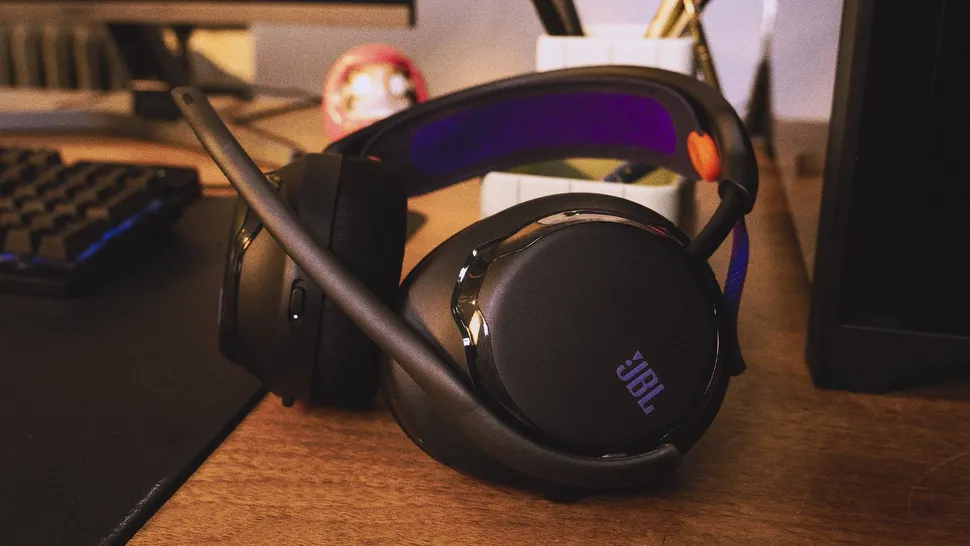
The base station also changes how the headset “lives” on your desk. Instead of tossing it onto a stand and forgetting to charge, you’ve got a spot that also acts as a control hub and charger.
Still, the weight is real. At 398g, you’ll want to pay attention to a few comfort deal-breakers once you try it: clamp force on your jaw, heat buildup over time (especially with ANC on), and whether the pads play nice with glasses. The upside is simple: swappable batteries can cut out that annoying moment when you have to plug in mid-match.
Sound quality
JBL’s big hardware promise here is the new 50mm carbon dynamic drivers, paired with Hi-Res Certified Audio and claims of ultra-low distortion with improved high-frequency reach. On paper, that’s a recipe for cleaner separation, which is what you want when a match gets messy.
For extra launch context, GamesRadar’s CES write-up helps explain why the feature set is getting attention, especially the battery and base station approach: JBL Quantum 950X CES 2026 impressions.
In real use, you should think about sound in three buckets:
Bass tends to be the “fun” part, but it can also blur detail. With 50mm drivers, you’ll likely have plenty of impact available. The main thing to listen for is control. Explosions should hit, then get out of the way.
Mids decide whether dialogue, pings, and ability cues feel clear. If you play team shooters, mids also shape how easy it is to hear a teammate call “two left” without turning your volume into a mistake.
Treble is where positional hints can pop, like light footsteps, reload clicks, and tiny movement sounds. JBL is claiming better high-frequency response, and the published 20Hz to 40kHz spec suggests headroom. That said, treble can also get sharp fast, so fatigue is the risk to watch for.
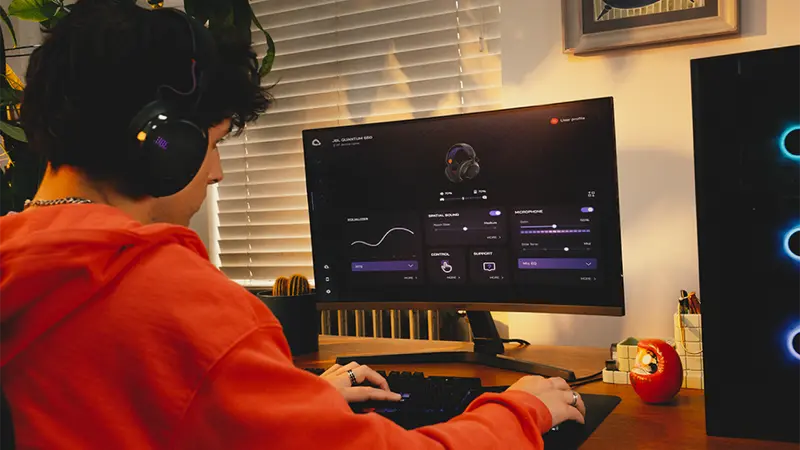
Once you have it, the practical move is to use JBL’s QuantumENGINE EQ to build two profiles, one for competitive clarity, one for cinematic weight.
ANC
JBL lists adaptive noise canceling plus an ambient sound passthrough mode. That combo is more useful for gaming than it sounds at first. ANC can take the edge off PC fan noise, HVAC hum, and the low rumble of a busy house, so you can keep volume lower while staying focused. Meanwhile, transparency is for the opposite problem: you need to hear the room without ripping the headset off.
The honest advice is to test three things right away. First, see if ANC creates pressure fatigue over long sessions. Second, check whether ANC changes your sound profile in a way you dislike. Some headsets dull the top end when ANC kicks in. Third, watch for comfort heat. A sealed fit plus ANC often feels warmer after an hour.
If you already own a strong ANC pair for everyday listening, it can help to compare expectations with something you trust. This roundup of best Sony headphones is a handy reference point for what “good ANC” feels like in real life.
Mic & voice chat quality
The Quantum 950X upgrades to a 6mm cardioid boom microphone and adds AI-based noise reduction. Cardioid pickup is the simple part: it focuses more on what’s in front of the mic (your mouth) and less on what’s around you (your room). That’s exactly what you want if you’ve got a keyboard, a loud PC, or people nearby.

JBL’s published mic specs are also gamer-friendly: 100Hz to 8kHz with -44 dBV/Pa sensitivity. You’re not chasing studio vocals here. You’re chasing clear comms that don’t turn into mush when a match gets loud.
Because the mic is replaceable, you also get a small but real longevity win. If the boom gets damaged or the connector wears out, you’re not forced into a whole new headset.
When you test it, listen for a few tells:
- Plosives on P and B sounds
- Keyboard bleed when you type fast
- “Swirly” artifacts from aggressive AI noise reduction
- Consistency between Bluetooth vs 2.4GHz voice quality
Features
The headline feature is JBL Quantum Spatial Sound with head tracking. Spatial audio can help you place sound around you, and head tracking can make that soundstage behave more like speakers. In plain terms, turning your head doesn’t “drag” the whole world with you. The audio stays anchored, which can boost immersion in story games and make directional cues feel more stable.
It won’t turn you into a pro overnight, but it can reduce second-guessing when you’re trying to place footsteps or distant gunfire.
Control lives in JBL’s QuantumENGINE software. That’s where you should expect to manage spatial settings, EQ tuning, mic tweaks, and RGB lighting behavior (RGB is mentioned in early coverage). If you like fiddling, you’ll have room to dial it in. If you don’t, you’ll want presets that sound right without work.
The other “quiet” value is repairability. Replaceable cushions and headbands don’t sound exciting, but they can keep a $399 headset from becoming e-waste over something small.
Connectivity and controls
You get four ways to connect: 2.4GHz wireless via the base station, Bluetooth 5.3, USB-C wired, and 3.5mm analog. That spread is the difference between a headset that only lives at your desk and one that follows you from PC to console to phone.
For competitive gaming, 2.4GHz is usually the move because it’s built for low latency. Bluetooth is better for casual listening, calls, and switching devices fast. USB-C wired is your “no-nonsense” mode when you want stable audio and you don’t care about wireless freedom. Finally, 3.5mm is the universal fallback for controllers and older gear.
JBL also lists broad compatibility across Windows, macOS, iOS, Android, and most gaming consoles. That’s the promise, anyway. In practice, you’ll still want to confirm how each platform handles chat mixing and mic behavior, because consoles can be picky.
If you want a quick outside take on the feature overload angle, TechRadar’s early look is useful: JBL’s high-end Quantum headset preview.
Battery life & charging
The best part of the Quantum 950X might be the least glamorous: swappable batteries plus a base station charger. JBL’s stated target is up to 50 hours combined using the dual-battery system. The number matters, but the concept matters more.
Hot-swapping changes the vibe of ownership. Instead of babysitting charge levels, you can keep one battery in the headset and keep the other charging in the base. When the headset dies, you swap and keep playing. That’s the whole win.
What you should check once you have it is very practical. See how easy the swap feels when you’re mid-session. Also check how fast the spare charges in the base, because a slow charger ruins the point. Desk space matters too. If your setup is already packed, the base station footprint could annoy you more than you expect.
For the official feature list in one place, JBL’s PDF is the cleanest reference: JBL Quantum 950 series spec sheet.
Price and value
At $399.95, you’re in “choose carefully” territory. The value argument only works if you want several of these features at once: ANC, head tracking spatial sound, dual wireless, a base station hub, and swappable batteries. If you only care about one or two of those, cheaper options start looking smarter fast.
The modular, replaceable design also adds real value, just not the flashy kind. If you keep gear for years, replaceable pads and headbands can save you from buying a whole new headset later.
The timing matters, too. Since availability is set for April 2026, early buyers may pay full MSRP before discounts show up. Also, early reviews can’t prove long-term durability. If you hate being a first-wave buyer, waiting a bit is a valid strategy.
The simplest way to judge value is to price out your current annoyances. If you’re sick of charging breaks, background noise, and multi-device juggling, the 950X’s feature stack starts to earn its keep.
Who this headset is for?
The JBL Quantum 950X makes the most sense when your setup and habits match its strengths. This is not the headset you buy just because it’s the “top model.” It’s the headset you buy because you’ll actually use the base station, the batteries, and the connectivity options.
Buy it if
- You want positional audio tools (spatial sound plus head tracking) for shooters and immersion
- You play in a noisy home and want ANC and transparency
- You switch between PC, console, and phone and hate re-pairing chaos
- You can’t stand charging downtime and like the idea of hot-swapping batteries
Do not buy it if
- You prefer a lighter headset than a 398g model
- Your desk is tight and you don’t want a base station in the mix
- You’re on a firm budget and only need basic wireless audio
- You’d rather wait until post-launch reviews confirm comfort and durability
FAQs
Is the JBL Quantum 950X really worth $399.95?
If you want ANC, head tracking, dual wireless, and a base station with hot-swap batteries, it can justify $399.95. Some sources list higher pricing, so check current listings.
What do you actually get in the 950X base station?
You get a wireless hub that also charges and manages the spare battery, plus it handles the 2.4GHz connection and central controls. It’s built for desk setups.
How long does the Quantum 950X battery last in real use?
Battery life depends on mode. Reported figures include up to about 25 hours on 2.4GHz, and shorter runtimes when ANC and mixed Bluetooth plus 2.4GHz are active.
Does head tracking improve games, or is it a gimmick?
Head tracking can make positional cues feel more locked in as you move, paired with JBL Quantum Spatial Sound. Still, you should treat it as a bonus until full testing confirms consistency.
Can you use the Quantum 950X on consoles and phones?
Yes, you can use 2.4GHz and Bluetooth 5.3 wireless, plus USB-C and 3.5mm wired. Compatibility is listed across PC, mobile, and most consoles.
How good is the mic for chat, Discord, and streaming?
You get a 6mm cardioid boom mic with AI noise reduction. It’s designed to cut background noise, with published specs like a 100Hz to 8kHz response range.
Is the 950X comfortable, or too heavy for long sessions?
Weight is listed around 398g for the headset. JBL counters that with a hammock-style headband and memory foam cushions, but comfort will depend on your head shape.
What parts can you replace if something breaks later?
JBL highlights modular, replaceable parts, including ear cushions, the mic, the headband, and cables. That’s a practical win if you keep gear for years.
Final verdict
If you want the most feature-complete JBL gaming headset, the JBL Quantum 950X is built to check every box that usually costs extra: head tracking spatial sound, ANC, dual wireless, a base station hub, and swappable batteries. The tradeoffs are straightforward, you’re paying premium money, you’re wearing a heavier headset, and you’re committing desk space to the base.
If those tradeoffs don’t bother you, the feature set looks genuinely practical. If even one of them is a deal-breaker, you’ll be happier saving cash and buying simpler. The smart move is to prioritize comfort and daily convenience over spec-sheet bragging rights.